
This post contains affiliate links. As an Amazon Associate I earn from qualifying purchases, and Work Wizardry may earn a small commission at no extra cost to you. Prices and stock change, so check each listing before you buy.
National Entrepreneurs’ Day is Tuesday, November 17, 2026, the third Tuesday of November. It honors the people who start and run businesses, and it sits inside National Entrepreneurship Month (all of November) and just before Small Business Saturday.
It is not a public holiday, so the best way to mark it is something useful: an owner looks hard at the business for one hour, a customer pays an invoice early, a manager gives staff ideas somewhere to go. This page gives you 30 ways to do that, original messages and captions, a 90-minute plan for a workplace and a free kit.
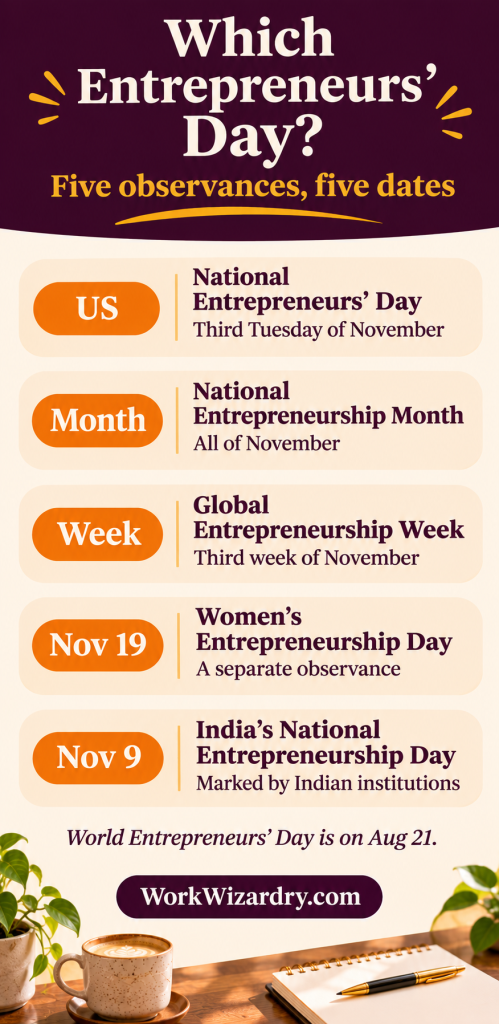
Check the date before you plan. Websites disagree: you will see November 17, 18, 19 and 20. Recent presidential proclamations have named the third Tuesday, such as November 21, 2023, which gives Tuesday, November 17 this year and Tuesday, November 16, 2027. Women’s Entrepreneurship Day (November 19) and India’s National Entrepreneurship Day (November 9) are separate days, and World Entrepreneurs’ Day is in August.
Key takeaways
- The date is the third Tuesday of November: Tuesday, November 17, 2026.
- Make the day useful. For owners, an hour of numbers beats a post. For customers, paying early beats praise.
- Four sets of ideas: owners, people who work with owners, managers and community organizers.
- Put real numbers in your plans. About 5.67 million business applications were filed in 2025, and about half of new establishments are still operating after five years.
- Be specific in messages. Thank a named person for a named thing.
- Give ideas an answer. If you invite ideas at work, say what will happen to them.
Want the worksheets and the printables? The free Founder Check-up and Event Kit has an Excel check-up (hourly pay, runway, customer concentration, price check), a pitch scorecard, thank-you cards, an event agenda and a 90-day plan.

Find Your Best National Entrepreneurs’ Day Ideas in a Minute
| You are | Start with | First move |
|---|---|---|
| I own a business | The one-hour founder check-up, the pay-yourself check, thank three people | Write down your hours for one week |
| I am a customer, supplier or friend of a founder | Pay an invoice early, one warm introduction, one specific review | Choose one entrepreneur to thank |
| I manage a team | An innovation hour, a founder at lunch, a pitch with a real answer | Book the 90-minute agenda |
| I work in a school, a library or a club | A pitch night, an ask-a-founder panel, mentor speed meetings | Recruit three founders now |
| I only have 10 minutes | Ask one question, share a specific post, send one referral | Pick one person |
| I want to start something myself | Talk to five customers, a 90-day plan, a mentor | Read our Thanksgiving business ideas guide |
When Is National Entrepreneurs’ Day? The Date, and Why Sites Disagree
The National Entrepreneurs’ Day date in the United States is the third Tuesday of November, which is November 17 in 2026. Searches turn up other dates because several different observances share the month, and because older pages repeat a date from the year they were written.
The related observances in 2026
| Observance | Date | Who it belongs to |
|---|---|---|
| National Entrepreneurs’ Day (US) | Tuesday, November 17 | Third Tuesday of November, named in presidential proclamations |
| National Entrepreneurship Month (US) | November 1 to 30 | Proclaimed by the President |
| Global Entrepreneurship Week | November 16 to 22 | Global Entrepreneurship Network, powered by the Kauffman Foundation |
| Women’s Entrepreneurship Day | Thursday, November 19 | A separate observance founded in 2014 |
| National Entrepreneurship Day (India) | Monday, November 9 | Marked by Indian institutions on this date |
| World Entrepreneurs’ Day | August 21 | A different day, in summer |
The third-Tuesday pattern, year by year
| Year | Date | Note |
|---|---|---|
| 2023 | Tuesday, November 21 | Named in the presidential proclamation of Oct 31, 2023 |
| 2024 | Tuesday, November 19 | Third Tuesday |
| 2025 | Tuesday, November 18 | Third Tuesday |
| 2026 | Tuesday, November 17 | Third Tuesday |
| 2027 | Tuesday, November 16 | Third Tuesday |
The rule is not written into law, so a proclamation could name a different day. The 2026 proclamation is normally issued around the start of November, so check the White House text before you print the date. The sources for the dates are listed at the end of this page.
National Entrepreneurs’ Day History: How It Began
National Entrepreneurs’ Day began in 2010. According to CBS News’s account, David Hauser and Siamak Taghaddos of the company Grasshopper started a petition on Twitter in May 2010 asking President Obama to create the day. The Kauffman Foundation later added its support. The president issued a proclamation on November 15, 2010, and the first National Entrepreneurs’ Day was observed on November 19, 2010, during National Entrepreneurship Week.
Since then, presidents have continued to mark November as National Entrepreneurship Month. A 2023 proclamation called on Americans to celebrate November 21, 2023 as National Entrepreneurs’ Day. It is an observance, not a holiday, and it does not give anyone a day off.
Global Entrepreneurship Week is a separate, worldwide event. The Global Entrepreneurship Network, powered by the Kauffman Foundation, runs it from November 16 to 22 this year. The organizers report more than 50,000 events in about 200 countries and territories last year. Individuals can attend events, and organizations can list their own through the GEN website.
The Numbers Behind the Day
Entrepreneurship is not one thing, so use numbers carefully. Here is what the main US sources say.
| Measure | Figure | Source |
|---|---|---|
| Business applications filed in 2025 | about 5.67 million | Census Business Formation Statistics |
| Business applications in 2019 | about 3.50 million (so 62% more in 2025) | Census Business Formation Statistics |
| Applications Census calls high-propensity in 2025 | about 1.71 million, or 30% of the total | Census Business Formation Statistics |
| Establishments still operating after 1, 5 and 10 years | 79.6%, 50.6% and 34.7% (born March 2013) | Bureau of Labor Statistics |
| Small businesses in the US | about 36.2 million | SBA, as cited by the SBDC network |
How to read these. A business application is a request for an employer identification number. Many are filed by people who then never hire anyone, or never open. That is why only about a third are in the high-propensity group, which means the Census Bureau thinks they are likely to become employers. Applications have risen sharply since 2019, but the number likely to hire has been roughly flat since 2021. The Census figures come from its Business Formation Statistics data, and the totals above are our sums of its unadjusted monthly series.
The survival figures come from the BLS’s Economics Daily note on establishments born in 2013. They count establishments, not companies, and they do not tell you why a business closed: some owners sell, retire or change direction. The honest message for the day is that starting is common, lasting is hard and the people who keep going deserve real support.
National Entrepreneurs’ Day Ideas, by Who You Are
How to celebrate National Entrepreneurs’ Day depends on who you are. Each idea shows its cost, time, who it suits and one thing to watch. Pick two or three, not thirty.
If you are the entrepreneur: ideas that make the day useful
Most guides tell owners to post a quote and feel proud. A better way to mark the day is to look hard at the business for one hour, and then thank the people who got you here.
At a glance
| Idea | Cost | Time |
|---|---|---|
| The one-hour founder check-up | Free | 1 hour |
| The pay-yourself check | Free | 30 minutes |
| The runway check | Free | 15 minutes |
| The customer concentration check | Free | 30 minutes |
| Thank three people, by name | $0 to $15 | 1 hour |
| Talk to five customers | Free | Half a day |
| A 90-day plan with three goals | Free | 1 hour |
| A half-day off the treadmill | Free | Half a day |
1. The one-hour founder check-up
Block one hour and answer five questions in writing: Am I paid fairly for my hours? How many months can the business run on its cash? Who pays me most of my revenue? Are my prices high enough? What will I change in the next 90 days? If the money questions feel fuzzy, Profit First is a readable book on paying yourself and planning cash.
- Why it works: A short, regular check-up catches problems that a busy year hides, and it turns a symbolic day into a decision.
- Cost: Free · Time: 1 hour
- Best for: Any owner, from a side hustle to a ten-person team
- Watch out: Use real numbers from your books, not feelings. If you do not have them, the first job is to get them.
- Sample line: “I’m spending today’s first hour on the business, not in it.”
2. The pay-yourself check
Work out what the business earns after costs, divide by the hours you really work and compare the result with what you would earn as an employee in the same role.
- Why it works: Many owners work for less than they would pay a hired manager without noticing. Knowing the number is the first step to fixing prices or workload.
- Cost: Free · Time: 30 minutes
- Best for: Owners who take whatever is left
- Watch out: Count all your hours, including evenings, and use profit before your own pay, not revenue.
- Sample line: “My business pays me $__ an hour. Is that the number I want?”
3. The runway check
Divide the cash you hold by the money you must spend every month, and write down the number of months it covers.
- Why it works: It tells you how long you can run if sales slow down, and it shows whether you need a buffer before you need growth.
- Cost: Free · Time: 15 minutes
- Best for: Owners with irregular income
- Watch out: Count only cash you can use. Money that belongs to taxes, refunds or suppliers is not yours.
- Sample line: “We have 4.5 months of runway. The goal is 6.”
4. The customer concentration check
List your five biggest customers and what share of your revenue each pays. Mark any above about 30%.
- Why it works: Losing one large customer can end a small business. Naming the risk is the first step to reducing it.
- Cost: Free · Time: 30 minutes
- Best for: Freelancers, agencies and small suppliers
- Watch out: The 30% line is a rule of thumb, not a law. Set your own, based on how fast you could replace that income.
- Sample line: “One customer is 42% of revenue. Plan: find two more like them.”
5. Thank three people, by name
Write three short notes: one to a mentor or adviser, one to your first customer and one to a supplier or partner who helped when it was hard. Say what they did and what it changed.
- Why it works: Specific thanks is rare, and it strengthens the relationships that a business depends on. It also keeps you honest about how much you did not do alone.
- Cost: $0 to $15 · Time: 1 hour
- Best for: Everyone
- Watch out: Be specific. ‘Thanks for everything’ is weaker than ‘Thanks for waiting two weeks for my invoice in March’.
- Sample line: “You were my first customer. You paid before I’d earned it.”
6. Talk to five customers
Ask five customers the same three questions: Why did you pick us? What almost stopped you? What would you tell a friend? The Mom Test is a short book on asking questions that get honest answers.
- Why it works: Customers describe your business in words you can use in your marketing, and they point to problems you cannot see from inside.
- Cost: Free · Time: Half a day
- Best for: Product and service businesses
- Watch out: Do not pitch. Listen, take notes and say thank you.
- Sample line: “What almost stopped you from buying?”
7. A 90-day plan with three goals
Choose three goals for the next 90 days, one for money, one for customers and one for your own time or health. Write the first step for each and a date.
- Why it works: Ninety days is short enough to feel real and long enough to finish something. Three goals force you to choose.
- Cost: Free · Time: 1 hour
- Best for: Owners who feel pulled in every direction
- Watch out: If a goal cannot be measured, rewrite it until it can.
- Sample line: “By Feb 15: raise prices on two services and book four new clients.”
8. A half-day off the treadmill
Close the shop or block your calendar for a half-day, go somewhere without email and think about one question: What should I stop doing?
- Why it works: Founders spend most of their time on urgent tasks. Stopping a task is as valuable as starting one.
- Cost: Free · Time: Half a day
- Best for: Owners who never take time to think
- Watch out: Tell customers in advance if you close, and keep the time for thinking, not catching up.
- Sample line: “Closed until 1 p.m. while we plan the year.”
If you work with or buy from entrepreneurs: practical ways to say thank you
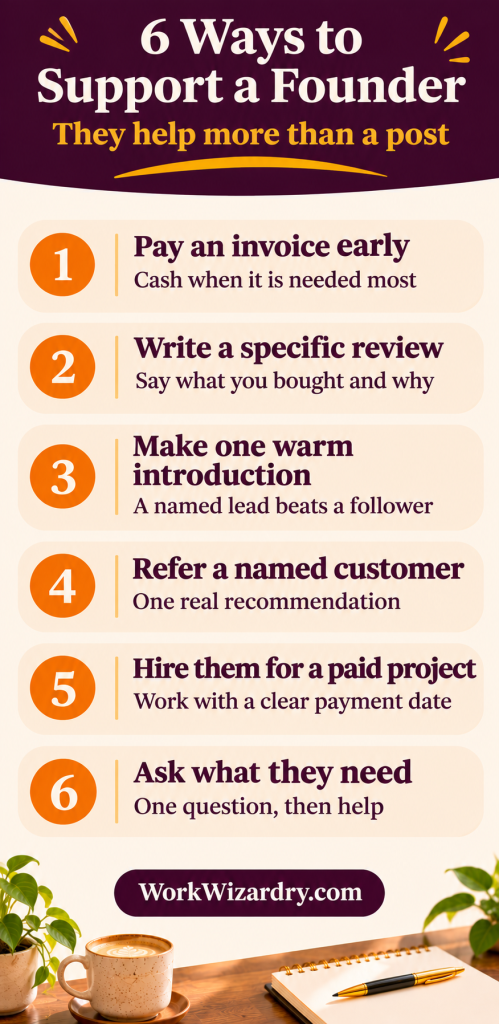
The best way to support small business is to make money and time easier for it. These ideas cost little and are worth more than a social post.
At a glance
| Idea | Cost | Time |
|---|---|---|
| Pay an invoice early | Free | 15 minutes |
| Write a specific review or testimonial | Free | 15 minutes |
| Make one warm introduction | Free | 15 minutes |
| Hire them for a real job | Varies | 1 hour |
| Refer one customer, by name | Free | 15 minutes |
| Buy office gifts or lunch from entrepreneurs | $20 to $500 | 1 hour |
| Share their work, not a generic post | Free | 15 minutes |
| Ask one question: what do you need? | Free | 10 minutes |
9. Pay an invoice early
Pick one small supplier you owe and pay their invoice today instead of at the end of the payment term.
- Why it works: Late payment is one of the hardest things for a small business. Cash on the day they need it can matter more than any compliment.
- Cost: Free · Time: 15 minutes
- Best for: Any customer of a small supplier
- Watch out: Do not skip your own approval process. Pay early only for invoices that are approved and correct.
- Sample line: “Your invoice is paid today. Thanks for the great work.”
10. Write a specific review or testimonial
Write a short review that says what you bought, what problem it solved and who you would recommend it to.
- Why it works: Specific reviews help the next customer decide, and they give the owner words to reuse.
- Cost: Free · Time: 15 minutes
- Best for: Customers
- Watch out: Be honest and be specific. Only write about things you really bought.
- Sample line: “I hired them to redo our kitchen, and they finished on the day they promised.”
11. Make one warm introduction
Introduce an entrepreneur you trust to one person who could buy from them, hire them or advise them, and explain why in two sentences.
- Why it works: A warm introduction from someone trusted is often the best lead a small business can get.
- Cost: Free · Time: 15 minutes
- Best for: People with a network
- Watch out: Ask both people before you introduce them, and keep it short.
- Sample line: “I’d like you two to meet: she does exactly what you were asking about.”
12. Hire them for a real job
Give a freelancer or a small agency a paid project this month instead of using a larger firm, and agree the scope and the payment date in writing.
- Why it works: Real work with a clear payment date does more for a small business than praise.
- Cost: Varies · Time: 1 hour
- Best for: Teams with small outside projects
- Watch out: Do not ask for free pilots. Pay for the work you ask them to do.
- Sample line: “We’re giving you the brochure project. Payment is due 15 days from delivery.”
13. Refer one customer, by name
Send one named person a short message recommending an entrepreneur you have used, with a link or a phone number.
- Why it works: One referral from someone trusted is worth many followers.
- Cost: Free · Time: 15 minutes
- Best for: Anyone with satisfied suppliers
- Watch out: Check with the entrepreneur first, so they are ready.
- Sample line: “You asked who does great photos. Here’s the person I use.”
14. Buy office gifts or lunch from entrepreneurs
Order the team’s coffee, lunch, snacks or gift boxes from a local entrepreneur for the day or the month.
- Why it works: It turns a day of appreciation into a real order, and the team gets to meet the people behind the products.
- Cost: $20 to $500 · Time: 1 hour
- Best for: Offices and teams
- Watch out: Order in good time and pay promptly. Ask about allergens for any food.
- Sample line: “Lunch for 20 from a founder two streets away.”
15. Share their work, not a generic post
Instead of posting a general message, share one real piece of work by an entrepreneur you know: a product, a project, a customer story. Tag them and say why you rate it.
- Why it works: A specific post sends real attention to a real business and reads as sincere.
- Cost: Free · Time: 15 minutes
- Best for: Social media users
- Watch out: Get their consent if you share anything private, and avoid vague praise.
- Sample line: “This is the bakery that made our wedding cake. Here’s why it was special.”
16. Ask one question: what do you need?
Message an entrepreneur and ask what one thing would help them most this month. Then, if you can, do it.
- Why it works: Most founders have a single bottleneck, such as a leads problem, a hiring problem or a tool problem, and most people never ask.
- Cost: Free · Time: 10 minutes
- Best for: Anyone with a relationship with a founder
- Watch out: Offer help you can actually give. Do not promise what you cannot deliver.
- Sample line: “What’s the one thing that would help your business most this month?”
If you manage a team: celebrate the entrepreneurs inside your company
National Entrepreneurs’ Day for employees is mostly about noticing the entrepreneurial people on the team and giving their ideas somewhere to go. You do not need to run a startup to have them.
At a glance
| Idea | Cost | Time |
|---|---|---|
| An innovation hour | Free | 1 hour |
| A protected-time pilot | Time | Half a day to set up |
| A founder at lunch | $50 to $200 | 2 hours |
| A pitch to leadership with a real answer | Free | Half a day |
| A supplier spotlight | Free | 1 hour |
| A clear conversation about side businesses | Free | 1 hour |
| A mentor match | Free | Half a day |
| A first-customer wall | Free to $30 | 2 hours |
17. An innovation hour
Set aside one hour for people to bring a problem they have noticed and a rough idea to solve it, then pick two to try.
- Why it works: Employees who spot a problem in daily work often have the best ideas, but rarely have a place to share them.
- Cost: Free · Time: 1 hour
- Best for: Any team
- Watch out: Agree beforehand who decides and what happens next, or the hour becomes theatre.
- Sample line: “Bring a problem you’ve noticed and a rough idea. Ten minutes each.”
18. A protected-time pilot
Offer a small, fixed share of time, for example half a day a month, for a staff member to work on an idea of their own, with a clear end date and a short review.
- Why it works: A well-known example is the commonly cited 3M practice of letting staff spend a share of their time on their own ideas. A pilot lets you test whether it works for you.
- Cost: Time · Time: Half a day to set up
- Best for: Teams with managers who can protect time
- Watch out: Start small. Set the review date first, and make sure the person’s regular work is covered.
- Sample line: “Four hours a month for one idea, reviewed in March.”
19. A founder at lunch
Invite a local founder to talk for 30 minutes over lunch about the worst month of their business and how they got through it.
- Why it works: Staff learn how businesses really work, and a lunch with a real owner is more memorable than a speech.
- Cost: $50 to $200 · Time: 2 hours
- Best for: Offices that can host guests
- Watch out: Ask them about the hard parts. Keep it informal and leave time for questions.
- Sample line: “Lunch with a founder: the worst month, and what she did next.”
20. A pitch to leadership with a real answer
Let staff pitch an idea in five minutes to a panel with a simple scorecard, and promise an answer within two weeks.
- Why it works: A fast answer builds trust, and a clear scorecard keeps the process fair.
- Cost: Free · Time: Half a day
- Best for: Companies with an idea backlog
- Watch out: A pitch with no answer is worse than no pitch. Tell people how you will decide and keep the date.
- Sample line: “Five minutes to pitch. Answer in two weeks.”
21. A supplier spotlight
Choose one small supplier or contractor your company relies on and share a short story about their work in your newsletter or on your intranet.
- Why it works: It shows staff that the company values its partners, and it gives the supplier genuine exposure.
- Cost: Free · Time: 1 hour
- Best for: Any company with small suppliers
- Watch out: Ask permission and let them approve what you write.
- Sample line: “Meet the family who make our packaging.”
22. A clear conversation about side businesses
Make sure your team knows what your policy says about side businesses and working for others, and invite questions.
- Why it works: Many employees run small ventures and are unsure what is allowed. Clarity helps trust, and avoids surprises.
- Cost: Free · Time: 1 hour
- Best for: Managers and HR
- Watch out: Check your contracts and local employment law with an expert. This page is not legal advice.
- Sample line: “Here’s what our policy says about side projects, and who to ask.”
23. A mentor match
Pair people who want to start something with someone who has done it, for three conversations over a month.
- Why it works: Mentoring is free, and it gives newer staff an adviser who is not their manager.
- Cost: Free · Time: Half a day
- Best for: Teams with experienced and newer staff
- Watch out: Keep it voluntary and short, with a clear start and end.
- Sample line: “Three conversations, one month, one mentor.”
24. A first-customer wall
Post the story of your own first customer, with a photo or a note, in a visible place, and invite teams to add their own first wins.
- Why it works: It reminds everyone that the company was once a small bet, and that customers came one at a time.
- Cost: Free to $30 · Time: 2 hours
- Best for: Companies with a customer story
- Watch out: Get permission from any customer you name.
- Sample line: “Our first customer paid $120 and waited three weeks. Thank you.”
If you run a school, a club or a business group: events with a real outcome
Event ideas are easy. Ones that help someone start, sell or learn something are harder. These aim for a result.
At a glance
| Idea | Cost | Time |
|---|---|---|
| A pitch night with real feedback | $50 to $300 | 1 day |
| A student market | $50 to $200 | 1 day |
| An ask-a-founder panel | $0 to $100 | Half a day |
| Mentor speed meetings | $0 to $100 | Half a day |
| A local shopping trail | $30 to $100 | 1 day |
| A Global Entrepreneurship Week listing | Free | 1 hour |
25. A pitch night with real feedback
Give each entrepreneur or student three minutes to pitch, then three minutes of questions from a panel that uses a written scorecard.
- Why it works: People remember feedback more than applause, and a scorecard keeps it fair and useful.
- Cost: $50 to $300 · Time: 1 day
- Best for: Schools, libraries, co-working spaces
- Watch out: Give each pitcher the scorecard afterwards, and agree prizes that help, such as a free consultation or a stall at a market.
- Sample line: “Three minutes to pitch. Three minutes of questions. A scorecard for everyone.”
26. A student market
Let student entrepreneurs sell real products for an afternoon, with a simple float, a price sheet and a short debrief about what sold.
- Why it works: Selling real things to real people teaches more than any worksheet.
- Cost: $50 to $200 · Time: 1 day
- Best for: Schools and colleges
- Watch out: Check school rules, sales tax and food rules before the day.
- Sample line: “Students make it. Students sell it. Come and buy.”
27. An ask-a-founder panel
Invite three founders at different stages to answer questions about money, mistakes and the first year, with one question from each audience member.
- Why it works: Audiences get honest answers, and founders get the satisfaction of helping.
- Cost: $0 to $100 · Time: Half a day
- Best for: Libraries, clubs and workplaces
- Watch out: Pick founders who will talk about problems, not only success.
- Sample line: “Three founders. Your questions. No slides.”
28. Mentor speed meetings
Pair newer entrepreneurs with experienced ones for ten-minute meetings, rotating every ten minutes.
- Why it works: A short meeting is enough to find someone useful, and follow-up happens after.
- Cost: $0 to $100 · Time: Half a day
- Best for: Business groups and chambers
- Watch out: Keep time strictly, and give every pair a card with space to write a follow-up.
- Sample line: “Ten minutes. One mentor. Then the next.”
29. A local shopping trail
Make a one-page map of ten local businesses with one offer from each, and invite people to follow it.
- Why it works: It sends customers from shop to shop, and it prepares the ground for Small Business Saturday ten days later.
- Cost: $30 to $100 · Time: 1 day
- Best for: Streets and districts with small shops
- Watch out: Agree the offers in writing, and use the same offer on every copy.
- Sample line: “Ten shops. One trail. Start anywhere.”
30. A Global Entrepreneurship Week listing
If you host an event during Global Entrepreneurship Week, which runs from November 16 to 22 this year, add it to the official listing.
- Why it works: A listing makes the event easier to find and ties it to a worldwide week.
- Cost: Free · Time: 1 hour
- Best for: Any organizer
- Watch out: Check the current instructions on the official site, because rules can change.
- Sample line: “Our pitch night is on the Global Entrepreneurship Week map.”
National Entrepreneurs’ Day Messages, Captions and Hashtags
You do not need famous quotes. Many of the best-known entrepreneur quotes are attributed to people who never said them, and several pages that rank repeat them without a source. Specific lines about real people work better. Use these as a start and change the details.
Thank you messages for entrepreneurs
- Thank you for building something from nothing. We’ve watched you do it, and we’re proud to be on the team.
- Happy Entrepreneurs’ Day. Your first year looked impossible. Look where you are.
- Thank you for taking the risk that makes the rest of us possible.
- I’m one of your customers, and I’d choose you again. Happy Entrepreneurs’ Day.
- You made something people actually need. That is rarer than you think.
- Today I just want to say that your work has made mine easier. Thank you.
- You’ve paid yourself last for years so others could have a job. We see it.
- Happy Entrepreneurs’ Day to the person who makes the coffee, the schedule and the decisions.
- Thank you for answering the phone at 9 p.m. and doing the thing you said you’d do.
- Thank you for teaching me what building a business really involves.
Messages from a team to a founder or boss
- To our founder: thank you for the risk, the late nights and the paychecks you protected. Happy Entrepreneurs’ Day, from all of us.
- Thank you for building a place where we can do our best work. Happy Entrepreneurs’ Day.
- You started this with an idea and a lot of nerve. We’re still here because of both.
- We know what this company has cost you. We’re proud of what it’s become.
- Thank you for trusting us with your idea. We’ll keep looking after it.
- Happy Entrepreneurs’ Day to the person who still answers every client email herself.
Messages to a mentor
- You told me the truth when everyone else was polite. Thank you.
- You gave me an hour in 2019 that I’ve spent seven years benefiting from.
- Thank you for saying ‘raise your prices’ when I didn’t want to hear it.
- I wouldn’t have started without you. Happy Entrepreneurs’ Day.
National Entrepreneurs’ Day captions for social media
Put the person or the point in the first line. Swap in your own names and numbers.
Thanking a founder
Today is National Entrepreneurs’ Day, and I want to thank someone by name: the owner of the print shop on Elm Street.
They’ve been on our invoices since day one and they’ve never been late.
If you need a printer, here’s the number.
As an owner
Entrepreneurs’ Day. I’m taking an hour to look at the numbers, not the likes.
Pay check, runway check, price check. I’ll share what I find.
Happy Entrepreneurs’ Day to everyone building something.
From a team
Our founder started this company with a laptop and a loan.
Today we’re saying thank you with lunch, a card and a promise to work on her list of ideas for next year.
Happy Entrepreneurs’ Day.
Supporting small
This Entrepreneurs’ Day we moved our office lunch order to a local founder.
It cost the same, it tasted better and we met the person who made it.
Who are you ordering from this week?
A first customer
My first customer paid $60 and waited two weeks.
Today, I’m thanking them in public.
Thank you, Priya. You made this possible.
A question
Founders: what’s one thing someone could do today that would really help your business?
I’ll start. Pay invoices early. Tell me yours.
A mentor
Everything I know about pricing, someone told me over a coffee.
Thank you, David. Happy Entrepreneurs’ Day.
A student
Today our students sold their products at a market for the first time.
One made $42. One lost money. Both learned more in four hours than in a term.
Happy Entrepreneurs’ Day.
An invoice
We paid three invoices early today to say thank you to three small suppliers.
It costs us nothing and it matters to them. Try it.
A tip
If you’re an owner, here’s a small gift for today: write down what you earn per hour.
It’s the most useful number you’ll never have counted.
National Entrepreneurs’ Day hashtags
Use a few: #NationalEntrepreneursDay, #EntrepreneursDay, #SmallBusiness, #Founder and a local tag such as the name of your town. If you tag a business or share a gifted product, say so openly. The FTC’s endorsement guidance covers disclosing a free product or other connection.

A 90-Minute National Entrepreneurs’ Day at Work
If you manage a team, this is the simplest plan that works for Entrepreneurs’ Day for teams. These National Entrepreneurs’ Day activities need one room, one timer and one scorecard.
| Time | Activity | What to do |
|---|---|---|
| 0:00 to 0:10 | Welcome and why | A leader says why the company is marking the day and what will happen to ideas that come out of it. |
| 0:10 to 0:25 | A founder’s story | A guest or a team leader tells the story of a hard month, in plain words. |
| 0:25 to 0:50 | Problem and idea round | In pairs, staff write one problem they have noticed and a rough idea to fix it. |
| 0:50 to 1:15 | Pitches | Four or five people pitch in two minutes each. The panel scores on a simple sheet. |
| 1:15 to 1:25 | Choose two to try | The leader names two ideas to test and the person who owns each. |
| 1:25 to 1:30 | Thank-yous | Everyone writes one thank-you note to an entrepreneur they know. |
A staff announcement you can copy. Subject: An hour for your ideas on Tuesday, Nov 17. Body: Tuesday is National Entrepreneurs’ Day. For one hour we will hear from a local founder, then anyone who wants to can bring a problem they have noticed and a rough idea to fix it. Two ideas will be picked to try, each with an owner and a start date. Joining is optional. You will have an answer by the end of the following week.
Entrepreneurs’ Day Gift Ideas That Are Actually Useful
Small business owner appreciation does not need a mug. Most owners have too many desk objects and too little time, cash and sleep. These Entrepreneurs’ Day gift ideas give them one of those, and most of them need no shopping at all, and the one book idea links to a title worth owning.
| Gift | Why it helps | Budget |
|---|---|---|
| A paid project, with the date they will be paid | Work and a clear payment date are worth more than any object | Varies |
| An invoice paid early | Cash when it is needed most | Free |
| A specific handwritten note | People keep notes that name what they did | Under $5 |
| An hour of your own skill | A flyer, a proofread, a spreadsheet or a website check | Free |
| An afternoon of cover | Staff their shop or answer their phone so they can leave | Free |
| A warm introduction to a customer | A named lead is worth more than a gift card | Free |
| Lunch delivered on a hard day | They will not stop to eat | $15 to $30 |
| A book you read and can say why you rate it, such as Profit First or The Mom Test | A recommendation with a reason is a gift | $15 to $30 |
| A subscription they already use, paid for a year | It removes a cost without adding a thing | $30 to $200 |
| A framed first customer’s note or receipt | It honors where they started | $20 to $50 |
Ask first if you are unsure. A founder is more likely to want a free Tuesday afternoon than another object.
Your 17-Day Plan
From October 31 there are 17 days to Tuesday, November 17. If you are starting late, do the first row and the last three.
| When | Focus | What to do |
|---|---|---|
| 17 to 14 days out | Decide and invite | Choose who the day is for (you, your team, customers) and pick two ideas. Invite any guests, a founder or panel. |
| 13 to 10 days out | Book and brief | Book the room, the lunch or the guests. Tell staff what the day is and what will happen to ideas. |
| 9 to 7 days out | Prepare materials | Print the scorecards, cards and check-up sheets. Order food from a local founder. Write your announcement. |
| 6 to 3 days out | Announce | Send the announcement and a short reminder. Post one teaser that names a real entrepreneur. |
| 2 to 1 days out | Final checks | Test the room, the timer and the materials. Remind guests and panelists. |
| Event day | Day 0 | Run the agenda, pay one invoice early, post one specific thank-you and write your three notes. |
| Wednesday to Friday | Follow up | Send thank-yous, share the two ideas chosen and give each owner a start date. |
| Within two weeks | Review | Check what happened to the ideas. Record what worked and what you would change. |
Check These Before You Launch
This is general information, not legal advice. Rules differ by state and country, so ask a qualified adviser if you are unsure.
| Check | What to do |
|---|---|
| Side businesses and contracts | If you talk about staff side projects, check your contracts and local law. Say what is allowed and who to ask. This page is not legal advice. |
| Gifted products and posts | If you gift a product and ask for a post, the person should say it was a gift. The FTC’s endorsement guidance explains the disclosure. |
| Prize draws | If a prize depends on chance, do not require a purchase to enter. Offer a free way to enter and check your state’s rules. |
| Food and allergens | If you order food, ask about allergens and label them. Check any local rules for events. |
| Honest framing | Not every business survives. Celebrate the effort as well as the success, and avoid implying that those who closed a business failed as people. |
| Inclusion | Make the day relevant to freelancers, side hustlers, family businesses and employees, not only to startup founders. |
| Privacy | Ask before you share a person’s story, photo or numbers. |
| Time and pay | If the event is during work hours, say clearly whether attendance is optional and paid. |
Free Founder Check-up and Event Kit
Do the check-up in an hour, not in your head. The free kit includes:

- An Excel check-up. Enter your numbers and it shows your effective hourly pay, your runway in months, how concentrated your revenue is and the price you need to reach a target margin.
- A pitch scorecard that weights five criteria and ranks up to three pitches.
- A 90-day plan with dates that fill in from the day.
- Printable thank-you cards, a pitch scorecard, an event agenda and a staff announcement (Letter and A4).
- A thank-you tracker and a results sheet.
Related Guides
- November themes for work: the whole month, with every awareness day.
- Thanksgiving business ideas: if you are starting a seasonal business.
- Small Business Saturday ideas: ten days later, for local shops.
- Cyber Monday ideas for small business: the margin math for sales.
- Thanksgiving employee appreciation ideas: thank your own team.
Frequently Asked Questions About National Entrepreneurs’ Day
When is National Entrepreneurs’ Day in 2026?
National Entrepreneurs’ Day in the United States is the third Tuesday of November, which is Tuesday, November 17, 2026. Some websites list November 18, 19 or 20, but those do not match the pattern of recent proclamations, such as the one naming November 21, 2023. Next year it falls on Tuesday, November 16, 2027.
What is National Entrepreneurs’ Day?
It is an annual US observance that honors people who start and run businesses. It began in 2010, when Grasshopper’s founders petitioned the White House and President Obama issued a proclamation. It is not a federal holiday, so there is no day off. It sits inside National Entrepreneurship Month, which runs through all of November.
What is the difference between National Entrepreneurs’ Day, Entrepreneurship Month and Global Entrepreneurship Week?
National Entrepreneurs’ Day is a single day, the third Tuesday of November. National Entrepreneurship Month covers all of November. Global Entrepreneurship Week is run by the Global Entrepreneurship Network and takes place from November 16 to 22 in 2026. Women’s Entrepreneurship Day (November 19) and India’s National Entrepreneurship Day (November 9) are separate observances.
Is National Entrepreneurs’ Day a public holiday?
No. It is an awareness day, not a federal or public holiday, so banks, schools and offices stay open as normal. It is also not an official day off for businesses. Many organizations mark it with a short activity, a social post, a lunch or an event rather than a day away from work.
How can employees celebrate National Entrepreneurs’ Day at work?
Run a short innovation hour, invite a local founder to talk over lunch, order the team’s lunch from a local entrepreneur, pay a small supplier’s invoice early and let staff pitch ideas to leadership with a promise of an answer. Keep it optional, and make clear what happens to the ideas afterwards.
How can I support an entrepreneur on National Entrepreneurs’ Day?
Pay an invoice early, write a specific review, make one warm introduction, refer a named customer or hire them for a paid project. These actions help more than a general post because they put money, trust or attention where the business needs it. You can also ask what one thing would help most this month.
What should entrepreneurs do on National Entrepreneurs’ Day?
Take an hour to look at the business rather than only celebrate it. Check what you earn per hour, how many months of cash you have, how much revenue comes from your biggest customers and whether your prices are high enough. Then thank three people by name and write a 90-day plan with three goals.
What are good messages or captions for National Entrepreneurs’ Day?
The best ones are specific: thank a named person for something they did, or share a real piece of work. A line such as ‘You were my first customer. You paid before I’d earned it’ works better than a general slogan. This page has original messages for founders, teams, mentors and customers, and ten captions you can adapt.
How many new businesses are started in the United States?
The Census Bureau counted about 5.67 million business applications in 2025, up from about 3.50 million in 2019. Applications are not the same as new businesses, because many people apply and never open or hire. About 1.71 million of the 2025 applications were in the group Census calls high-propensity, meaning likely to become employers.
How many new businesses survive?
The Bureau of Labor Statistics found that of private-sector establishments born in March 2013, about 79.6% were still operating after one year, 50.6% after five and 34.7% after ten. These figures count establishments, not companies, and survival does not always mean a business failed, since some owners close on purpose.
Sources: ideas, messages and captions are original to Work Wizardry. History: CBS News and the 2023 proclamation summary. Dates: Global Entrepreneurship Network (genglobal.org/gew) for the Week; Women’s Entrepreneurship Day, India’s National Entrepreneurship Day and World Entrepreneurs’ Day from calendar and news sources that agree; calculated third Tuesdays. Data: Census Business Formation Statistics (applications summed from the unadjusted monthly series), BLS Economics Daily and the SBA count of small businesses as cited by the SBDC network. Intrapreneurship: the 3M example is commonly cited and not independently verified here. This page is general information, not legal advice.
