
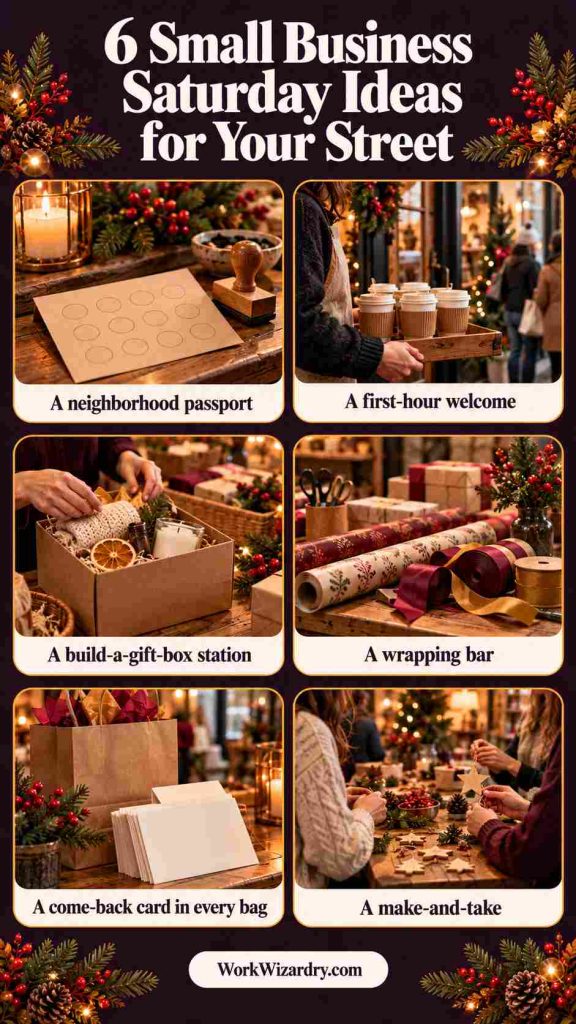
The best Small Business Saturday ideas do four jobs: they get people through the door, raise what each shopper spends without cutting your prices, collect a contact with permission and give people a reason to come back in December. A neighborhood passport, a first-hour welcome, a gift-box station, a friendly question at the register and a come-back card in every bag cover all four. This page gives you 37 ideas, a way to set a realistic goal for the day, a staffing plan and a run sheet.
Small Business Saturday is the Saturday after Thanksgiving: November 28, this year. Thanksgiving is Thursday, November 26, Black Friday is the 27th and Cyber Monday is the 30th. From October 31 you have 28 days, which is enough time to do it well and to recruit your neighbors.
We read the pages that rank before writing this one. Most are long lists of 20 to 64 ideas. Many are generic (“post on social media”, “offer a discount”), several still show the date or statistics from an old year, and some contradict themselves on spending figures. One of our own earlier pages had that problem. The questions a shop owner actually has are different: How many people do I need? How many staff? What do I do about the second visit? Can I use the official name? None of the pages we read answered the staffing question, and almost none planned for what happens after Saturday.
Key takeaways
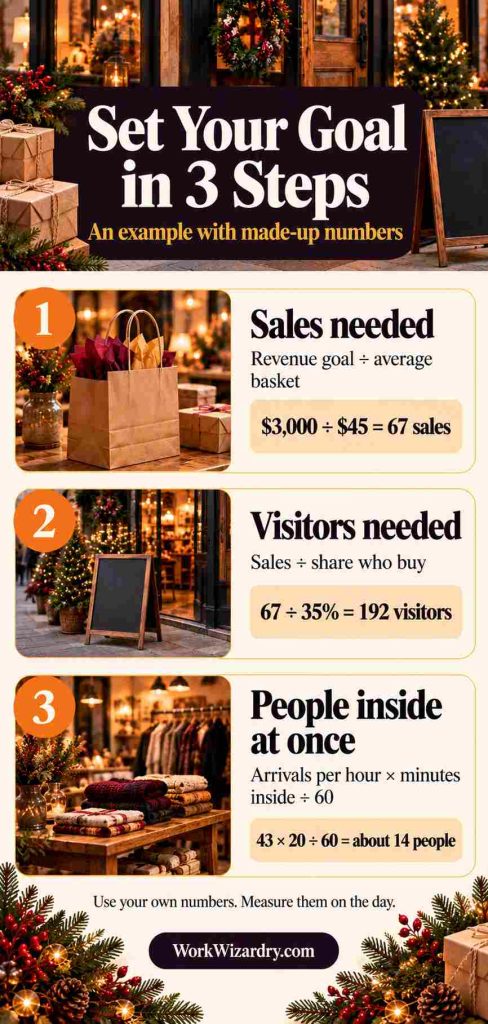
- Set a goal from your own numbers. Sales needed = revenue goal ÷ average basket. Visitors needed = sales ÷ the share of visitors who buy.
- Traffic is not sales. Raise the basket with gifts, sets and wrapping, not with markdowns.
- Ask for a contact at the register, with permission. One friendly sentence beats a sign nobody reads.
- Plan the second visit before the first one ends. A come-back card with a December date is the cheapest idea on this page.
- Recruit your neighbors. A shared guide or passport costs little and sends shoppers from door to door.
- Check the name and the rules. Small Business Saturday and Shop Small are registered trademarks of American Express.
Want the numbers and the printables in one place? The free Small Business Saturday Day Planner has a goal and staffing calculator in Excel, come-back cards, entry slips, hint cards, signs, a 28-day plan and a run sheet.
Want the finished signs, cards and documents, not just the ideas? The Saturday Shop Kit has printable signs and posters, neighbor and passport documents, a staff kit, loyalty and come-back cards, 30 captions and an Excel Command Center with an hourly staffing model.
Find Your Best Small Business Saturday Ideas in a Minute
| Your business | Start with | First move |
|---|---|---|
| A shop with a street door | A neighborhood passport, a first-hour welcome, a gift box station | Join forces with two neighbors this week |
| A cafe, bakery or restaurant | A first-hour welcome, a come-back card, a local performer | Plan how you will manage a rush at 10 a.m. |
| A salon, studio or service | Same-day slots, gift certificates, a December invitation | Cap the number of slots you sell |
| An online shop | A shop-small-online offer, a meet-the-maker video, a makers gift guide | Send one personal email on the morning |
| A very small team or one person | A meet-the-maker hour, a friendly ask at the register, a come-back card | Pick two ideas, not ten |
| A business that wants repeat customers | A loyalty card with a stamp, a come-back card, a December invitation | Capture one contact from every shopper |
What Small Business Saturday Is, and What the Numbers Can’t Tell You
American Express started Small Business Saturday on November 27, 2010, working with the National Trust for Historic Preservation and others, as Wikipedia’s history records. The Senate passed a resolution in support in 2011 and the SBA supports the day, according to the SBDC network. The SBA counts about 36.2 million small businesses in the US, which is why the day matters to so many neighborhoods. The same SBDC page cites an American Express study from 2025 in which 86% of consumers said they were likely to shop small.
Treat the spending estimates with care. American Express publishes an estimate of what consumers spent each year, but it comes from consumer surveys, not from receipts, and the figure has moved a lot, from $19.6 billion in 2019 to $23.3 billion in 2021 in the company’s own press release headlines. A national total says little about your street. The better approach is to set your own goal.
Who owns the name. Small Business Saturday and Shop Small are registered trademarks of American Express. You can freely invite people to your shop on the day, but the logos belong to the official program, so use the official materials and read the current terms before putting a logo on your own signs.
The Shop Small Map. American Express runs a free map where shoppers can find participating businesses. According to the US Chamber of Commerce’s guide, you must accept American Express cards, have no more than 25 locations and meet a few other conditions, and updates can take up to three days to appear. If you do not accept American Express, you can still run a strong day without the map.
Set Your Small Business Saturday Goal With Three Numbers
Most shops start with ideas and never ask what the day has to produce. Start with the goal, then work backwards to people and staff. Here is an example with made-up numbers. Replace them with yours.
| Step | Formula | Example |
|---|---|---|
| Sales needed | Revenue goal ÷ average basket | $3,000 ÷ $45 = 67 sales |
| Visitors needed | Sales ÷ share of visitors who buy | 67 ÷ 35% = 192 visitors |
| Visitors per hour | Visitors ÷ hours open | 192 ÷ 9 = about 21 an hour |
| Busiest hour | Average × peak factor | 21 × 2 = about 43 an hour |
| People in the shop at once | Arrivals per hour × minutes inside ÷ 60 | 43 × 20 ÷ 60 = about 14 people |
| Registers needed | Sales per hour × minutes per sale ÷ 60 | 15 × 3 ÷ 60 = 0.7, so one register |
How to use it. Your average basket comes from last year’s receipts. The share of visitors who buy is the hardest number, and the easiest way to learn it is to count the people who come in for an hour next Saturday and compare it with sales. The peak factor and time inside are guesses, so measure them on the day and improve next year. If the visitors you need are more than your street can send, raise the average basket instead: see the second group of ideas.
Staffing rule of thumb. If about 14 people are in the shop at once and one person can help about 8 at a time, you need two on the floor plus a register. Use the numbers from your own shop, not ours.
Small Business Saturday Ideas, by Job
Whether you need Small Business Saturday ideas for retail stores, restaurants, service businesses or online shops, each idea below shows its cost, how long it takes to set up and who it suits best. Pick two or three that fit, and do them well.
Get people through the door
Foot traffic is the first problem. These ideas give shoppers a reason to choose your street over the mall, and a reason to come before noon.
At a glance
| Idea | Cost | Setup time |
|---|---|---|
| A neighborhood passport | $50 to $200 shared | 1 day |
| A first-hour welcome | $25 to $100 | 2 hours |
| A meet-the-maker hour | Free | 1 hour |
| A twenty-minute make-and-take | $50 to $150 | Half a day |
| A kids’ corner | $20 to $60 | 1 hour |
| A shared local shopping guide | $30 to $100 shared | Half a day |
| Early or late hours on the street | Free to $100 | 1 hour |
| A guest-maker pop-up inside your shop | Free | Half a day |
| A bring-a-friend perk | Low | 1 hour |
1. A neighborhood passport
Five to eight neighboring businesses hand out a card that gets stamped at each shop. A full card enters the holder in a draw for a basket made of items from every shop.
- Why it works: Each shop borrows the others’ customers, and shoppers move on foot from door to door, which is the real goal of the day.
- Cost: $50 to $200 shared · Setup time: 1 day
- Best for: Shops on the same street or in the same district
- Watch out: A prize draw that depends on a purchase can count as a lottery under many state laws. Offer a free way to enter, and check your state’s rules.
- Sample line: “Six shops. Six stamps. One basket of everything.”
2. A first-hour welcome
The first 40 to 50 people through the door get a small treat, such as a hot drink, a cookie or a sample.
- Why it works: It gives people a reason to be waiting at the door at opening time, and a line outside is free advertising.
- Cost: $25 to $100 · Setup time: 2 hours
- Best for: Cafes, bakeries, boutiques, gift shops
- Watch out: Label allergens on anything edible. Say the number is limited only if it really is, and stop on time.
- Sample line: “The first 40 through the door get a hot cocoa on us.”
3. A meet-the-maker hour
Schedule one hour when the owner or maker is on the floor, showing how the product is made and answering questions.
- Why it works: Shoppers choose small shops partly for the story, and the story is strongest when the person who made it is standing there.
- Cost: Free · Setup time: 1 hour
- Best for: Shops that make, bake, brew or design
- Watch out: Pick a fixed hour and post it ahead, so it feels like an event and not an accident.
- Sample line: “Meet the person who makes it. 11 a.m. to noon.”
4. A twenty-minute make-and-take
Run short, drop-in sessions where people make something small, such as an ornament, a wreath bow or a stamped tote, and take it home.
- Why it works: People stay longer, buy supplies and talk about it afterwards. It also fills the dead hour after lunch.
- Cost: $50 to $150 · Setup time: Half a day
- Best for: Craft, home, floral and gift shops
- Watch out: Prepare kits in advance, cap each session and decide who runs the table so the register is never left alone.
- Sample line: “Make an ornament in 20 minutes. Drop in any time.”
5. A kids’ corner
Set up a small table with colouring sheets or a simple craft near the front, so children are busy and parents can shop.
- Why it works: Parents shop for longer when children are content, and families remember the shops that welcomed them.
- Cost: $20 to $60 · Setup time: 1 hour
- Best for: Boutiques, bookshops, toy and gift shops
- Watch out: Keep it where staff can see it, avoid small parts for toddlers and check your insurance for supervised activities.
- Sample line: “Kids colour. Grown-ups shop. Everyone wins.”
6. A shared local shopping guide
Make a one-page map listing eight to ten nearby businesses with one offer from each, printed for the counter and posted online.
- Why it works: It gives every shop a way to send customers to the next one, and shoppers like having a route.
- Cost: $30 to $100 shared · Setup time: Half a day
- Best for: Any group of nearby shops
- Watch out: Agree the offers in writing, keep them simple and put the same offer on every copy.
- Sample line: “Our street, one map: ten shops, ten reasons.”
7. Early or late hours on the street
Open earlier or close later than usual, and coordinate with neighbors so the street feels open all day.
- Why it works: Shoppers move on from the big sales of the day before and want somewhere calm; extra hours catch the early riser and the late stroller.
- Cost: Free to $100 · Setup time: 1 hour
- Best for: Shops that can stretch their hours
- Watch out: Only extend if you can staff it well. A half-staffed shop at 8 p.m. loses more than it earns.
- Sample line: “Open 8 a.m. to 8 p.m. this Saturday.”
8. A guest-maker pop-up inside your shop
Invite a local maker to sell a small range in a corner of your space, taking a stated share of sales or nothing at all.
- Why it works: The maker brings their own followers, and you offer shoppers something they cannot find elsewhere.
- Cost: Free · Setup time: Half a day
- Best for: Shops with spare shelf or table space
- Watch out: Agree the sales share, who handles tax and who is responsible for damage, in writing.
- Sample line: “Today only: handmade candles by a maker from two streets over.”
9. A bring-a-friend perk
Give both people a small perk when they arrive together, such as a free upgrade, a sample or a shared treat.
- Why it works: People who shop with friends spend longer and tell more people.
- Cost: Low · Setup time: 1 hour
- Best for: Boutiques, salons, studios and cafes
- Watch out: Make the perk small and obvious, and test it on a quiet day first.
- Sample line: “Bring a friend and you both get a free hot drink.”
Raise the basket without cutting your prices
Foot traffic is not sales. These ideas raise what each shopper spends without a markdown. If you want to use a discount anyway, check it against the margin math in our Cyber Monday guide first.
At a glance
| Idea | Cost | Setup time |
|---|---|---|
| A gift with purchase | $25 to $100 | 1 hour |
| A build-a-gift-box station | $50 to $150 | Half a day |
| A wrapping bar | $30 to $80 | 1 hour |
| A fifteen-minute personal shopper | Free | 1 hour |
| Staff picks with handwritten notes | Free | 1 hour |
| A gift hint card | $15 for printing | 1 hour |
| Saturday sets | Low | Half a day |
10. A gift with purchase
Offer a small free item when an order passes a set amount, such as a sample, a card, a pin or a sweet.
- Why it works: It lifts order size without touching your list prices and leaves a good last impression at the register.
- Cost: $25 to $100 · Setup time: 1 hour
- Best for: Almost any shop
- Watch out: Choose a gift people will not return on its own, and keep a count so you do not run out at noon.
- Sample line: “Spend $50 and take home a free ornament.”
11. A build-a-gift-box station
Set out boxes and a few shelves of items, and let customers choose three or four for a fixed price.
- Why it works: Gift shoppers hate deciding. A box with a clear price turns browsing into a purchase and raises the basket.
- Cost: $50 to $150 · Setup time: Half a day
- Best for: Gift, food, home and beauty shops
- Watch out: Price the box from your margins, show examples and keep wrapping supplies close.
- Sample line: “Fill a box for $40: choose any four from this shelf.”
12. A wrapping bar
Set up a corner with paper, ribbon and tags, and offer free or low-cost wrapping on gifts bought that day.
- Why it works: It saves shoppers a chore and gives them a reason to buy the gift here instead of somewhere that ships in a box.
- Cost: $30 to $80 · Setup time: 1 hour
- Best for: Shops that sell gifts
- Watch out: Decide who wraps, set a limit on how many items and have a sign that states the price clearly.
- Sample line: “Wrapped while you wait. Free over $40.”
13. A fifteen-minute personal shopper
Offer to help anyone who is stuck: ask who they are shopping for, then pick three options.
- Why it works: Most shoppers on a gift trip do not know what to buy. A confident, quick suggestion is the best sale you will make all day.
- Cost: Free · Setup time: 1 hour
- Best for: Boutiques, bookshops and specialty shops
- Watch out: Train staff to ask one question first: who is it for?
- Sample line: “Stuck on a gift? Tell us who it’s for and we’ll pick three.”
14. Staff picks with handwritten notes
Ask each team member to choose a favorite and write a short note about why, then put the note beside the item.
- Why it works: A real person’s opinion beats any label, and it shows what makes a small shop different from a chain.
- Cost: Free · Setup time: 1 hour
- Best for: Any shop with a team
- Watch out: Use real favorites. Customers can tell when a pick is only the item the owner wants to move.
- Sample line: “Maria’s pick: “I’ve had this for three winters.””
15. A gift hint card
Offer a small card where people write down what they love and who they want to hint to. The shop emails or texts the hint on request.
- Why it works: People get gifts they want, and you collect permission-based contacts and future sales.
- Cost: $15 for printing · Setup time: 1 hour
- Best for: Gift, jewelry, bookshops and boutiques
- Watch out: Only message the person who filled in the card, and only with their agreement.
- Sample line: “Leave a hint for someone who loves you.”
16. Saturday sets
Group two to four related items into a set, name it and give it a clear price.
- Why it works: A set is a ready-made gift, and it makes the choice easy.
- Cost: Low · Setup time: Half a day
- Best for: Shops with several related products
- Watch out: Check each set against your margin, and build only what you can stock.
- Sample line: “The Cozy Night Set: candle, mug, tea. $38.”
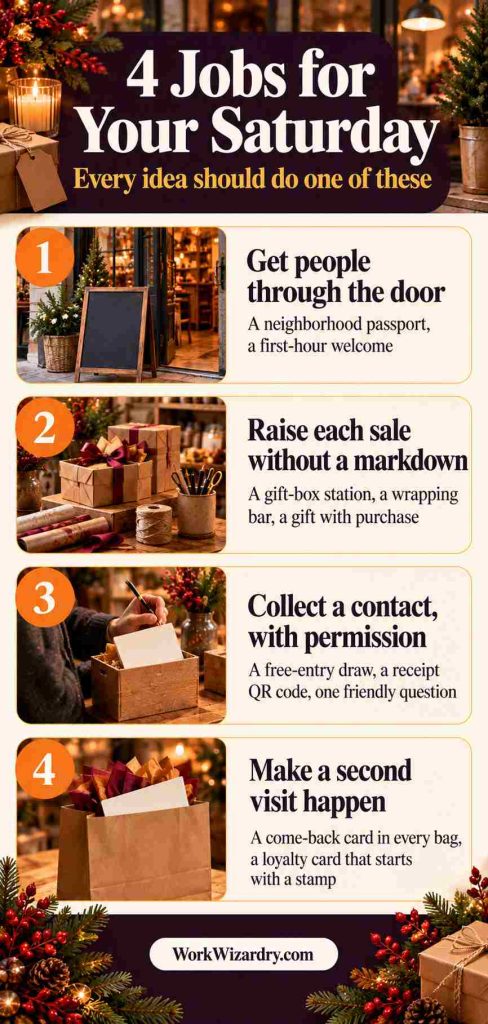
Capture contacts, with permission
A shopper who leaves without telling you who they are is a customer you will have to win again. These ideas build your list without being pushy.
At a glance
| Idea | Cost | Setup time |
|---|---|---|
| A free-entry basket draw | $30 to $100 for the prize | 1 hour |
| A receipt QR code | Free | 1 hour |
| A text-to-join sign | Low | Half a day |
| A friendly ask at the register | Free | 30 minutes |
| A pass-it-on card | $15 for printing | 1 hour |
17. A free-entry basket draw
Put an entry box by the register with a simple slip: name, email and a clear permission line. Draw a winner after the weekend.
- Why it works: It is the simplest way to collect emails on the day, and customers like the chance to win.
- Cost: $30 to $100 for the prize · Setup time: 1 hour
- Best for: Any shop with a counter
- Watch out: No purchase can be required to enter, and the slip must say that and how their details will be used. Check your state’s rules.
- Sample line: “Enter the basket draw. No purchase needed.”
18. A receipt QR code
Put a QR code on receipts, bags or the counter that goes to a short sign-up page with a clear December perk.
- Why it works: People scan when they are happy and have a phone in hand, so the code catches them at the right moment.
- Cost: Free · Setup time: 1 hour
- Best for: Shops with a till printer or paper bags
- Watch out: Use a short, mobile-friendly form and ask only for an email address.
- Sample line: “Get a December perk: scan to join.”
19. A text-to-join sign
Display a sign that invites people to text a keyword to a number in return for a perk on a later visit.
- Why it works: Text lists have high attention, and a keyword sign works in a queue.
- Cost: Low · Setup time: Half a day
- Best for: Shops that already use a text service
- Watch out: Include your business name, how often you will text and how to stop. Only text people who have agreed.
- Sample line: “Text THANKS to 55555 for a December perk.”
20. A friendly ask at the register
Teach every team member one sentence to say at checkout, such as: Would you like a note in December about our holiday evening?
- Why it works: A quick, polite question gets far more sign-ups than a sign nobody reads.
- Cost: Free · Setup time: 30 minutes
- Best for: Every shop with staff at the till
- Watch out: Ask once, take no for an answer and never ask a rushed customer.
- Sample line: “Would you like a note when we have our holiday evening?”
21. A pass-it-on card
Give every shopper two cards to hand to friends, each worth a small perk, with a place on the card to record who passed it on.
- Why it works: It brings in new customers with a personal recommendation attached.
- Cost: $15 for printing · Setup time: 1 hour
- Best for: Shops with loyal regulars
- Watch out: Keep the perk small and track redemptions so you can thank the people who share.
- Sample line: “Give a friend a free treat. We’ll thank you too.”
Make a second visit happen
One Saturday of sales is good. A customer who comes back in December is better. These ideas build the second visit before the first one ends.
At a glance
| Idea | Cost | Setup time |
|---|---|---|
| A come-back card in every bag | $15 for printing | 1 hour |
| A loyalty card that starts with a stamp | $15 for printing | 1 hour |
| A thank-you email the next morning | Free | 1 hour |
| A December invitation | Low | Half a day |
| A gift card with a bonus for January | Low | 1 hour |
22. A come-back card in every bag
Put a card in each bag with a small perk valid only from the following Monday for two weeks.
- Why it works: It gives people a reason to return before the holiday rush and makes Saturday’s shoppers into December’s shoppers.
- Cost: $15 for printing · Setup time: 1 hour
- Best for: Every shop with bags
- Watch out: Set a clear start and end date, and count how many are redeemed.
- Sample line: “Thank you for shopping small. Come back Dec 1 to 15 for a free gift.”
23. A loyalty card that starts with a stamp
Start a stamp card for every shopper on Saturday with the first stamp already filled in.
- Why it works: Research by Nunes and Drèze found that loyalty cards that began with a head start were more likely to be completed and finished sooner.
- Cost: $15 for printing · Setup time: 1 hour
- Best for: Cafes, salons, studios and shops with repeat buyers
- Watch out: Keep the reward realistic and the number of stamps low.
- Sample line: “Your card already has one stamp. Fill four more for a free gift.”
24. A thank-you email the next morning
Send a short message the day after: thank people, show what happened and share one thing coming up in December.
- Why it works: It keeps the shop in mind while the memory is fresh, and it makes the list feel like a relationship.
- Cost: Free · Setup time: 1 hour
- Best for: Shops that captured contacts
- Watch out: Send one email, not four. Keep it warm and short.
- Sample line: “Thank you for yesterday. Here’s what’s coming in December.”
25. A December invitation
Invite Saturday’s customers to a late-night or in-store event in December, with a specific date.
- Why it works: It turns a one-day relationship into a calendar entry and brings people back at the best time of year.
- Cost: Low · Setup time: Half a day
- Best for: Shops that can host an evening
- Watch out: Choose a date you can staff, and tell people the date on the day.
- Sample line: “Join us Thursday, Dec 10, for late-night shopping and cider.”
26. A gift card with a bonus for January
Give a bonus card with each gift card bought, valid only in January or February.
- Why it works: You get cash now, and the bonus brings a second visit in the quiet weeks after the holidays.
- Cost: Low · Setup time: 1 hour
- Best for: Shops that can offer gift cards
- Watch out: Check federal and state rules on gift card terms and keep the bonus terms short and visible.
- Sample line: “Buy a $50 gift card and get a $10 bonus card for January.”
Give back and work with the community
Small Business Saturday began as a way of pointing people toward neighbors. These ideas make that visible.
At a glance
| Idea | Cost | Setup time |
|---|---|---|
| A stated percentage to a local cause | Varies | 1 hour |
| A collection drive with a thank-you | Low | 1 hour |
| Recommend a neighbor | Free | 1 hour |
| A local performer outside | $50 to $200 | Half a day |
27. A stated percentage to a local cause
Choose a named local charity and give a stated share of the day’s sales to it, then publish the final amount.
- Why it works: It gives shoppers a reason to choose a local shop, and it connects to Giving Tuesday three days later.
- Cost: Varies · Setup time: 1 hour
- Best for: Any shop
- Watch out: Say percent of sales or of profit, set a cap if you need one and only claim what you actually give.
- Sample line: “10% of today’s sales go to the food bank on Oak Street.”
28. A collection drive with a thank-you
Collect tins, coats or toys at the door, and give donors a small thank-you.
- Why it works: It builds goodwill and gives people a simple way to take part.
- Cost: Low · Setup time: 1 hour
- Best for: Shops near a school, church or food bank
- Watch out: Do not make the thank-you feel like a payment. Make sure the cause agrees and can collect.
- Sample line: “Bring a tin for the food bank, and we’ll give you a cookie.”
29. Recommend a neighbor
Put a card in each bag that recommends a nearby business, and ask that business to do the same for you.
- Why it works: A recommendation from someone shoppers already trust is worth more than an advert.
- Cost: Free · Setup time: 1 hour
- Best for: Shops on a shared street
- Watch out: Choose businesses that complement yours, not compete with you.
- Sample line: “Loved your visit? Try the bakery two doors down.”
30. A local performer outside
Invite a school choir, a local band or a street musician to play for an hour outside the shop or on the corner.
- Why it works: Music draws people from the next street and makes the day feel like an event.
- Cost: $50 to $200 · Setup time: Half a day
- Best for: Shops on a walkable street
- Watch out: Check local noise rules and any permit you may need for the sidewalk.
- Sample line: “Live carols outside at 2 p.m.”
Small Business Saturday ideas for online shops and service businesses
You do not need a storefront to take part. If you sell online or sell your time, the same idea applies: make the person behind the business visible.
At a glance
| Idea | Cost | Setup time |
|---|---|---|
| A shop-small-online offer | Low | 2 hours |
| A meet-the-maker video | Free | 1 hour |
| Same-day slots and gift certificates | Free | 2 hours |
| A local makers gift guide | Free | Half a day |
31. A shop-small-online offer
Send a Saturday-only offer to your list with a personal note from the owner, plus free local pickup if you have a workshop.
- Why it works: Customers who want to support small business are often shopping from the couch, and a personal message stands out.
- Cost: Low · Setup time: 2 hours
- Best for: Online shops
- Watch out: Do not hide the offer behind a code. Show the price clearly.
- Sample line: “From my kitchen table to yours: free shipping today.”
32. A meet-the-maker video
Post a one-minute video that morning showing how you make or pack the product and why you started.
- Why it works: People buy from a person. A short, honest video builds trust faster than a banner.
- Cost: Free · Setup time: 1 hour
- Best for: Online shops and creators
- Watch out: Keep it plain and short. Do not read a script.
- Sample line: “Here’s where your order is made.”
33. Same-day slots and gift certificates
Open a limited number of Saturday slots at your normal price with a small bonus, and sell gift certificates for later.
- Why it works: A service business cannot run out of stock, but it can run out of time, so limited slots are honest.
- Cost: Free · Setup time: 2 hours
- Best for: Salons, studios, trainers and consultants
- Watch out: Cap the slots, set an expiry date that is clear and check your state’s rules on prepaid services.
- Sample line: “Five Saturday slots left. Book one, or gift one.”
34. A local makers gift guide
Publish a page that lists gifts from five or six local makers, including you, with links to each.
- Why it works: Neighbors link back, and shoppers get a ready-made gift list.
- Cost: Free · Setup time: Half a day
- Best for: Online shops and blogs
- Watch out: Ask each maker first, and send them the link.
- Sample line: “Gifts from our neighbors: ten makers, one page.”
Make the shop feel like the day
Atmosphere is free, and it is one of the reasons shoppers choose a small shop.
At a glance
| Idea | Cost | Setup time |
|---|---|---|
| Warmth, scent, light and sound | Low | 2 hours |
| A photo spot | $20 to $60 | 1 hour |
| The owner on the floor | Free | None |
35. Warmth, scent, light and sound
Brew something hot, play music softly, light the window and keep the doorway clear.
- Why it works: A comfortable shop keeps people longer, and the cold November Saturday makes warmth especially welcome.
- Cost: Low · Setup time: 2 hours
- Best for: Any shop
- Watch out: Keep scents mild for allergies and keep music below conversation level.
- Sample line: “Come in out of the cold. We have hot cider.”
36. A photo spot
Make one corner worth photographing, such as a sign, a wreath or a painted wall, and invite shoppers to tag you.
- Why it works: Photos are free advertising, and a visible spot invites people to share.
- Cost: $20 to $60 · Setup time: 1 hour
- Best for: Shops with a corner to spare
- Watch out: Do not require a tag for a discount. Just invite it, and ask permission before reposting.
- Sample line: “Snap a photo here and tag us.”
37. The owner on the floor
Be on the floor, not in the back office. Greet people by name where you can, and thank them for choosing a small shop.
- Why it works: It is the one thing a chain cannot copy, and the reason many shoppers come.
- Cost: Free · Setup time: None
- Best for: Every shop
- Watch out: Prepare ahead so you are free to talk. Do your counting on Friday.
- Sample line: “Thank you for being here. I’m Sam, and I own the place.”
Running the Day: Roles, Capacity and a Run Sheet
A good plan fails if the shop is chaos at 10 a.m. Give every person a role, and write down who does what.
| Role | What they do |
|---|---|
| Greeter | Welcomes people, hands out the passport and the first-hour treat, and answers the first question |
| Floor | Helps shoppers, runs the personal shopper offer and restocks shelves |
| Register | Serves customers, gives out come-back cards and asks the friendly question |
| Wrapper or maker | Runs the wrapping bar or make-and-take |
| Owner or lead | Floats, solves problems, takes breaks for others and talks to neighbors |
A five-minute staff briefing. Before you open, say these five things:
- What the offer is, in one sentence.
- What each person is doing and when their break is.
- The friendly question to ask at the register, and that it is fine if the answer is no.
- What to do if there is a queue: one person calls for help, one person opens a second till.
- Who to hand a problem to, so you are never alone with one.
The Small Business Saturday run sheet. Adjust the times to your opening hours.
| Time | Action | What to do |
|---|---|---|
| 7:30 a.m. | Open the shop | Set up displays, check the float and the card reader, light the window, put out signs. |
| 8:30 a.m. | Staff briefing | Walk through the plan, roles, the friendly ask and what to do in a rush. |
| 9:00 a.m. | Doors open | First-hour welcome. Greet people and start the passport stamps. |
| 11:00 a.m. | Meet the maker | Maker on the floor for one hour. Post a photo. |
| 1:00 p.m. | Mid-day check | Count the gift stock and cards. Replenish the wrapping bar. Everyone gets a break. |
| 2:30 p.m. | Second wave | Local performer or make-and-take. Post an update. |
| 4:30 p.m. | Last-hour push | Post that the last hour has begun. Offer the personal shopper. |
| 6:00 p.m. | Close | Thank people at the door. Count entries and cards. |
| 7:00 p.m. | Debrief | Write down three things that worked and three that did not while it is fresh. |
Signs, Captions and Hashtags That Sound Like You
You do not need a hundred slogans. You need a few lines that sound like your shop. For many more lines, sorted by offer, see our Black Friday slogans guide.
Sign lines for the window and the counter
- Thank you for shopping small.
- Small shop. Big thank you.
- Real people made this. Real people are here.
- Our neighbors made this.
- You chose a small shop today. We noticed.
- Ask us anything. We know the answers.
- Made here. Packed here. Thanked here.
- Locally owned and happy to see you.
- This street thanks you.
- Every purchase here stays on this street.
Small Business Saturday captions for Instagram and Facebook
Put the day and the time in the first line, and one real detail in the second. Swap in your shop.
The week before
Next Saturday is the day we say thank you.
We’ll have hot cider at 9, a maker in the shop at 11 and a surprise in every bag.
Save the date.
The morning
The doors are open and the cider is hot.
Come in out of the cold, say hello and meet the person who made it.
We’re here until 6.
Midday
It’s 1 p.m. and the shop is full of neighbors.
Thank you. There’s still a seat at the wrapping table.
A neighbor
If you’re out shopping small today, don’t miss the bakery two doors down.
Their cinnamon buns are the reason we gain weight every December.
A maker
This is Maria, who made the candles on our front shelf.
She’s here until noon, and she’ll tell you how she makes them.
Last hour
One hour left.
There are a few gift boxes left and a lot of wrapping paper. Come in and we’ll make it easy.
The giving post
10% of today’s sales go to the food bank on Oak Street.
We’ll post the total tomorrow.
The thank you
Thank you for the best Saturday we’ve had.
You came out in the cold, you brought friends and you chose a small shop. We noticed.
Small Business Saturday hashtags
Use three to five, not thirty. Pick one for the day, one for your town and one for your kind of shop, and add the Shop Small tag only if you are taking part in the program. Look at what your neighbors are using and match them, because a shared hashtag helps everyone on the street.
Check These Before You Launch
This is general information, not legal advice. Rules differ by state and city, so ask your local authority or an advisor if you are unsure.
| Check | What to do |
|---|---|
| Trademark and logo | Small Business Saturday and Shop Small are registered trademarks of American Express. Use the official materials and read the current terms before using the logos. Describing your own event plainly is a different thing from using a logo. |
| Prize draws | If a prize depends on chance, do not require a purchase to enter. Offer a free way to enter and check your state’s rules. |
| Food and drink | Label allergens, keep hot drinks safe and check any food license or temporary permit you may need. |
| Children and activities | Supervise children, avoid small parts for toddlers and check your insurance for any event on your premises. |
| Sidewalks and music | Check your city’s rules on sidewalk displays, noise and outdoor performers. |
| Texts and email | Only message people who agreed, name your business and give a way to stop. |
| Discounts | Check each discount against your margin. Our Cyber Monday guide has the formula. |
| Claims | Only claim stock limits, donations and deadlines that are true. |
Your 28-Day Small Business Saturday Plan
Count back from Saturday. If you are starting late, do the first row, the “Prepare the shop” row and the “Saturday” row.
| When | Focus | What to do |
|---|---|---|
| 28 to 22 days out | Decide and recruit | Choose your goal, pick two or three ideas, and talk to five neighbors about a passport or guide. Check your insurance for any activity you plan. |
| 21 to 15 days out | Order and design | Order stamp cards, come-back cards, entry slips and gift-box supplies. Draft signs and the staff briefing. Register for the Shop Small Map if you accept American Express. |
| 14 to 8 days out | Tell people | Post the date and the plan, email your list, put a sign in the window and hand out flyers with every sale. Confirm guests and performers. |
| 7 to 4 days out | Prepare the shop | Build the displays, test the card reader, count stock and prepare prizes. Run the staff briefing and make a rota. |
| 3 days to Thanksgiving | Remind | Send the reminder email and post. Confirm everything with partners. |
| Thanksgiving Day and Black Friday | Rest and recheck | Say thank you. Check supplies and opening time. Keep your Black Friday offer separate from Saturday. |
| Saturday | Run the day | Follow the run sheet. Take photos. Ask every customer one friendly question. |
| Sunday and Monday | Thank | Send the thank-you email, post the donation total, count entries and redeem nothing yet. |
| Within two weeks | Bring them back | Run the come-back card period. Count redemptions and record results. |
After Saturday: Bring Them Back and Learn
The work that pays most happens in the next two weeks.
- Within 24 hours: send one thank-you email, post the donation total if you made a pledge and count your entries.
- In the first week: put the come-back card period into your calendar and decide who will count redemptions.
- In the first two weeks: record how many contacts you collected, how many come-back cards came back and how many shoppers were new.
- Within a month: write down three things to repeat and three to change, while the day is fresh.
Judge the day by sales, new contacts and second visits, not by how busy it felt. For the bigger season plan, including Cyber Monday and December, see our Thanksgiving marketing ideas and Cyber Monday ideas for small business.
Free Small Business Saturday Day Planner
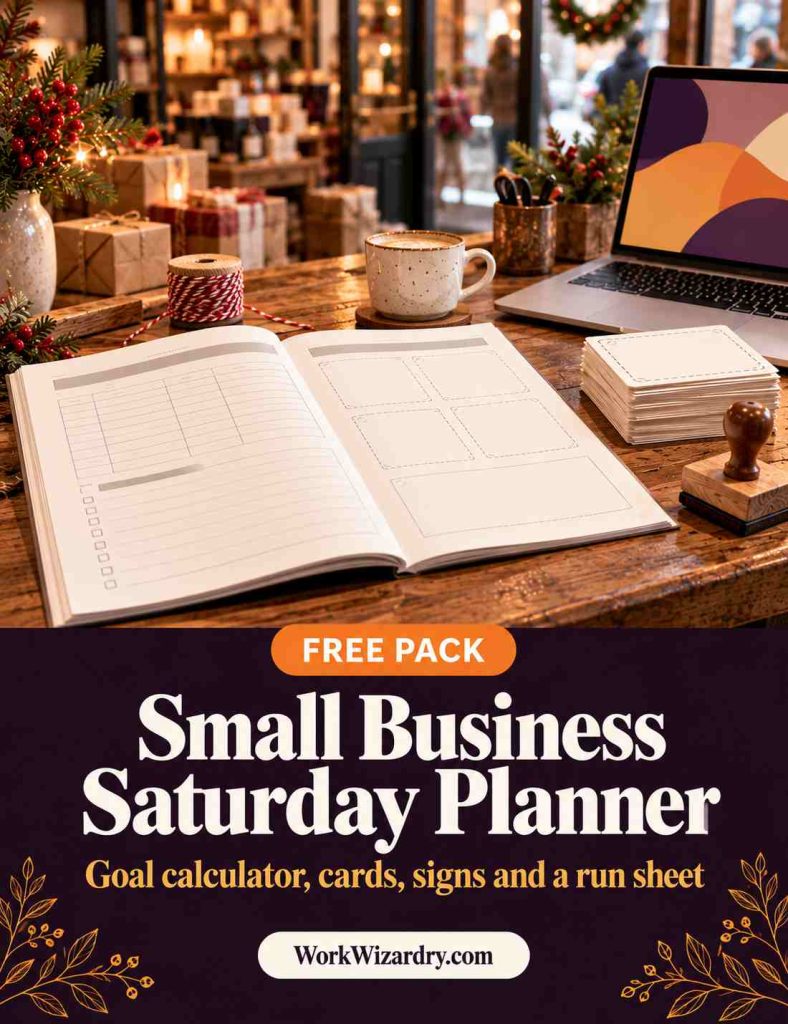
Plan the day in an afternoon. The free pack includes:
- A goal and staffing calculator in Excel. Enter your goal, basket and conversion, and it shows visitors needed, your busiest hour, people in the shop and registers needed.
- A margin check for any discount or gift you plan.
- A passport and neighbor tracker, a contact capture tracker and a second-visit tracker.
- A 28-day plan with dates that fill in from the Saturday date, and a run sheet.
- Printable come-back cards, hint cards, entry slips and thank-you signs (Letter and A4).
The Saturday Shop Kit: Everything Ready to Print and Edit
This guide shows you how to set a goal and choose ideas. If you would rather have the finished work, the paid kit contains what is not in this article or the free planner: the signs, cards, documents, scripts and the full staffing model, ready to print or edit.
- A shop playbook (PDF): the run of the day, opening and closing checklists, cash, card and access checks, rush and weather plans, a worked staffing model by hour, the neighbor program, the second-visit system, giving, media outreach, a 16-step plan and a 12-month calendar.
- A sign and poster set (PDF): four window posters, counter signs, special signs, shelf talkers, bag tags and 30 chalkboard lines. No logos or trademarked names.
- A neighbor and passport kit (Word): invitations, a call script, a one-page agreement, free-entry draw rules, a map template, joint posts, a press release and community notices.
- A staff kit: role cards, 12 conversation scripts, the rush protocol and a quiz.
- A capture and return kit: passport cards, entry slips, hint cards, 12 come-back offers, loyalty cards that start with a stamp, plus four thank-you emails, ten texts and consent lines.
- A content pack: 30 captions with dates, 8 story scripts, announcements, flyer text and a content calendar.
- An Excel Command Center: staffing by hour with labor cost, an offer check, partner and contact trackers, a come-back return sheet, an hourly sales log, a budget and a post-mortem.
It costs $14.99 and is for use in your own business. Everything in this article stays free. The kit is not affiliated with American Express and does not use the Small Business Saturday or Shop Small names or logos.
Related Guides
- Cyber Monday ideas for small business: the online day that follows, with the margin math.
- Black Friday slogans: 200+ lines, captions and subject lines.
- Thanksgiving marketing ideas: the full season plan.
- Thanksgiving messages for clients and customers: ready thank-you notes for the day after.
- Thanksgiving business ideas: if you are starting a seasonal business.
Frequently Asked Questions About Small Business Saturday Ideas
What are good Small Business Saturday ideas?
The best ideas get people through the door, raise what each shopper spends without cutting prices, capture contacts with permission and bring shoppers back in December. A neighborhood passport, a first-hour welcome, a gift-box station, a friendly ask at the register and a come-back card in every bag do all four.
When is Small Business Saturday?
Small Business Saturday is the Saturday after Thanksgiving, which makes it the day between Black Friday and Cyber Monday. When Thanksgiving falls on November 26, Small Business Saturday is November 28. American Express started it in 2010, and it is a registered trademark of American Express.
How do I promote my business on Small Business Saturday?
Tell people early: post the date and the plan two weeks ahead, email your list, put a sign in the window, hand out flyers with every sale and recruit neighbors for a shared guide. If you accept American Express, you can add your business to the free Shop Small Map.
How do I get on the Shop Small Map?
The map is run by American Express and is free, but you must accept American Express cards, have no more than 25 locations and meet other conditions. Log in to your American Express merchant profile and turn on the option. Updates can take up to three days to appear, so register well ahead.
What should I do if I don’t accept American Express?
You can still take part in the day. Run your own promotion, invite neighbors to a shared guide or passport, and use your own signs. Do not use American Express logos or imply a link unless you are part of the official program, and read the current terms.
What are good Small Business Saturday ideas for a service business?
Offer a limited number of same-day slots at your normal price with a small bonus, sell gift certificates, share a meet-the-practitioner video, hand out come-back cards and invite Saturday clients to a December event. Cap slots and set clear expiry dates so you can honor everything you sell.
Do I need to discount on Small Business Saturday?
No. Many customers come for the story, the people and the experience. A gift with purchase, a gift-box station, free wrapping, a loyalty card with a head start and a December perk raise sales without cutting your price. If you do discount, check it against your margin first.
How much will I sell on Small Business Saturday?
It depends on your shop, your street and how well you promote the day. American Express’s reported spending estimates are based on consumer surveys and have moved a lot between years. Use your own numbers: set a goal from your average basket and the share of visitors who buy, then track what happens.
How do I turn Small Business Saturday shoppers into regular customers?
Collect a contact with permission, hand out a come-back card with a clear December date, start a loyalty card with the first stamp filled in and send a short thank-you email the next day. Then invite them to one specific December event.
Can I run a giveaway on Small Business Saturday?
Yes, but keep it simple. If the winner is chosen by chance, offer a free way to enter and do not require a purchase. Say clearly how entries will be used and how to opt out of emails, and check your state’s rules before you launch.
Sources: ideas, copy and examples are original to Work Wizardry. History and trademark: Wikipedia. Senate resolution, SBA support, the 2025 American Express consumer study figure and the SBA count of small businesses: SBDC network. Shop Small Map eligibility: US Chamber of Commerce. Loyalty card head-start research: Nunes and Drèze, “The Endowed Progress Effect”, Journal of Consumer Research (2006), summarized by Knowledge at Wharton. Example numbers in the goal calculator are illustrative. This page is general information, not legal advice.
