
The best way to celebrate Hanukkah at work is to ask your Jewish colleagues what they want, keep everything optional and plan around the dates: Hanukkah 2026 begins at sundown on Friday, December 4 and ends at nightfall on Saturday, December 12. Work is permitted during Hanukkah, and many Jewish employees work through it. So the job is a small, respectful moment (a menorah display, a lunch or a game), a clear time-off and scheduling note, and a greeting that treats Hanukkah as its own holiday, not a Jewish Christmas.
This post contains affiliate links. As an Amazon Associate I earn from qualifying purchases, and Work Wizardry may earn a small commission at no extra cost to you.
We have not tested these products. We chose them from listing details, and prices and stock change, so check each listing before you buy.
Key takeaways
- Ask first, once, privately. Observance varies. The answer you get decides the plan.
- Time and scheduling matter more than decorations. Friday, December 4 and Friday, December 11 are Shabbat evenings, so keep late Friday events off the calendar.
- Everything is optional. The EEOC says an employee cannot be forced to take part in a religious activity as a condition of employment.
- Say Hanukkah, not Jewish Christmas. Chabad: they are two entirely different holidays.
- Keep gifts small and the same for everyone. Gift giving at Hanukkah is a modern custom.
- Use an LED menorah for shared spaces, and check fire rules before any open flame.
Want everything ready to run? The paid Hanukkah at Work Kit has an Excel planner for the eight nights, editable messages and manager scripts, run sheets, bingo cards, a trivia set and a 10-slide deck. This guide is complete on its own.
Start Here: Pick Your Starting Point
This guide covers how to celebrate Hanukkah at work, from a two-line greeting to a lunch and a full week. Hanukkah in the workplace works best when the plan is small, specific and led by volunteers.
Whether you are a colleague asking how to celebrate Hanukkah with coworkers or HR planning inclusive holiday celebrations in the workplace, the same rules apply. Use the table to find your first move, then read the sections that match.
| You are | Start with | First move |
|---|---|---|
| HR or people team | Rules 1 to 7 and the time-off section | Publish a scheduling note and the floating holiday option |
| Manager | Scripts for your team | Ask once, privately, then act on the answer |
| Colleague who wants to help | The ask-first script | Offer to help, never to speak for anyone |
| Small business owner | Ideas by effort and the gifts section | Pick one lunch and one gift for everyone |
| Remote team lead | Remote and hybrid section | Move the moment to a short call at a fixed time |
| Jewish employee asked to organize | Rule 2 | You can say no, or say yes to a small part |
What to buy first. If you want one visible thing for a shared space, start with an LED menorah. Section 2 has the safe pick and the candles that fit a standard menorah.
Hanukkah in Two Minutes for Colleagues
Hanukkah, also spelled Chanukah, is an eight-night Jewish festival. It remembers a Jewish revolt in Judea that began in 167 BCE against Antiochus IV and the rededication of the Temple in Jerusalem in 164 BCE, according to My Jewish Learning.
The word means rededication. Rabbinic tradition later added the story of a small amount of oil that burned for eight days, and that is why many foods are fried in oil.
The menorah. A Hanukkah menorah, called a hanukkiah, has eight places for candles and a ninth, set at a different height, for the helper candle, the shamash. On night one you light the shamash and one candle.
One more is added each night, and all nine are lit on night eight. A menorah needs 44 candles for the full holiday, and most boxes hold 45.
Candles are placed right to left and lit left to right, after dark. Blessings are said by the person lighting: three on night one and two on the rest.
Food and play. Latkes are potato pancakes, and sufganiyot are jelly doughnuts. Gelt is Yiddish for money and today usually means chocolate coins.
A dreidel, in Hebrew a sevivon, is a four-sided spinning top whose letters stand for Nes gadol haya sham, a great miracle happened there.
What Hanukkah is not. It is a minor holiday, not the Jewish Christmas. Gift giving is a modern custom: the historian Jonathan Sarna, quoted by My Jewish Learning, says gelt is old but gift giving is new, and it took off in the 1950s.
Work does not stop for Hanukkah: ordinary work is allowed on its days, apart from when a day falls on Shabbat.
A first shopping idea for a shared space. An LED menorah keeps a symbolic display in the office without open flame, and electric menorahs are a common sight in office buildings. A battery model such as the Aviv Judaica chrome battery LED menorah needs no outlet.
If someone will light real candles, a box of 44 such as Ner Mitzvah white Chanukah candles, 2 pack covers all eight nights including the shamash, though the kosher claim on a listing is the seller’s own, so check the symbol on the package.
The Hanukkah Workweek: Night by Night
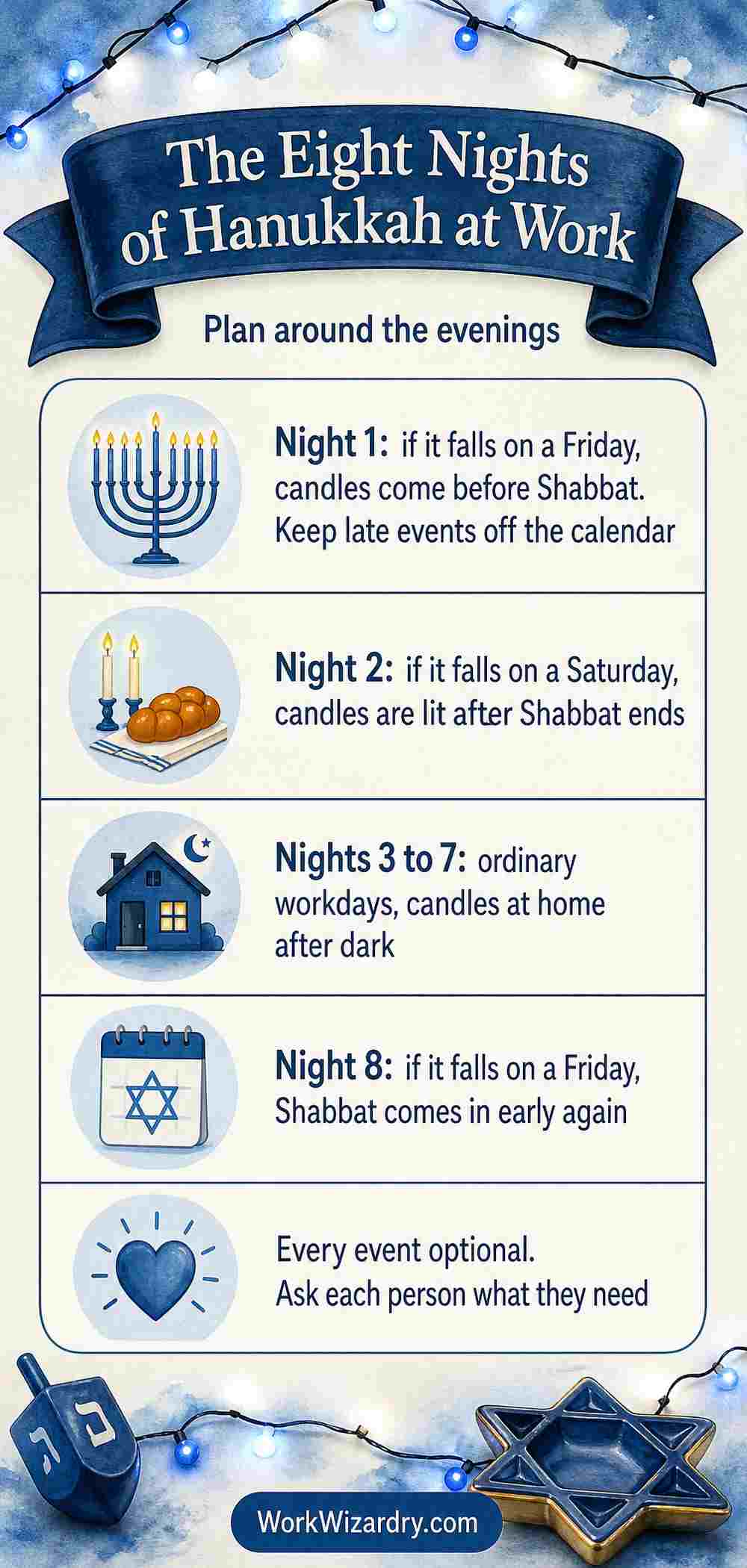
The Hanukkah 2026 dates are the first thing to settle, because sites disagree and that confuses scheduling. Hanukkah begins at sundown on Friday, December 4, and ends at nightfall on Saturday, December 12.
Some pages list December 5 because they name the first full day. For work, use sundown.
Hebrew dates are 25 Kislev to 2 Tevet.
| Night | Evening | What it means at work |
|---|---|---|
| Night 1 | Fri Dec 4, at sundown | Also Shabbat eve. Candles are lit before Shabbat candles, so observant staff may leave early. No late Friday events. |
| Night 2 | Sat Dec 5, after Shabbat ends | No workday effect. Do not message staff about work. |
| Night 3 | Sun Dec 6 | No workday effect. |
| Night 4 | Mon Dec 7 | Normal workday. Candles are lit after dark at home. |
| Night 5 | Tue Dec 8 | Normal workday. Good day for an office lunch. |
| Night 6 | Wed Dec 9 | Normal workday. Good day for a lunch and learn. |
| Night 7 | Thu Dec 10 | Normal workday. Keep late meetings light. |
| Night 8 | Fri Dec 11, at sundown | Shabbat eve again. Hanukkah ends at nightfall Sat Dec 12. Plan the last gathering for Thursday or Friday morning. |
Two Fridays matter. Night one (Friday, December 4) and night eight (Friday, December 11) fall on Shabbat evenings. On Friday the candles are lit before the Shabbat candles while it is still light, and on Saturday they are lit after Shabbat ends, according to My Jewish Learning.
Observant staff may leave early, and a late Friday meeting is the quickest way to make a Jewish colleague choose between work and the holiday. Hanukkah candle lighting happens at home after dark on the other nights, so Monday to Thursday are ordinary workdays.
Check local times. Candle lighting follows local sunset, so the time differs by city. Ask your colleagues rather than guess.
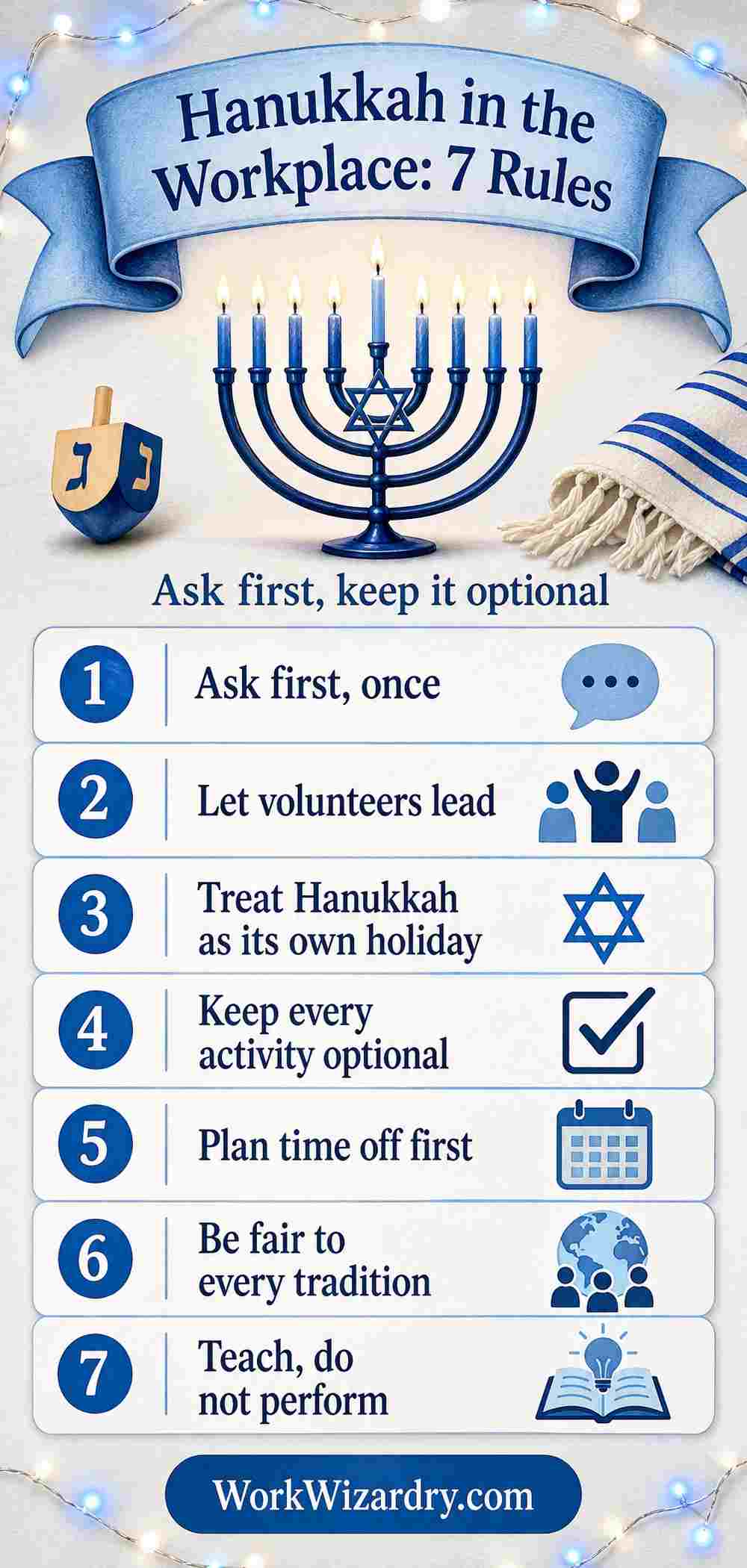
Before You Plan: Seven Rules for Celebrating Hanukkah at Work
- Ask first, once. Ask your Jewish colleagues, privately and without pressure, whether and how they would like Hanukkah marked. Observance varies. Some people want a lunch and a greeting, some want only flexible time, some want nothing. Their answer decides, not your guess.
- Let volunteers lead. Invite people who want to organize or share. Do not assign the only Jewish employee. CultureAlly and Indeed both warn against assumptions and pressure on people who observe.
- Treat Hanukkah as its own holiday. It is not a Jewish Christmas. Chabad puts it plainly: Christmas and Hanukkah are two entirely different holidays. Do not fold it into a generic December party or add one menorah to a Christmas display and call it done.
- Keep every activity optional. The EEOC says an employee cannot be forced to take part in a religious activity as a condition of employment. A menorah moment, a game or a lunch must be easy to skip with no explanation and no penalty.
- Plan time off and scheduling first. Do the accommodation work before the party: how people can leave early, swap shifts or take a floating holiday. A latke lunch does not make up for a Friday 4 pm meeting.
- Be fair to every tradition. Make the same effort for other observances at your workplace, such as Diwali or Kwanzaa. Fairness is the point of an inclusive workplace, and staff notice when one holiday is skipped.
- Teach, do not perform. Short, accurate explanation cards beat a costume or a stereotype. Keep humor kind, avoid jokes about money or stereotypes, and let Jewish colleagues correct the facts.
Time Off, Schedules and Accommodation
Do Jews work on Hanukkah, and do Jewish employees need time off? Work is allowed, and many do work. Requests for Hanukkah time off work are usually small: an early finish, a swapped shift or one floating day.
Hanukkah is a minor holiday, so ordinary work is permitted on its days, and work is restricted only when a day coincides with Shabbat. There is a custom, not a law, for some women to refrain from certain work for about half an hour after candle lighting, and some people extend it.
Some employees take the first or last night off, or leave early on Fridays, and some follow stricter personal practice. The honest answer to every scheduling question is to ask the person.
What US law asks of employers. This is a summary of the EEOC’s pages and not legal advice. Hanukkah accommodation at work falls under Title VII like any other religious accommodation.
Title VII requires an employer to reasonably accommodate an employee’s religious beliefs or practices unless doing so would cause a burden that is substantial in the overall context of the employer’s business. That is the standard after the Supreme Court’s 2023 Groff v.
DeJoy decision, which replaced the older test of more than a minimal cost, and the EEOC pages carry a notice saying so. Title VII covers employers with 15 or more employees, and many state laws reach smaller ones, so check your state.
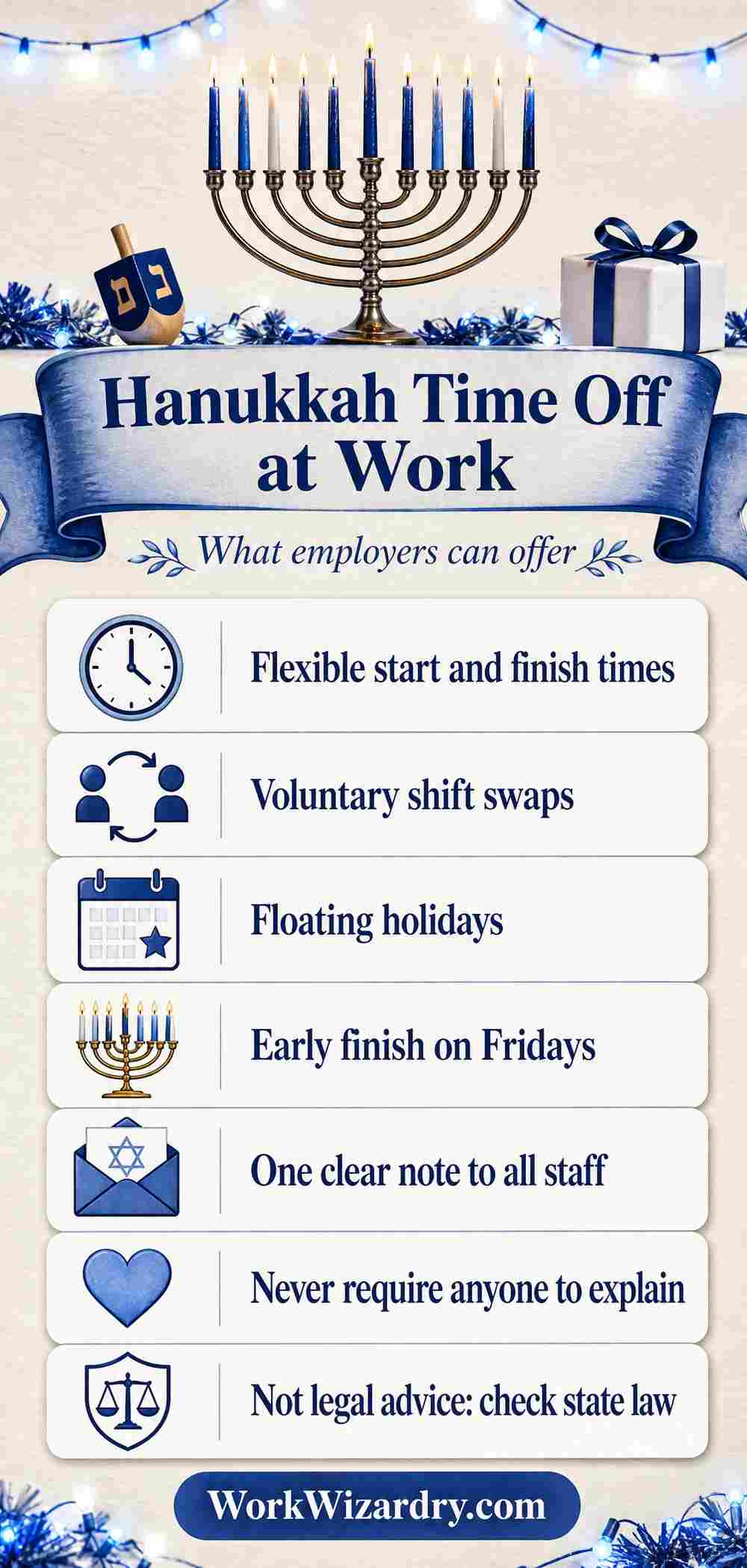
What counts as accommodation. The EEOC lists flexible scheduling, voluntary shift swaps, job reassignments and changes to workplace policies. Its compliance manual adds floating or optional holidays, flexible arrival and departure times, and using lunch time in exchange for early departure.
Coworker resentment alone is not an undue hardship. Employers must make a good-faith effort to allow voluntary substitutions and shift swaps, and the manual says an adjustment that only partly resolves the conflict may not be reasonable.
What the EEOC says about participation. An employee cannot be forced to participate, or not participate, in a religious activity as a condition of employment, and an employee who asks to be excused from an employer event for religious reasons, including non-belief, generally must be accommodated absent undue hardship. This is why every moment in this guide is optional.
The EEOC also notes that employers need not remove Christmas decorations or add decorations for other religions, so the case for inclusive celebration is good practice, not a legal duty.
What to publish. One short note to all staff is enough: the dates, how to request time or a swap, who to ask, and that events are optional. Offer floating holidays if you can.
The SHRM piece (2018) cites a 2017 figure that only 30 percent of employers gave paid floating holidays, an old number but a useful reminder that offering them stands out.
Scripts you can use
Announcing to the team. Hanukkah begins on the evening of Friday, December 4 and ends on the evening of Saturday, December 12. If you observe and need to leave early, swap a shift or take a day, tell me or HR and we will plan it.
I will keep team meetings out of late Friday afternoon on December 4 and 11. Nothing is required of anyone.
Asking a Jewish colleague. Hanukkah is coming up. Would you like us to mark it in any way, like a short greeting, a lunch or nothing at all?
Either answer is fine. If you do want something, I would value your ideas and I will handle the work.
Replying to a time-off request. Thank you for telling me. You can leave at [time] on [day] and I will cover [task].
Let me know if the first or last night needs more time and we will work it out.
When a coworker asks why Hanukkah is not run like the Christmas party. Hanukkah is a separate holiday with its own traditions, so we are not treating it as a version of Christmas. We are asking people what they would like and keeping everything optional.
When someone declines to take part. No problem at all. Thanks for letting me know. You do not need to explain.
Hanukkah Gifts at Work: What to Give and What to Skip
Hanukkah gift ideas for coworkers and Hanukkah gifts for employees should be small, because gifts are optional and Hanukkah gift giving is a modern custom. Gelt, a small treat or something useful for a shared space works.
Never give one gift to the Jewish colleague and a different one to the rest, and ask before giving anything religious. Chabad notes that a Jewish colleague may skip a Christmas gift exchange simply because it is not her holiday, so a Hanukkah gift should be an offer, not an assumption.
| Budget level | Idea | Notes |
|---|---|---|
| Free | A handwritten note | Most people keep these |
| Under $10 each | Gelt or a card | Check allergens and write by hand |
| $10 to $25 each | A mug, tea or a cookie box | Same item for all |
| Group gift | A shared lunch or donation | No wrapping, no pressure |
Money rule. If the company pays for the gift, the IRS says in Publication 15-B that cash and cash equivalents such as gift cards are taxable to the employee, while small non-cash items are treated differently, so ask your payroll provider.
Non-product gifts that work
- A handwritten note with one specific thank-you. It costs nothing and is the gift most people keep.
- A donation in the team’s name. Pick a charity the team votes on. Giving to others fits the spirit of the holiday and costs the same for everyone.
- A floating holiday or an early finish. The most valuable gift for an observant colleague is time. It also costs less than a present.
- Lunch for the team. A shared lunch needs no wrapping, helps people connect and can follow allergy and kosher notes.
Gift ideas with listings. These are work-safe picks. Each appears once on this site and none is repeated elsewhere.
Listing details, kosher claims and counts are the sellers’ own, so open the page and confirm before you buy.
Mugs and cards
- Menorah mug, 11 oz. A plain ceramic mug with a menorah is the safest desk gift for a colleague who celebrates. Buy the same mug for everyone who likes tea or coffee and let people choose to use it. Check care instructions on the listing, since some similar mugs are hand-wash only. See the listing: HSPD ceramic menorah mug.
- Dreidel and menorah mug. This mug leans lighter and brighter, so it suits a team that already jokes together. A dreidel image is easy to understand without explanation. Pick one style for the whole group and avoid mixing designs, which can look like ranking people. See the listing: SMALLWONDERGIFTS dreidel mug.
- Snowflake menorah mugs, 2 pack. The snowflake design reads as winter first and Hanukkah second, which works in a mixed office. A two-pack lets you give one and keep one at your own desk or pair it for a manager and a deputy. Confirm the size you are ordering. See the listing: ThisWear Snowflake Menorah mug, 2 pack.
- May Your Candles Burn Bright mug. The line on this mug is warm and not religious in tone. It works for a card-plus-mug gift for a friendly colleague. The listing offers white, black or accent handle options, so choose a neutral color that suits your office. See the listing: QUANKUN Happy Hanukkah mug.
- Boxed Hanukkah cards, 36 count. A box of 36 cards covers a whole team or a floor. The set has six designs and self-adhesive envelopes, which saves time. Choose plain cards with a short note, and sign every card by hand. See the listing: Nihuecne 36 Hanukkah greeting cards.
- Gold foil boxed cards, 16 count. These foil-lined cards suit a manager writing to staff or a client note. Hanukkah icons are clear and tasteful. Sixteen cards is a smaller set, so it fits a team of ten or less. See the listing: Masterpiece Hanukkah Icons cards, 16.
- Funny Hanukkah cards, 12 count. A pun-based set for a team with a light culture. Humor is the risk: read every card and skip any that jokes about a stereotype before you hand them out. Best from one Jewish colleague to another, or when a colleague gave you the idea. See the listing: NobleWorks Hanukkatz cards, 12.
Treats and tea
- Hanukkah tea gift set. Two small tins of tea suit people who skip coffee. It is a small treat for a close colleague. Flavors are listed on the page, so check for caffeine and herbal choices if your colleague avoids one. See the listing: Hanukkah tea gift set, two tins.
- Kosher herbal tea variety pack. The listing describes a kosher herbal sampler with individually wrapped bags. It is useful for a whole team because it has no Hanukkah branding and nobody has to be singled out. Check the kosher symbol on the package, because listing claims are the seller’s own. See the listing: Ceremonie kosher tea herbal variety pack.
- Hanukkah cookie gift box. Menorah and dreidel shortbread cookies make a good table gift for a team or a shared break room. The listing counts differ between versions, so read the piece count. Contains dairy, wheat and eggs, so add an allergen note and offer a non-food option. See the listing: Stern’s Bakery Hanukkah cookie gift box.
- Fortune cookies with Hanukkah messages. Eight individually wrapped cookies with a Hanukkah saying inside are a light and easy gift for a small team. The listing states kosher certification, but check the label yourself. Wrapped cookies avoid sharing from one open bag. See the listing: Chanukah fortune cookies gift box.
- Chocolate gelt in mesh bags. Gelt are chocolate coins, an older custom that works as a small treat for everyone. A mesh bag per person is easy to hand out. The listing says kosher dairy. Chocolate melts and contains milk, so deliver it on the day and offer a swap. See the listing: The Dreidel Company gelt, 12 mesh bags.
Desk and game gifts
- Extra large wooden dreidels. Large wooden dreidels work as a desk toy or a conversation piece and double as the spinner for a team game. One for a shared space is enough. Use the game rules later in this guide so nobody feels they must gamble. See the listing: The Dreidel Company extra large Jerusalem wood dreidels.
- Modern LED menorah for a desk. This is a battery and USB menorah with LED rods, so it works at a desk with no flame. It suits a colleague who has said they would like one. Do not give a menorah as a default gift, because colleagues who observe may already own one. See the listing: Zion Judaica electronic menorah.
- Hanukkah trivia card game. A card game for four or more players, listed for adults and families. It suits a team that likes games at lunch. Make play optional, and use the 12 questions in the games section if you want a free alternative. See the listing: Yule Never Guess Who Knew? Hanukkah trivia game.
Wrapping
- Hanukkah wrap kit. Three rolls of themed wrap, six tags and six bows make wrapping simple if you are giving small gifts to a group. Use plain wrap for gifts to colleagues of different faiths so the wrap does not decide the holiday for them. See the listing: Zion Judaica Hanukkah gift wrap kit.
- Blue and gold gift tags, 42. Peel-and-stick labels in menorah, dreidel and star designs. Use them on any plain box or bag when you want a Hanukkah touch on an otherwise neutral gift for a Jewish colleague who has told you they would like it. See the listing: Hanukkah gift tags, 42 labels.
For wider gift budgets and tax notes see Christmas Gift Ideas for Employees, which has its own set of listings.
40 Hanukkah Ideas for Work, by Effort
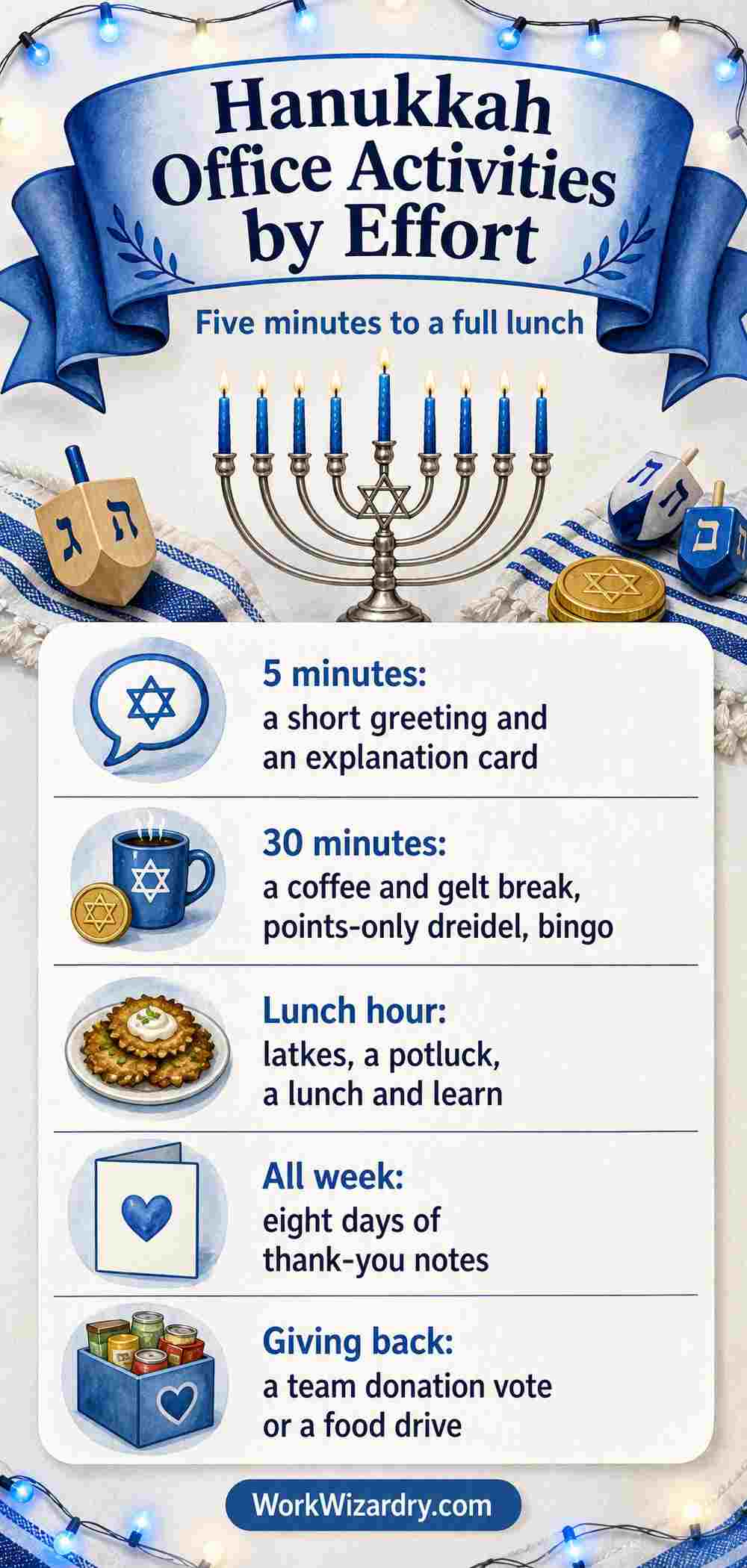
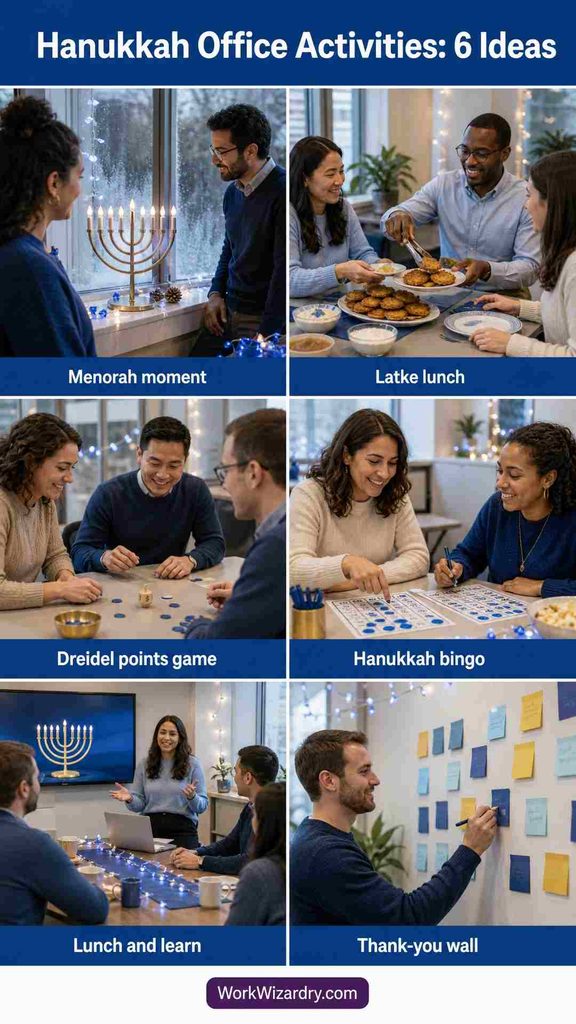
These Hanukkah office activities and Hanukkah office party ideas are all optional, and they work as Hanukkah team activities for a group of any size. Pick one or two and do them well.
The short note on each says what to watch for.
5 minutes
- Send a short greeting. Email or chat a two-line message the first day. Name Hanukkah and the dates. No promotion, no emoji overload. Watch out: Do not send it from a no-reply address.
- Add a calendar note. Put the eight nights in the shared calendar as an all-day marker, not a day off. Watch out: Label it clearly as an observance, not a holiday.
- Post an explanation card. A short card by the kitchen: what Hanukkah is, how many nights, what the menorah means. Watch out: Have a Jewish colleague review the wording.
- Ask people to share, if they wish. A chat thread where colleagues add a tradition from any holiday this month. Watch out: Never call on a person to speak.
- Share the schedule. Tell people when team meetings and deadlines will stay clear of late Friday afternoons. Watch out: Say it once, plainly.
- Wear blue and white day, optional. A color day for anyone who wants to join. Watch out: Optional, and not on a Friday afternoon.
- Start the meeting with a one-line fact. One true fact about the holiday before a regular meeting, such as the 44 candles a menorah uses over eight nights. Watch out: Keep it to one line.
- Light a screen menorah, with permission. A short image or video of a menorah on a shared screen at the start of a call if your Jewish colleague suggests it. Watch out: Do not recite blessings unless someone who observes leads them.
30 minutes
- A coffee and gelt break. Gelt, tea and a short explanation of the dreidel. Watch out: Check for milk and nut allergies on the gelt.
- Dreidel tournament, points version. Play with tokens, not money. Winner takes bragging rights. Watch out: Make it clear there is no gambling. Supplies: Set of 36 blue and white dreidels with game map.
- Hanukkah bingo. Cards with menorah, dreidel, latke and gelt squares. Players learn as they play. Watch out: Choose an adult card set. Supplies: Adult bingo set, 18 cards.
- Lunch and learn. A 20-minute talk from a Jewish colleague, a local rabbi or a cultural center on the holiday. Watch out: Pay speakers. Never expect a colleague to present.
- Build a menorah craft. Paint wooden dreidels or build paper menorahs for desks. Watch out: Keep materials simple and safe. Supplies: 25 unfinished wood dreidels to paint.
- Story circle. Five volunteers each share a family food or holiday memory from any tradition. Watch out: Opt in only.
- Trivia round. Ten questions from the games section. Teams of four. Watch out: Include fun facts, not trick questions.
- Quiet candle moment. A short moment where a volunteer lights a menorah or LED menorah and people simply watch. Watch out: Follow fire rules in the safety section.
Lunch hour
- Latke lunch. Latkes with applesauce and sour cream, plus a vegetarian main and a salad. Watch out: Label allergens and ask about kosher needs.
- Sufganiyot and coffee. Jelly doughnuts from a local bakery with coffee. Watch out: Contains gluten, egg and milk. Offer an alternative.
- Shared plate lunch. One of the easiest Hanukkah potluck ideas: colleagues bring a dish from any culture, with a card naming the dish. Watch out: Ask about ingredients to avoid, and let anyone buy instead of cook.
- Cook-along, remote. A video latke demo where everyone cooks at home. Watch out: Check oil safety and offer a no-fry version.
- Hanukkah food tasting. Three foods, three cards, a vote for favorite. Watch out: Include a dairy-free and a gluten-free option.
- Potluck with a theme card. A card by each dish explaining its link to Hanukkah or to the cook’s own holiday. Watch out: Avoid a rating contest between cultures.
- Interfaith table. A table where staff from several traditions answer questions over lunch. Watch out: Invitation only, and pay for the lunch.
- Cookie decorating. Menorah and dreidel cookie cutters with plain cookies and icing. Watch out: Disclose allergens and use sealed icing.
All week
- Eight days of thank-yous. One thank-you card per day, written to a different colleague, ending with the whole team on night 8. Watch out: Make sure everyone receives one.
- Daily fact on a screen. One fact a day in the break room: story, food, dreidel letter, the menorah. Watch out: Keep sources accurate.
- Blue and white display. A neutral winter display on a board with a Hanukkah explanation card beside it. Watch out: Do not mix religious symbols.
- A menorah with a daily light, if safe. An LED menorah in a shared space, one more light each day. Watch out: Confirm with the Jewish colleagues that this is welcome first.
- Reading list. A short list of books and articles from Jewish authors on the shared drive. Watch out: Offer, do not assign.
- Gift of time. Optional early finish for the eight evenings that matter to an observant employee. Watch out: Handle it as an accommodation, not a perk.
- Colleague spotlights. A few volunteers tell how they mark a December tradition. Watch out: Volunteers only.
- Gratitude wall. A wall of notes naming what people appreciate about each other. Watch out: Moderate for kindness.
Giving back
- Team donation vote. Staff vote on a charity and the company matches. Watch out: Choose a charity that is not religious unless the team agrees.
- Food drive. Collect non-perishables for a local food bank. Watch out: Check what the food bank accepts.
- Volunteer day. A shared shift at a shelter or food bank. Watch out: Make it optional and paid.
- Coat or toy drive. Gather new coats or gifts for a local organization. Watch out: Ask the organization what it needs.
- Gelt to charity. Staff give a small amount in place of gelt to a charity of choice. Watch out: No one is expected to give.
- Skills offering. Staff offer an hour of skills to a nonprofit. Watch out: Choose a project with clear scope.
- Blood drive. Host a drive and mark it as a service moment. Watch out: Share donor eligibility rules.
- Thank a service worker. Cards and coffee for cleaners, guards or drivers who work your building. Watch out: Do it year-round, not only in December.
How to Host a Hanukkah Celebration at Work
Hanukkah party ideas for work should stay smaller than a Christmas party. Hosting a Hanukkah celebration at work takes less effort if you keep it focused: one gathering, volunteers, clear notes and a plan for time off.
| When | Do | Who |
|---|---|---|
| 6 weeks out | Ask Jewish staff what they want. Form a volunteer group. Set a budget. | HR or a volunteer lead |
| 4 weeks out | Pick the date and format. Check fire policy for any candles. Book food. | Organizer |
| 3 weeks out | Send a short invitation: optional, time, food notes, access needs. | Organizer |
| 2 weeks out | Collect dietary and access needs. Order supplies. Confirm any speaker is paid. | Organizer |
| 1 week out | Send a reminder and the scheduling note to managers. Print explanation cards. | Organizer and managers |
| Day of | Set up early, label food, keep a quiet space open, and start on time. | Volunteers |
| Day after | Send thanks, clean up, and collect feedback in one anonymous question. | Organizer |
Budget guide
| Level | What it covers |
|---|---|
| $0 to $50 | Greeting, calendar note, explanation card, gelt for a small team |
| $50 to $250 | Lunch for 10 to 20 people, decorations, small gifts |
| $250 and up | Catering for a whole floor, a paid speaker, a donation match |
Supplies. For a full lunch, a set such as 142-piece Chanukah tableware set with plates, napkins, cups and tablecloth keeps serving simple. Pick blue and white and avoid anything with a cartoon or stereotype.
Short on time this year? Skip to the four-week plan near the end. It compresses these steps into the weeks left.
Roles. A lead (planning), a host (welcome and time-keeping), a food volunteer (labels and allergens), a safety volunteer (fire policy and candles), and an accessibility check (seating, light, space to move).
Run sheets
15-minute menorah moment
- 0:00 Welcome and one sentence: what the moment is and that it is optional.
- 0:02 A volunteer or the team lead explains what the menorah and the shamash are, or plays a short video.
- 0:06 A volunteer lights an LED menorah or follows the fire rules for real candles.
- 0:09 A colleague shares a short memory or reading, only if they want to.
- 0:13 Thanks, gelt or tea, and back to work.
30-minute coffee and game break
- 0:00 Welcome, optional, gelt and tea on the table.
- 0:03 Two-minute dreidel overview and rules.
- 0:05 Dreidel tournament, points version, in teams of four.
- 0:22 Five-question trivia lightning round.
- 0:28 Thank you and clean up.
60-minute lunch
- 0:00 Welcome and a one-minute explanation of what is on the table.
- 0:05 Eat. Soft music, no speeches.
- 0:25 A volunteer shares a two-minute Hanukkah story or tradition.
- 0:30 Bingo round.
- 0:50 Optional craft or trivia.
- 0:57 Thank you, gelt to take away, and feedback card.
Food, Allergies and Kosher Basics
- Ask about kosher needs in the invitation. Kosher means food prepared under Jewish dietary law, and some people keep it strictly. Do not call food kosher unless it carries a certification symbol you have checked.
- Offer a vegetarian main so everyone has something. Latkes are potato pancakes fried in oil, a food that recalls the story of the oil. Sufganiyot are jelly doughnuts, the Israeli favorite.
- Label every dish with its main allergens: milk, eggs, wheat, peanuts, tree nuts, soy and fish. Put labels in front of the food.
- Do not serve meat and dairy together at a Hanukkah lunch if your guests keep kosher. A dairy meal or a fully vegetarian meal avoids the problem.
- Fried food needs a plan: use a kitchen with ventilation, never fry in the open office, and give a baked option for anyone who cannot be near hot oil.
- No alcohol by default. A toast with juice includes everyone.
Hanukkah lunch ideas for work start with the menu above and a clear list of allergens on the table.
Kitchen helpers. If you cook, a mix such as Manischewitz potato pancake mix, 6 pack saves grating and makes latkes the same each time, and the cutters in The Dreidel Company stainless steel Hanukkah cookie cutters, 5 piece turn plain cookies into menorahs and dreidels. Check the label for allergens before you serve, since listings and ingredients can differ.
Menorah Lighting at Work: Safety and Respect
- Start with an LED or battery menorah for any shared space. It keeps a symbolic display in the office without open flame. Religious guidance on electric menorahs is mixed, so ask the colleague who observes before you call it a ceremony.
- For real candles, check your fire policy, landlord rules and local fire marshal first. Keep flame at least three feet from paper, decorations and curtains, as one university’s fire rule requires, and place it on a stable tray on a nonflammable surface.
- Never leave a lit menorah alone. Assign one adult to stay with it. Candles in a menorah burn about half an hour, and a box of 44 covers eight nights including the helper candle.
- On Friday the candles are lit before Shabbat candles while it is still light. On Saturday they are lit after Shabbat ends. At work, that means no late Friday events on December 4 and 11.
- Blessings are said by the person who is lighting. Let a Jewish colleague lead them or skip them. A non-observant organizer should not recite blessings for others.
- Think about access: make sure the table is at a seated height, avoid dim rooms that make it hard to move, and offer a seat near the display.
Safe picks for shared spaces. A 13-inch gold LED menorah, battery or USB or a blue Zion Judaica LED menorah, battery or USB stands on a table and runs without a flame. If a colleague asks to light real candles at their own desk, treat it as an accommodation, check the fire policy with them and follow the same distance and supervision rules.
Hanukkah Games and Activities, With Rules
These Hanukkah games for adults and Hanukkah activities for adults take little setup and need no gambling.
Dreidel rules
- Players: any number. Setup: each player starts with 10 to 15 tokens, such as paper clips or candy. Each player puts one token in the pot at the start of a round, and again whenever the pot is empty or has one piece left.
- Nun means nothing happens. Gimel means take the whole pot. Hey means take half, and if the number is odd, half plus one. Shin means put one piece in (in Israel the letter is peh).
- A player who runs out is out, or may ask for a loan. The round ends when one player holds everything. Rules vary by family.
- Four Hebrew letters on the dreidel, nun, gimel, hey and shin, stand for the phrase Nes gadol haya sham, a great miracle happened there.
- For work, play for points, not money: a token is one point, the top three teams win bragging rights, and nobody pays in. Remove any link to gambling.
Dreidel supplies. A set like The Dreidel Company 4 natural wood dreidels with instructions covers a small team. The rules above print on the back of most sets, but not all.
Hanukkah trivia questions and answers: 12 for a break
- How many nights does Hanukkah last? Eight.
- What does the word Hanukkah mean? Rededication, of the Temple in Jerusalem.
- What is the helper candle called? The shamash.
- How many candles do you need for all eight nights, including the helper? 44.
- What do the four letters on a dreidel stand for? Nes gadol haya sham, a great miracle happened there.
- Which letter replaces shin on dreidels in Israel? Peh.
- What is gelt? Money in Yiddish. Today usually chocolate coins in gold foil.
- Why are latkes and sufganiyot fried in oil? To recall the story of the oil that lasted eight days.
- What is the Hebrew word for a dreidel? Sevivon, from a word meaning to turn around.
- Is gift giving an ancient Hanukkah custom? No. It is modern and grew in the 1950s, influenced by Christmas.
- Which Hebrew calendar date does Hanukkah start? 25 Kislev.
- On which weekday does Hanukkah 2026 begin at sundown? Friday.
Bingo, scavenger hunt and a craft. Bingo cards need squares for the menorah, dreidel, latke, gelt, oil, candle, eight nights and a few facts. A scavenger hunt can send teams to find items with a clue each, such as the shamash or the number 44.
A craft table with paints and unfinished dreidels suits a lunch break.
Hanukkah Decorations That Work in an Office
Hanukkah office decorations and Hanukkah decorations for office spaces should be neutral, optional and explained.
- Use blue and white and keep decorations neutral and winter in feel: snowflakes, stars, candle shapes and plain garlands. Do not mix Hanukkah symbols into a Christmas display.
- Add a small explanation card next to anything religious, such as a menorah or a dreidel, so colleagues know what they are looking at.
- Place a menorah where it is visible but not in a walkway. LED menorahs are the safe choice for a shared space.
- Do not use a tablecloth or paper goods with a stereotyped image. Choose clean menorah, dreidel and star designs.
- Keep decorating optional and volunteer-led. Do not put decorations on a Jewish colleague’s desk without asking.
- Take decorations down on the day after the last night. Leaving them up for weeks looks like a leftover.
Easy blue-and-white pieces. A garland such as the Rite Lite 8-foot Hanukkah garland or battery window lights such as Meonum window silhouette lights, 2 pack add color without flame, which is the point for open offices. Check battery or USB needs on the listing.
What to Say: Hanukkah Greetings and Messages
Safe greeting. “Happy Hanukkah” is the most common and widely used wish. Chag Urim Sameach means happy festival of lights, and Chag Sameach means happy festival or holiday, but use Hebrew only if you are sure of it.
Make it personal if you can, and send it as a person, not through a no-reply account.
Do
- Keep it short and warm.
- Name Hanukkah.
- Tie it to your working relationship.
- Offer help with coverage.
Don’t
- Call it Jewish Christmas.
- Attach a sale or a work request.
- Send it from a no-reply address.
- Insist that someone say it back.
If you are not Jewish. Hanukkah for non Jews at work is mostly about support, not participation: learn the basics, greet warmly, protect schedules and join only what is offered.
24 messages to copy. They include a Hanukkah message to employees from a CEO, a happy Hanukkah message to coworkers and Hanukkah greetings for coworkers by relationship.
- Email to all staff. Subject: Hanukkah begins Friday evening. Hanukkah begins at sundown on Friday, December 4 and ends on Saturday, December 12. If you observe and need flexible time, please talk to your manager or HR. Any event we hold is optional. Thank you for the way you support each other.
- Short chat post. Happy Hanukkah to everyone who celebrates. Wishing you eight nights of light.
- To a Jewish colleague you know well. Happy Hanukkah, [name]. I hope you get good time with family. Let me know if you need anything covered.
- To a Jewish colleague you do not know well. Wishing you a happy Hanukkah.
- From a CEO. Hanukkah begins this Friday evening. To everyone who celebrates, thank you for what you bring to our team. We will keep your schedules flexible, and I hope the eight nights are warm.
- From a manager to the team. This week includes the start of Hanukkah. If you want time or flexibility, tell me and we will plan around it. I will keep late Friday meetings off the calendar.
- To a client. Warm wishes for a happy Hanukkah to you and your team. Thank you for your partnership this year.
- Out-of-office note for Hanukkah. I am away from [date] to [date] for the holiday and will reply on my return. For urgent matters contact [name]. Wishing you a happy Hanukkah.
- Card message. Happy Hanukkah. Thank you for [specific thing]. I hope you have a bright week.
- Thank-you note on night 8. For eight nights of light and one year of good work, thank you for everything.
- Invitation to the lunch. You are invited to a Hanukkah lunch on [day] at [time]. Optional, vegetarian food, allergen labels on the table. Tell us about dietary needs by [date].
- Reply to a Hanukkah greeting. Thank you, I appreciate that.
- Reply when you do not celebrate. Thank you for thinking of me. I hope your Hanukkah is lovely.
- When someone wishes you Merry Christmas and you celebrate Hanukkah. Thank you. I celebrate Hanukkah, but I appreciate the warmth.
- Reminder to managers. Hanukkah begins at sundown on Friday, December 4. Please avoid scheduling team events late Friday afternoon, approve early-leave and shift-swap requests, and keep any event optional.
- Invitation to share, optional. If you would like to share a holiday tradition from any culture this month, add it to this thread. Totally optional.
- Message to the one organizing volunteer. Thank you for offering to help. You decide how much you want to do, and I will cover the rest.
- Greeting on the first day. Tonight is the first night of Hanukkah. Wishing everyone who celebrates a good start.
- LinkedIn post. Happy Hanukkah to everyone celebrating. Wishing you light and time with the people you love.
- Text to a close colleague. Happy Hanukkah. Thinking of you and your family this week.
- Message after the event. Thank you for coming to the Hanukkah lunch. Your feedback helps us plan next year. One anonymous question: what should we keep?
- Message to remote staff. Hanukkah begins Friday evening. We are holding a 15-minute call at [time] with an optional menorah lighting. Camera on or off, your choice.
- Message on the last night. Tonight is the last night of Hanukkah. Thank you for a week of warmth.
- Message to an employee requesting time. Thank you for letting me know. Take the time you need and I will handle coverage.
Remote, Hybrid and Frontline Teams
- Pick one 15-minute call at a fixed time that works across time zones. Avoid Friday afternoon.
- Light an LED or real menorah on camera only if the colleague who observes wants to. Offer a recording for people who cannot attend.
- Send a small gelt packet or a card by mail to remote staff with a Hanukkah greeting, with the same item for everyone.
- Use a shared document for greetings and traditions, optional, with no names required.
- For hybrid teams, run any in-person moment with a camera, a mic and an equal remote agenda.
- For frontline and shift staff, give an equal moment in the break room and a written greeting. Do not limit the celebration to the people at head office.
- Candle-lighting time is local sunset, so remote colleagues in different cities will light at different times. Keep the group moment short and flexible.
Mistakes to Avoid
| Mistake | Why it hurts | Do this instead |
|---|---|---|
| Calling it Jewish Christmas | It erases the holiday’s own meaning | Say Hanukkah and describe it on its own terms |
| Adding one menorah to a Christmas party | It reads as an afterthought | Make a separate, small moment or invite colleagues to help plan |
| Scheduling late Friday meetings | Friday candles come early for observant staff | Keep Dec 4 and Dec 11 afternoons clear |
| Picking one Jewish colleague to organize | It makes them a spokesperson | Ask for volunteers and offer help |
| Serving mixed meat and dairy and calling it kosher | It is not kosher and may exclude guests | Offer vegetarian options and check symbols |
| Requiring attendance | The EEOC says no one can be forced to join a religious activity | Make every event optional |
| Gambling with dreidel at work | It can break policy and exclude people | Play for points |
| Using cartoons or stereotypes | It hurts people and your reputation | Choose clean designs and ask a colleague to review |
| Sending an automated greeting | It feels cold | Send a short human message |
| Promoting a sale in the greeting | It cheapens the wish | Keep greetings separate from promotions |
Your Four-Week Plan for Hanukkah 2026
| When | Do | Who |
|---|---|---|
| Nov 9 to 15 | Ask Jewish staff what they want. Choose a volunteer lead. Write the scheduling note. | HR |
| Nov 16 to 22 | Decide the event, budget and menu. Check fire policy. Order supplies and gifts. Brief managers with the scripts above. | Organizer |
| Nov 23 to 29 | Send invitations and the scheduling note. Collect dietary and access needs. | Organizer and managers |
| Nov 30 to Dec 3 | Set up decorations and cards. Prepare the lunch. Send the all-staff greeting on Dec 3 or Dec 4. | Volunteers |
| Dec 4 to 12 | Run the moment, keep Friday afternoons clear, thank people daily and take notes. | Everyone |
| Dec 13 to 18 | Send thanks, ask one anonymous question and write down what to keep for next year. | Organizer |
After Hanukkah. Ask one anonymous question: what should we keep next year? Write the answer down with the dates so next year’s plan takes an hour.
The dates will change, because Hanukkah follows the Hebrew calendar.
What the Hanukkah at Work Kit Adds
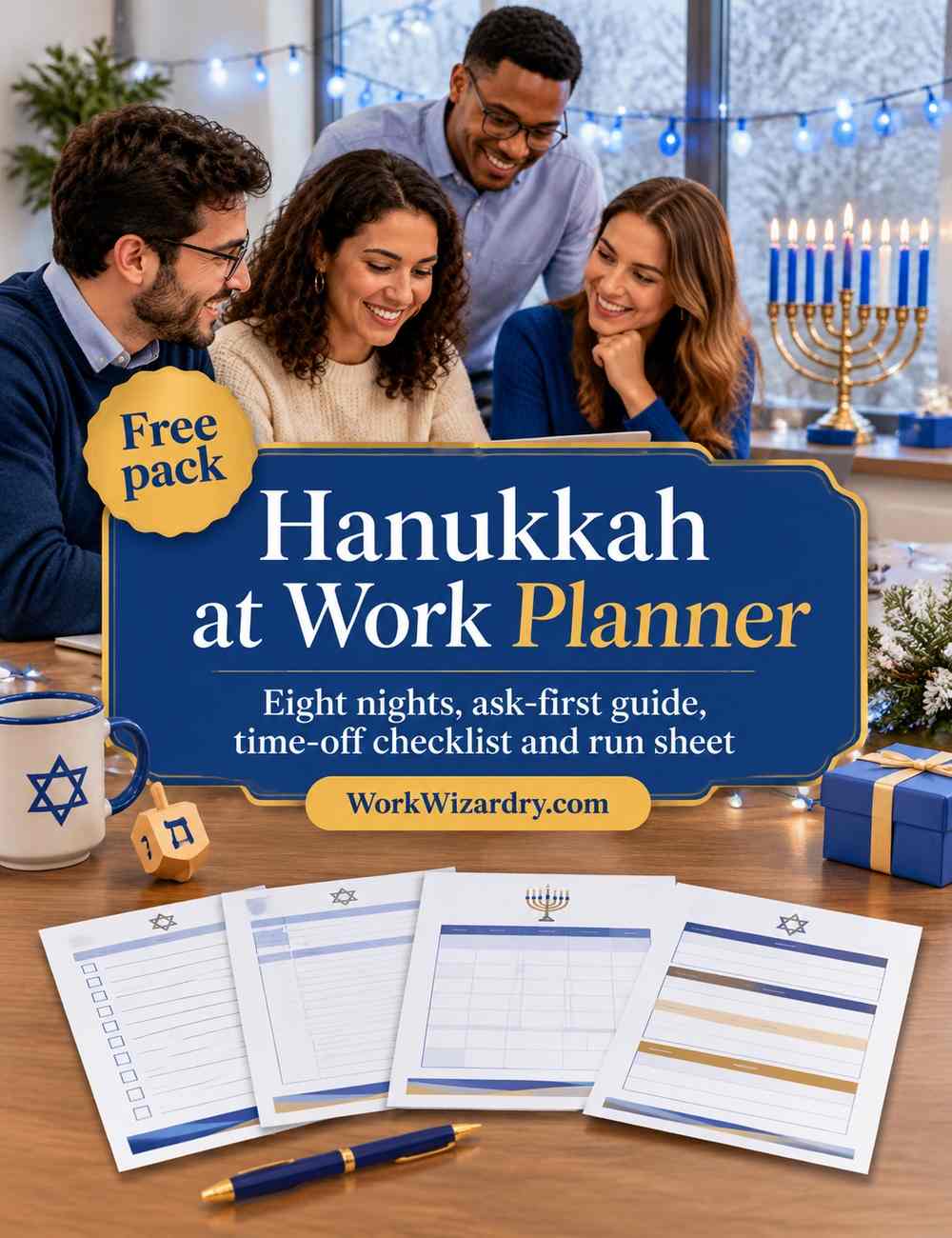
Everything above is free. The Hanukkah at Work Kit ($12.99) is the done-for-you version for the person who has to run it:
- An Excel planner that fills the eight nights from the first-night date, flags meeting conflicts and tracks budget, RSVPs and dietary needs.
- Editable messages and manager scripts in Word, plus invitations and a reminder email.
- Run sheets for the 15, 30 and 60 minute versions.
- Explanation cards, a dreidel poster, 12 bingo cards and a 40-question trivia set with answers.
- A 10-slide editable deck called Hanukkah in five minutes.
- Thank-you cards and a remote team kit.
Related Guides
| You need | Go to | What you will find |
|---|---|---|
| Plan the whole month | December Themes for Work | Dates, weekly themes and a closure plan |
| A December party for everyone | Christmas Party Ideas for Work | Formats, themes and a timeline |
| A gift exchange that suits everyone | White Elephant Gift Exchange Ideas for Work | Rules and 54 work-safe gifts |
| A Secret Santa that is not Christmas-specific | Secret Santa Ideas for Work | Formats and a Twelve Days plan |
| Year-end thank-you notes | Christmas Messages to Employees | Messages by moment |
| Gifts for the whole team | Christmas Gift Ideas for Employees | Budgets and tax notes |
Frequently Asked Questions About Celebrating Hanukkah at Work
When is Hanukkah 2026?
Hanukkah 2026 begins at sundown on Friday, December 4 and ends at nightfall on Saturday, December 12. It lasts eight nights, from 25 Kislev to 2 Tevet on the Hebrew calendar.
Some sites list December 5 because they count the first full day, so use the sundown date for scheduling.
Do Jewish employees work during Hanukkah?
Many do. Hanukkah is a minor holiday, so ordinary work is allowed on its days, and work is restricted only when a day falls on Shabbat.
Some people leave early on Fridays, take the first or last night off, or follow personal customs, so ask each person rather than assume.
Is Hanukkah a holiday off work?
No. It is not a federal holiday in the United States, so workplaces stay open unless the employer chooses otherwise. Many employers offer floating holidays or flexible time so staff can mark their own holidays, and religious accommodation law may require schedule flexibility.
Do employers have to give time off for Hanukkah?
Federal law requires reasonable accommodation of religious practice unless it would cause a burden that is substantial in the overall context of the business, after the 2023 Groff decision. Time off, shift swaps and flexible hours are common solutions.
This is not legal advice, so check state law.
Is it okay to put up Hanukkah decorations at work?
Yes, if the display is optional, kept safe and not mixed into Christmas decor as an afterthought. Ask Jewish colleagues first, add a short explanation card, and use an LED menorah for shared spaces.
Do not decorate a person’s desk without asking.
What should I say to a Jewish coworker on Hanukkah?
Say Happy Hanukkah, keep it short and warm, and tie it to your working relationship if you can. Chag Urim Sameach means happy festival of lights, but use it only if you are comfortable.
Do not attach a sales pitch or insist on a reply.
How do I celebrate Hanukkah at work without excluding anyone?
Ask first, keep every activity optional, offer food that people can eat, and run the same effort for other observances. Make time-off and schedule flexibility the first priority.
A short, specific moment is better than a big party that makes someone perform.
Can I use dreidel games at work?
Yes, if you play for points or bragging rights instead of money. Traditional play uses tokens in a pot, which can look like gambling.
Use paper-clip tokens or points, keep teams small and make it clear anyone can skip the game.
Is it okay to light a real menorah in the office?
Check your fire policy, landlord rules and local fire marshal first. Many offices use LED menorahs for shared spaces.
If you use real candles, keep flames away from combustibles, supervise constantly and ask the colleague who observes how they want it handled.
What food works for a Hanukkah lunch at work?
Latkes, applesauce, a vegetarian main, salad and a few sufganiyot work well. Label allergens, ask about kosher needs, avoid mixing meat and dairy if guests keep kosher, and keep alcohol out by default.
Do not call food kosher without a checked symbol.
Should I give Hanukkah gifts to coworkers?
Gifts are optional and Hanukkah gift giving is a modern custom, so keep any gift small and the same for everyone. Neutral items such as tea, treats or a plain mug work.
If the company pays, the IRS treats cash and gift cards as taxable wages.
Can I ask a Jewish colleague to organize Hanukkah events?
Offer, do not assign. Ask whether they would like to help and say it is fine to decline.
Put the work on volunteers and the budget on the company, and never make one person the spokesperson for a whole religion.
Can remote teams celebrate Hanukkah together?
Yes. Hold one short call, optional, with an LED or real menorah on camera only if the observing colleague wants it.
Send a small card or gelt packet to everyone, record the call, and remember candle lighting times differ by city.
What if I do not celebrate Hanukkah and a coworker wishes me a happy one?
A simple thank you is enough. You do not need to correct or explain anything.
If you celebrate another holiday, you can say so kindly. Do not insist that someone return a greeting for a holiday they do not observe.
Sources (read Nov 7, 2026):
- U.S. Equal Employment Opportunity Commission, Religious Discrimination, including the notice on Groff v. DeJoy and the statement that employees cannot be forced to participate in a religious activity.
- EEOC, Compliance Manual, Section 12: Religious Discrimination, for schedule changes, shift swaps, floating holidays and employer events. The manual predates Groff, which supersedes contrary text.
- My Jewish Learning, Hanukkah 101, Hanukkah candle lighting, How to play dreidel and Hanukkah gifts.
- Chabad.org, Jewish coworker not joining Christmas gift giving.
- My Jewish Learning, Is it permissible to work on Hanukkah? and Ask the expert: the office Christmas party.
- Hanukkah dates: Farmers’ Almanac and universaltimedate (sundown Dec 4 to nightfall Dec 12).
- Workplace practice: Indeed, inclusive holiday celebrations, SHRM, How to make holiday celebrations more inclusive (2018), CultureAlly and Awardco.
- Greeting meaning: Jewish Languages, Chag Urim sameach.
- IRS, Publication 15-B, for cash and gift cards as taxable fringe benefits.
Good to know: the EEOC compliance manual predates the 2023 Groff decision, which supersedes contrary text. This guide is not legal advice or a statement of Jewish law. Listing details for products come from Amazon pages, and kosher claims are the sellers’ own.
