
The best Christmas games for work party are short, optional and easy to score: an arrival game people play while they walk in, a quick quiz, one team game and a seated option. Use the game picker below to match games to your time, room and team, and keep score with one simple points system. To print everything, the Christmas Office Games Kit has the bingo cards, scavenger hunts, score sheets and a scoreboard.
Key takeaways
- Pick by situation, not by popularity. Arrival, desk, team, seated, quiz and virtual games solve different problems.
- Make every game optional. Offer a role for people who would rather judge or keep score.
- Score with one system. Three points for a win, two for second, one for taking part.
- Offer a seated and a virtual version of anything active.
- Skip the risky ones. Blindfolds, mistletoe, eating contests and forced singing cause more trouble than fun.
- Keep prizes small and non-cash. Cash and gift cards are taxable wages.
Pick Office Christmas Games by Time, Room and Team
Good office Christmas games match the moment. Use this table to find fun office Christmas games for your time slot, and treat the rest of the guide as your list of Christmas game ideas for the office.
It doubles as a menu of office Christmas games ideas and Christmas office games ideas, from fun Christmas games for work to Christmas game ideas for workplace teams of any size.
| You have | Pick | Time |
|---|---|---|
| People arriving, no host | Jingle Count, Tag Trail or Song Snippet Sheet | Runs while they arrive |
| A 10 minute break in a meeting | Holiday ABCs, Winter Word Chain or Paper Snowball Target | 5 to 10 minutes |
| A team of 4 to 20 with a table | Paper Cup Tree, Candy Cane Fishing or Paper Snowman Line | 15 to 20 minutes |
| A large group (50 or more) | Mingle Bingo, Jingle Count and one team quiz | Stations over 30 minutes |
| People who prefer to stay seated | Would You Rather, Holiday Cipher or Pass the Parcel Questions | 10 to 15 minutes |
| A remote or hybrid team | Home Ornament Hunt, Chat Emoji Bingo or Two-Room Trivia | 10 to 15 minutes |
| A shift team in small groups | Mystery Guest, Emoji Carol Quiz or Tag Trail | 5 to 10 minutes per slot |
Ground Rules That Keep Office Christmas Games Fair
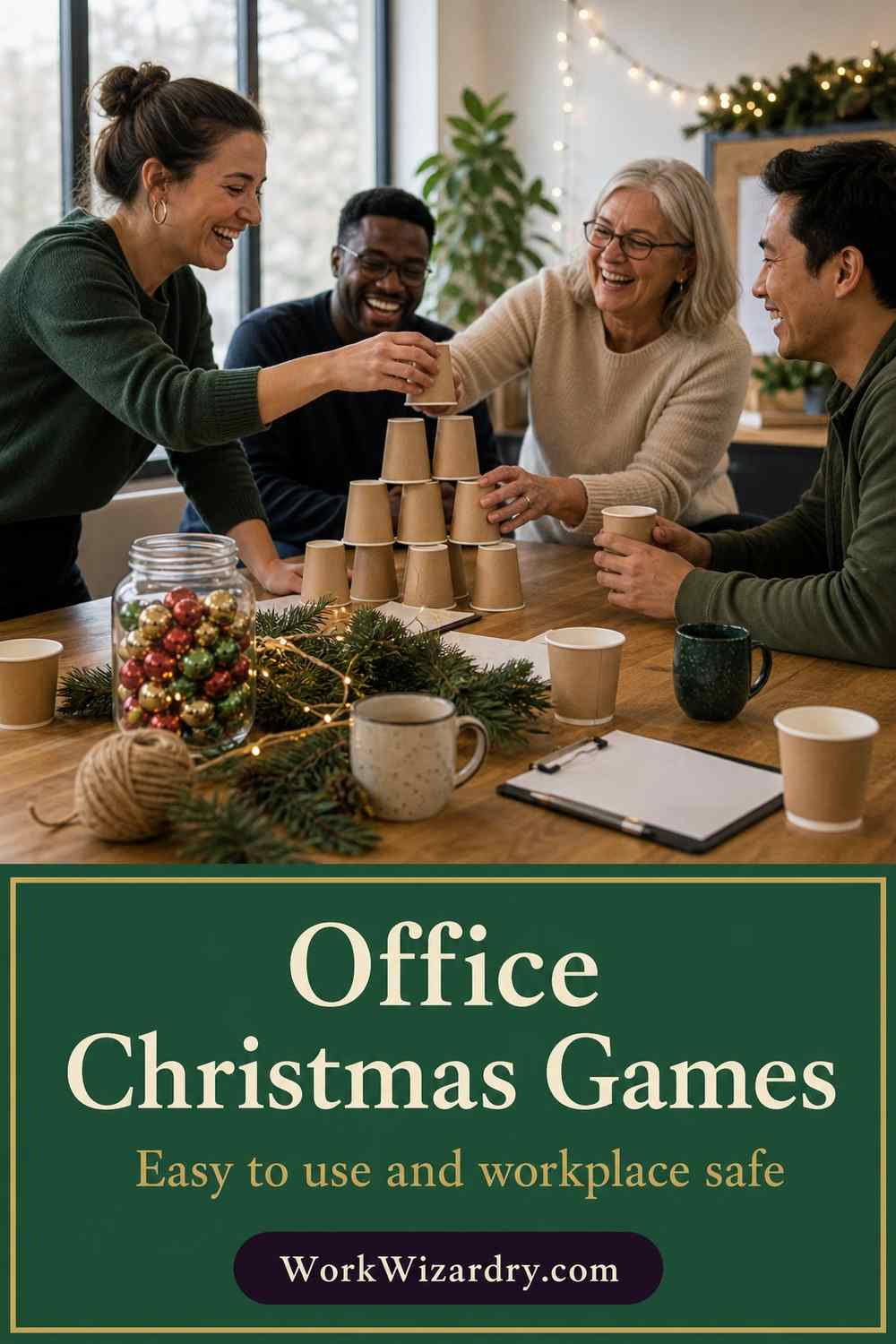
Office Christmas party game ideas only work when everyone can join in and nobody gets embarrassed. Use these eight rules for every game.
- Make it optional. Say so in the invitation. Offer a role for people who do not want to play, such as scorekeeper or judge.
- Keep it kind. No game should embarrass anyone, ask for personal details or put someone on the spot to sing, dance or perform alone.
- No contact, no blindfolds, no eating contests. They create safety, privacy and allergy problems at work.
- Offer a seated version of every active game and a printed copy of every spoken one.
- Keep food games allergy-safe. Use sealed, labelled items and ask about allergies first, or choose a non-food game.
- Use mixed teams across departments so managers do not judge their own team and quiet people are not left out.
- Set the rules and the scoring before you start, write them where everyone can see, and have a neutral judge settle disputes.
- Do not tie prizes to performance. Games and prizes are about fun, not reviews.
Arrival Games: Office Christmas Party Ideas Games That Need No Host
Arrival games fill the first 10 to 15 minutes while people find drinks and chat. They are among the easiest Christmas game ideas for coworkers because nobody needs a turn to speak.
They also suit small office Christmas game ideas, because a single person can set them up.
1. Jingle Count
Players: Any size. Time: Runs all arrival minutes. Supplies: A clear jar, jingle bells or wrapped candy, slips of paper.
- How to play: Fill the jar and set it by the door. Each person writes a guess and their initials on a slip as they arrive. Reveal the count when the games start.
- Scoring: Closest guess wins. If two are equal, the earlier slip wins.
- Inclusive version: Guessing needs no movement or speaking. Keep the jar at wheelchair height.
2. Whose Mug?
Players: Teams of any size. Time: 10 to 15 minutes. Supplies: Photos of volunteers’ mugs, a printed answer sheet.
- How to play: Ask a few colleagues beforehand to share a photo of their favorite work mug. Pin the photos up with numbers. Guests match each mug to its owner on a sheet.
- Scoring: One point per correct match. Most points wins.
- Inclusive version: Only volunteers appear. Never use personal photos without a yes.
3. Mingle Bingo
Players: 10 to 100. Time: 15 to 20 minutes. Supplies: A printed 3 by 3 or 4 by 4 grid per person, pens.
- How to play: Each square holds a prompt such as ‘has a winter tradition from another country’ or ‘has worked here five years’. Guests find a different person for each square and note the name.
- Scoring: First full row calls out and wins. Everyone who fills a row gets one point.
- Inclusive version: Prompts stay light and optional. Let people sign their own square so nobody is asked to share.
4. Tag Trail
Players: Any size. Time: 10 to 15 minutes. Supplies: Eight gift tags, string, answer sheets.
- How to play: Hang tags around the room, each with a quick question or puzzle. Guests walk the trail and write answers as they arrive.
- Scoring: One point per right answer. Tie-break: the shorter written answer to the last question.
- Inclusive version: Place tags at eye level on a flat route. Read tags aloud on request.
5. Song Snippet Sheet
Players: Any size. Time: Runs all arrival minutes. Supplies: A playlist of instrumental holiday tunes, a printed sheet with numbered lines.
- How to play: Play short instrumental snippets of public-domain carols while people arrive. Guests write the title for each number.
- Scoring: One point per correct title. Reveal answers at the start of the program.
- Inclusive version: Let guests play along in the chat or with a neighbor. Keep the volume low enough for conversation.
Desk and Meeting Games: Quick Christmas Activity Ideas for Work
These 5 to 15 minute games fit a meeting break, a team huddle or a quiet desk hour. They are quick Christmas activity ideas for work and office party game ideas for Christmas that need almost no supplies.
6. Holiday ABCs
Players: Teams of 4 to 6. Time: 5 to 8 minutes. Supplies: Paper, pens, a timer.
- How to play: Teams list one holiday word for every letter of the alphabet in two minutes, from decorations to foods to songs. Skip hard letters like X.
- Scoring: One point per unique word that no other team wrote. Judge disputes by a vote of non-playing guests.
- Inclusive version: Works seated. Teams can write, type or dictate.
7. Jingle Jargon
Players: Pairs or small teams. Time: 8 to 10 minutes. Supplies: A printed dull workplace email, pens.
- How to play: Hand each team a boring memo about printer settings. They rewrite it using only holiday words and phrases, then read it aloud anonymously.
- Scoring: Guests vote by applause for the funniest memo. Winner gets 3 points, second 2.
- Inclusive version: Anyone can read, or let the host read it. Avoid jokes about coworkers or managers.
8. Paper Snowball Target
Players: Teams of 4. Time: 10 minutes. Supplies: Scrap paper, three bins or boxes at different distances.
- How to play: Everyone crumples ten sheets of paper into snowballs. Players take turns tossing into the bins: near bin 1 point, middle 2, far 3. Stay seated or stand behind a line.
- Scoring: Highest team total after two rounds. Tie-break: one extra toss each.
- Inclusive version: Seated players toss from their chairs. Move the far bin closer for anyone who needs it.
9. Speed Wrap
Players: Pairs or solo. Time: 10 to 15 minutes. Supplies: A small box and wrapping paper per player, tape, scissors.
- How to play: Each player wraps a box in one minute, with one hand behind their back if they wish. A neutral judge scores neatness and speed.
- Scoring: Judge scores 1 to 5 for neatness. Add 2 points for finishing within the minute.
- Inclusive version: One-handed is optional, never a requirement. Offer pre-cut paper.
10. Winter Word Chain
Players: Teams of 5 to 8. Time: 5 to 10 minutes. Supplies: None.
- How to play: The first player says a holiday word. The next says a word starting with the last letter, and so on around the circle. A repeated word or a pause longer than five seconds ends the turn.
- Scoring: The last team still chaining wins the round, 3 points.
- Inclusive version: Players can pass once. Let anyone write instead of speak.
11. Five-Minute Holiday Pitch
Players: Teams of 3 to 5. Time: 10 to 15 minutes. Supplies: Paper, pens, a timer.
- How to play: Each team invents a ridiculous holiday product for the office, such as a noise-cancelling snowman, and gives a 30 second pitch. Everyone else scores clarity and creativity.
- Scoring: Average score from 1 to 5 from the room. Highest wins 3 points, next 2.
- Inclusive version: Any team member can pitch. The group chooses who speaks.
Team Games for 20 to 40 Minutes: Christmas Party Game Ideas for Work
When you have a table and a bit of time, run a team game. These are christmas party game ideas for work that give groups a shared goal.
For large groups, run two or three at once on separate tables, because company Christmas game ideas such as relays and quizzes need stations. Fun Christmas game ideas for work like these keep the whole room busy.
Work Christmas party game ideas for large groups work best with stations, so nobody waits.
12. Reindeer Relay
Players: Two teams of 6 to 10. Time: 10 to 15 minutes. Supplies: Spoons, pom-poms or paper balls, two bowls.
- How to play: Teams pass a pom-pom along a line on a spoon, then drop it in the bowl at the end. First to move ten pom-poms wins.
- Scoring: First team to ten wins 3 points, second 2. Drops mean start that pom-pom again.
- Inclusive version: Seated line version: players stay in chairs and pass along. Offer larger spoons.
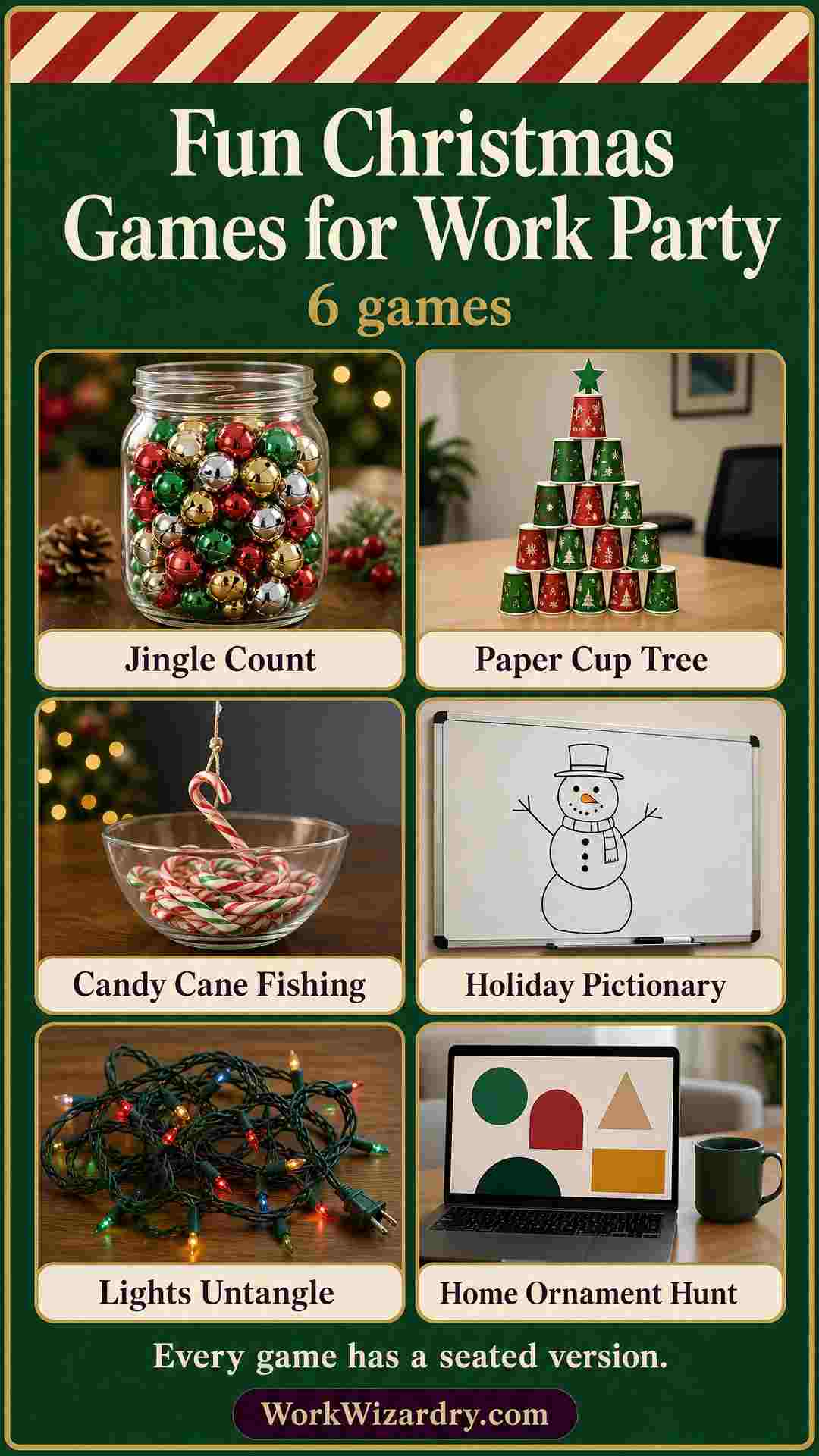
13. Paper Cup Tree
Players: Teams of 4 to 6. Time: 15 minutes. Supplies: Plastic or paper cups (about 36 per team), a timer.
- How to play: Teams build the tallest freestanding cup tree they can in ten minutes. It must stand unaided for ten seconds.
- Scoring: Tallest tree wins 3 points, second 2. Judges measure at the same time.
- Inclusive version: Table-height build, no kneeling or lifting. Roles can be swapped by ability.
14. Paper Snowman Line
Players: Teams of 5 to 8. Time: 15 minutes. Supplies: Colored paper, glue sticks, tape, scissors.
- How to play: Each player does one step on one snowman: cut the body, fold the hat, make the scarf, add the face, assemble. Pass it down the line in silence.
- Scoring: Judges score neatness and creativity 1 to 5. Highest wins 3 points.
- Inclusive version: Steps can be done seated. Offer pre-cut shapes for anyone who prefers them.
15. Gift Wrap Relay
Players: Two teams of 4 to 6. Time: 15 to 20 minutes. Supplies: A box, wrapping paper, tape, scissors per team.
- How to play: The first player wraps one side, then passes the box to the next player. The last player adds the bow. The team that wraps the box neatly first wins.
- Scoring: First neat wrap wins 3 points. A sloppy wrap adds a 30 second penalty.
- Inclusive version: Offer pre-cut paper and a seated table. Skip scissors for anyone who prefers tape tabs.
16. Candy Cane Fishing
Players: Teams of 4. Time: 15 minutes. Supplies: Yarn or string, a ruler or dowel, wrapped candy canes or small ornaments, two small bowls.
- How to play: One player lowers a string with a loop at the end to hook an ornament or candy cane in a bowl and lifts it to a second bowl. Teammates take turns.
- Scoring: The team with the most items moved in three minutes wins 3 points.
- Inclusive version: Seated stations. Use wrapped sweets or small ornaments to avoid allergy issues.
17. Holiday Pictionary Tournament
Players: Pairs, 6 to 40. Time: 20 to 30 minutes. Supplies: A whiteboard or paper, markers, a bowl of word slips, a timer.
- How to play: In each round one player draws a holiday word and their partner guesses within 60 seconds. Pairs play until one pair has three wins.
- Scoring: Win a round 2 points. Pair with the most points after three rounds gets the prize.
- Inclusive version: Teams can pick a drawer and a guesser by preference. Let anyone use the board at seat height.
18. Lights Untangle
Players: Teams of 3 to 5. Time: 10 to 15 minutes. Supplies: One tangled string of LED lights per team (unplugged), a timer.
- How to play: Tangle a string of lights loosely in a pile. Teams race to untangle the string and lay it straight. No pulling hard or cutting.
- Scoring: First team with a straight string wins 3 points, second 2.
- Inclusive version: Seated at a table. Keep lights unplugged for safety.
19. Carol Charades Tournament
Players: Teams of 4 to 8. Time: 20 to 30 minutes. Supplies: Slips with public-domain carol titles, a timer.
- How to play: One player acts out a carol title silently while their team guesses in 60 seconds. Play three rounds.
- Scoring: 1 point per correct guess. Highest total after three rounds wins.
- Inclusive version: Players can draw or hum instead of acting. Let anyone pass without penalty.
For more cooperative exercises, see Christmas team building activities.
Seated and Quiet Games: Christmas Games for Adults at Work
Not everyone wants to move or be loud. These Christmas games for adults at work are calm, work in any room and need no performance.
20. Would You Rather Cards
Players: Any size. Time: 10 to 15 minutes. Supplies: Two colored cards per person, a list of questions.
- How to play: Read a holiday Would You Rather question. Everyone holds up the color for their choice. A few volunteers explain their pick in one sentence.
- Scoring: No points, or give 1 participation point per question answered.
- Inclusive version: Silent and seated. Never use questions about family, money or personal life.
21. Two Truths and a Tradition
Players: Teams of 4 to 6. Time: 10 to 15 minutes. Supplies: Paper, pens.
- How to play: Each player writes three statements about a holiday or winter tradition they know, two true and one false. The team guesses the false one.
- Scoring: 1 point per correct guess. Players who stump the team earn 1.
- Inclusive version: Players can use a tradition from any culture or a fun fact. Nobody has to share anything personal.
22. Holiday Cipher
Players: Teams of 3 to 5. Time: 10 to 15 minutes. Supplies: A printed cipher sheet with a coded holiday message and a key.
- How to play: Give each team a printed message written in a simple letter swap. They decode it and tell the host the hidden phrase.
- Scoring: First correct team 3 points, then 2 and 1.
- Inclusive version: Large print and good contrast. Teams can split the code between members.
23. Pass the Parcel Questions
Players: One circle of 8 to 20. Time: 15 to 20 minutes.
Supplies: A small prize wrapped in many layers of paper, each with a trivia or Would You Rather question, music.
- How to play: Pass the parcel while music plays. When it stops, the holder unwraps a layer and answers the question or passes it to a volunteer. The last layer reveals a small prize.
- Scoring: The player who unwraps the last layer takes the prize. No other scoring.
- Inclusive version: Players can pass the question. Choose a prize that fits any diet and any age.
24. Mystery Guest
Players: Teams of 4 to 6. Time: 10 minutes. Supplies: A set of five clue cards for each mystery guest (a holiday character or object).
- How to play: The host reads five clues from hardest to easiest. Teams write down their guess after each clue. Fewer clues earn more points.
- Scoring: 5 points on clue one, down to 1 on clue five.
- Inclusive version: Teams can write or whisper. Avoid clues that rely on one culture’s holiday.
Brain Games and Quizzes: Christmas Quiz Ideas for Work
Quizzes are the safest Christmas games for work party celebrations because anyone can take part. These Christmas quiz ideas for work, and office Christmas party quiz ideas, need only paper and a host.
The first game is a ready-made round of Christmas trivia for work, with answers. For a full question bank, see our Christmas trivia games for work guide, and for conversation questions, our Christmas icebreaker questions for work.
25. Christmas Trivia Round
Players: Teams of 4 to 6. Time: 10 to 15 minutes. Supplies: The question sheet below, pens.
- How to play: Read the 10 questions below or print them. Each team writes its answers. Swap papers to mark.
- Scoring: 1 point per right answer. Tie-break: a closest-number question.
- Inclusive version: Offer a printed copy and let teams discuss quietly.
26. Emoji Carol Quiz
Players: Teams of 4 to 6. Time: 10 to 15 minutes. Supplies: A printed or projected sheet of emoji strings for public-domain carols.
- How to play: Show a string of emoji that stands for a carol title, such as bells and a sleigh. Teams write the title.
- Scoring: 1 point per correct title.
- Inclusive version: Provide a printed copy and an answer sheet. Keep emoji clear and simple.
27. Scene Description Movies
Players: Teams of 4 to 6. Time: 10 to 15 minutes. Supplies: A list of Christmas movie scenes described in one sentence.
- How to play: Read a one-line description of a famous scene without naming the film. Teams write the title.
- Scoring: 1 point per title. Tie-break: the first team to answer the bonus question.
- Inclusive version: Choose widely known films. Skip scenes that rely on one culture.
28. Around the World Match
Players: Teams of 3 to 5. Time: 10 to 15 minutes. Supplies: A printed match sheet.
- How to play: Teams match six customs to six countries: KFC meals in Japan, giving books in Iceland, Las Posadas in Mexico, Santa Lucia in Sweden, giant lanterns in the Philippines and Advent calendars in Germany.
- Scoring: 1 point per correct match. Share the answers at the end.
- Inclusive version: Frame it as learning, not guessing. Invite volunteers to share their own traditions.
29. Carol Lyric Fill-In
Players: Teams of 4 to 6. Time: 10 minutes. Supplies: A printed sheet with a line missing a word from public-domain carols.
- How to play: Give each team the lyric of a carol with five blanks. They fill in the missing words from memory.
- Scoring: 1 point per right word.
- Inclusive version: Teams can write instead of sing. Use only public-domain carols such as Jingle Bells and Deck the Halls.
30. Twelve Days Math
Players: Teams of 3 to 5. Time: 5 to 10 minutes. Supplies: A whiteboard or paper.
- How to play: Ask how many gifts arrive in total across all twelve days. Teams show their working. The answer is 364.
- Scoring: 1 point for the right number. Bonus for each correct step.
- Inclusive version: No singing needed. Let teams use a calculator.
Ten Christmas trivia questions, with answers
| Question | Answer |
|---|---|
| Who wrote the story A Christmas Carol? | Charles Dickens, published in 1843 |
| How many spirits visit Scrooge after Marley’s ghost? | Three |
| How many reindeer pull the sleigh in the poem A Visit from St. Nicholas, before Rudolph joined? | Eight |
| Rudolph the Red-Nosed Reindeer began in 1939 as what? | A giveaway booklet for a department store, written by Robert L. May |
| In which language was the carol Silent Night first written? | German |
| The poinsettia is native to which country? | Mexico |
| Which carol did two astronauts play in orbit in December 1965? | Jingle Bells (Gemini 6) |
| Who wrote Jingle Bells, first published as One Horse Open Sleigh in 1857? | James Lord Pierpont |
| In The Twelve Days of Christmas, how many gifts in total are given across all twelve days? | 364 |
| Which country is closely tied to the first Advent calendars? | Germany |
Virtual and Hybrid Games: Christmas Games Ideas for Work on a Call
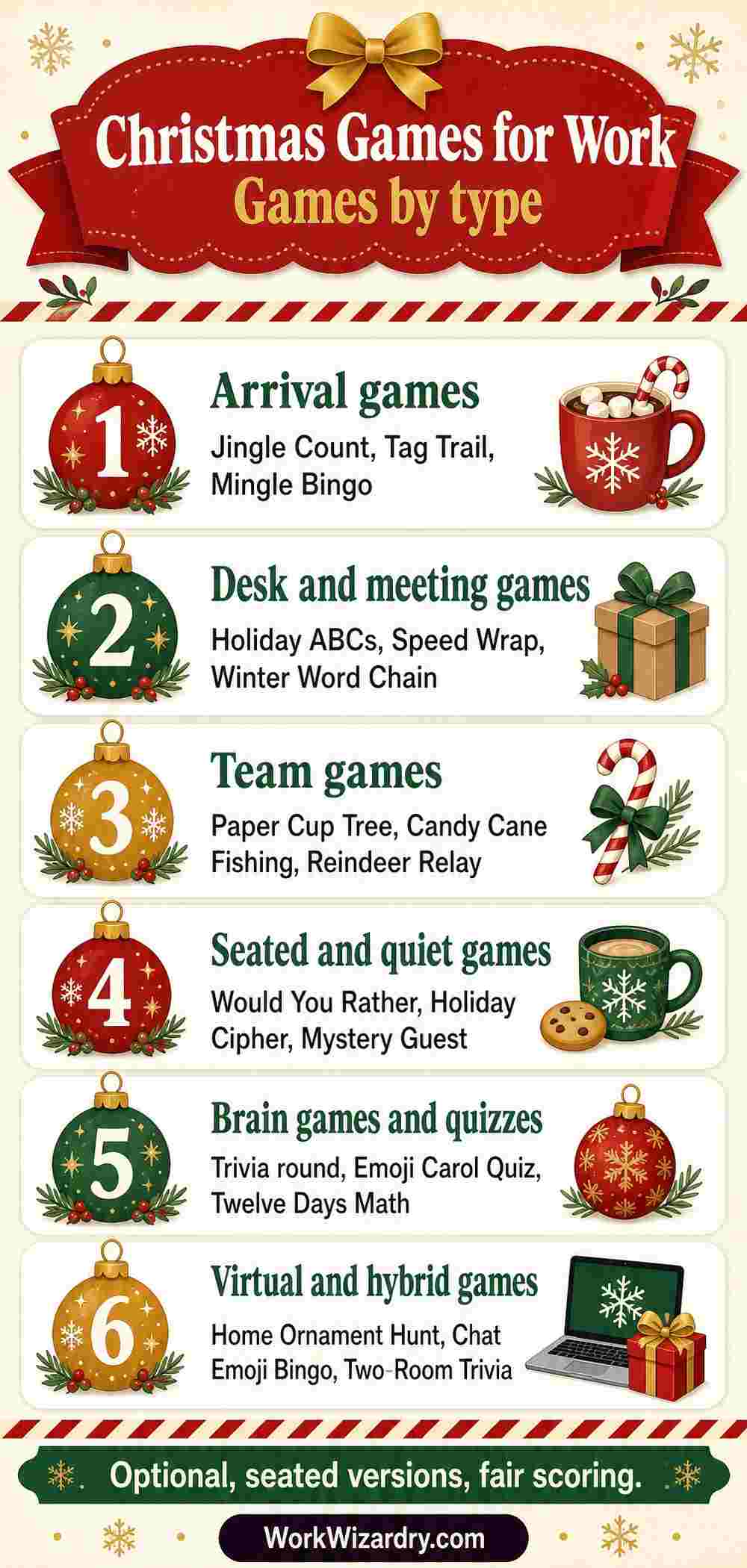
Virtual games work when they are short, need no props and let people join without a camera. These games ideas for work suit remote teams, hybrid teams and shift teams who cannot all be in one room.
31. Home Ornament Hunt
Players: Any size. Time: 10 minutes. Supplies: A call and a timer.
- How to play: The host names an item. Players bring it to the camera in 60 seconds, for example ‘something red’ or ‘something you drink from’. Keep it to items in sight.
- Scoring: 1 point per round for everyone who shows an item. Bonus for the most creative.
- Inclusive version: Cameras are optional. Players can type a description instead.
32. Chat Emoji Bingo
Players: Any size. Time: 10 to 15 minutes. Supplies: The chat, a shared bingo grid.
- How to play: Share a bingo grid of holiday emoji. The host calls out clues, and players mark squares they match in the chat. First to complete a row types BINGO.
- Scoring: First row wins 3 points.
- Inclusive version: Works with captions and no camera. Read the grid aloud for screen reader users.
33. Whiteboard Pictionary
Players: Breakout rooms of 4 to 6. Time: 15 to 20 minutes. Supplies: A shared whiteboard, a list of holiday words.
- How to play: In each breakout room one player draws a word on the shared whiteboard while the room guesses. Rotate the drawer.
- Scoring: 1 point per correct guess. The room with the most wins.
- Inclusive version: Anyone can type guesses. Offer a ‘describe it in words’ alternative.
34. Festive Background Vote
Players: Any size. Time: 5 minutes. Supplies: A call with video.
- How to play: Players choose a festive background or a corner of their space. The group votes for the best one by emoji in the chat. Winner gets 2 points.
- Scoring: 2 points to the top background.
- Inclusive version: Optional. Avoid focusing on personal homes. Allow blur or virtual backgrounds.
35. Two-Room Trivia
Players: One room plus one screen. Time: 15 minutes. Supplies: A shared quiz, a scoreboard, a co-host for each room.
- How to play: Split into the room team and the screen team. Ask 10 trivia questions and let each team confirm answers in the chat. Compare scores.
- Scoring: 1 point per right answer. Winning team gets 3.
- Inclusive version: A co-host on each side keeps both groups equal. Use captions.
36. Tradition Show and Tell
Players: Any size. Time: 10 to 15 minutes. Supplies: A call.
- How to play: Each volunteer shows a holiday item or tradition for 30 seconds. Others cast a thumbs up reaction for the most interesting story.
- Scoring: No scoring, or 1 point per volunteer.
- Inclusive version: Fully optional. Skip anyone who prefers to just watch.
For the whole virtual or hybrid party, see Christmas party ideas for work.
Christmas Scavenger Hunt Ideas for Work: Office, Remote and Hybrid
A scavenger hunt is one of the easiest ways to get a whole team moving. The same rules work for three versions:
- Office hunt. Hide 15 paper ornaments around shared areas, each with a number, or send teams to find 10 items such as a red stapler, a mug with a holiday word or a staircase with a window. Teams record the item and a team photo only if they wish.
- Remote hunt. Give players 5 minutes to find 10 items at home, from something red to something older than ten years. They hold each item to the camera or type a description.
- Hybrid hunt. Split items between the room and screens, so each team has a room player and a remote partner who describe what they see.
Keep hunts safe: no climbing, no entering private spaces and no rushing. Print a one-page rules sheet and score with one point per item.
Christmas bingo works the same way and is one of the best Christmas games for work party crowds, because a single caller can run it for 50 people. The kit includes 30 ready cards.
Scoring and Prizes: The Elf Points System
Use one points system for every game so the final winner is clear.
| Result | Points |
|---|---|
| Win a round | 3 points |
| Second place | 2 points |
| Take part | 1 point |
| Good sportsmanship (judge’s pick) | 1 bonus point |
If there is a tie
- Share the prize or the win, if the prize can be split.
- Play a quick closest-number question, such as guessing the number of jingle bells in the jar.
- Use the earlier slip or the lower number of attempts, if the game has one.
- Never decide by popularity or by rank.
Prizes that work (small, safe and fair)
| Prize | Ideas |
|---|---|
| A treat | Wrapped sweets, a hot chocolate packet or a mug (note allergies) |
| A desk item | A small plant, a notepad or a desk ornament |
| Time | A long lunch, an early finish or a team coffee break (agree with HR first) |
| A team prize | A small treat for the winning team to share |
| A donation | A small donation in the winning team’s name to a charity the group picks |
Tax and policy note. General US information, not tax advice. Cash and gift cards are taxable wages under IRS Publication 15-B, even in small amounts.
A low-value physical item given occasionally is often a minimal benefit. Ask payroll or HR before you announce a prize, especially anything with real value.
Games to Skip at Work, and Why
Some popular games cause more trouble than fun. Skip these or replace them with the safer version.
| Skip | Why |
|---|---|
| Blindfold games | They cause anxiety and falls, and sight loss is real for some colleagues. |
| Mistletoe games | They can create unwanted contact and a power imbalance with managers. |
| Eating contests and food challenges | Choking, allergies and food waste. Use non-food versions instead. |
| Forced singing, dancing or karaoke | Public performance is a stress for many people. Make it opt-in only. |
| Naughty or nice votes about coworkers | They can sting. Vote on things, not on people. |
| Baby photo or personal photo guessing | Only use photos from volunteers, and never from a private account without a yes. |
| Games that involve age, weight, pay or relationships | Never appropriate at work. |
| Alcohol-based games | They conflict with most workplace policies and create liability. |
A 60-Minute Christmas Games Hour: Run Sheet
Use this run sheet for a lunch hour, a party slot or an afternoon break. Swap any game for another in the same group.
| Minutes | What happens |
|---|---|
| 0 to 10 | Arrival: Jingle Count and Tag Trail, no host needed |
| 10 to 15 | Welcome, explain the rules and the points, and name the judge |
| 15 to 25 | Round 1: Christmas trivia round (teams of 4 to 6) |
| 25 to 40 | Round 2: Paper Cup Tree or Candy Cane Fishing |
| 40 to 45 | Break and snacks |
| 45 to 55 | Round 3: a seated game such as Holiday Cipher or Mystery Guest |
| 55 to 60 | Add up the Elf Points, give small prizes and say thanks |
Put the run sheet and the points table on a wall or slide, and give your judge a copy. If you also run a gift exchange, see the white elephant and Secret Santa guides.
What the Christmas Office Games Kit Adds
The ideas above are free. If you run the games for many people, the Christmas Office Games Kit is the Christmas office games kit that saves the setup.
It is a paid upgrade and has:
- An Excel scoreboard with team tallies, Elf Points and a tie-break column.
- 30 bingo cards with a caller sheet, in a festive design.
- Three scavenger hunts: office, remote and hybrid.
- 120 charades and emoji prompts and 60 quick quiz, Would You Rather and conversation cards, with different questions from our full trivia guide.
- Score sheets, rules sheet and certificates for a games hour.
- Run sheets for a 30 and a 60 minute games hour.
- Word templates: an announcement and a one-page rules and opt-out note.
Related Guides
- Christmas party ideas for work: the format, cost, rules and timeline for the party.
- Christmas team building activities: cooperative exercises.
- Christmas contest ideas for work: decorating contests and competitions.
- Christmas decorating ideas for work: decor for the office.
- Christmas spirit week ideas for work: dress-up days.
- Christmas potluck ideas for work: food plans and menus.
- White elephant gift exchange ideas for work: a gift exchange for the party.
- Christmas trivia games for work: a full question bank.
Frequently Asked Questions About Work Christmas Games
What are good Christmas games for a work party?
Choose games that fit your time, room and team: an arrival game like Jingle Count, a 10 minute desk game like Holiday ABCs, a team game like Paper Cup Tree and a seated or quiz round. Keep them optional, score them with one simple points system and offer a seated and a virtual version.
How long should office Christmas games last?
Plan about 60 minutes for a full games hour: ten minutes of arrival games, three rounds of 10 to 15 minutes, a short break and five minutes to add up points. For a meeting break, one 5 to 10 minute game is enough.
Shorter, clear rounds keep energy up and let people leave when they need to.
How do I choose games for a mixed group?
Think about age, ability, culture and who is remote. Choose games that work seated, need no singing or acting and do not depend on one culture’s holiday knowledge.
Offer a printed copy of anything spoken, and let people choose a role such as judge or scorekeeper instead of playing.
Are Christmas games during work hours paid time?
A game that happens during a shift is normally paid time. Games outside work hours must be genuinely optional and free of work duties.
The federal rule at 29 CFR 785.27 covers meetings and training, not social events, so treat it as a guide and ask HR how to count the time.
What prizes are safe to give at a work game?
Small, low-value treats and desk items work well. Cash and gift cards are taxable wages under IRS Publication 15-B, even at small amounts, while a low-value physical item given occasionally is often a minimal benefit.
Ask payroll first, and avoid prizes tied to reviews or promotions.
What games work for large groups of 50 or more?
Use stations and games that scale: Mingle Bingo, Jingle Count, a quiz played by tables and a relay for teams of ten. Run two or three games at once so nobody queues, and name a host for each station.
Keep rules short and posted on a sign.
What are good virtual Christmas games for work?
Home Ornament Hunt, Chat Emoji Bingo and Whiteboard Pictionary in breakout rooms all work well on a call. Keep cameras optional, use captions and give players a way to join by typing.
Keep rounds to 10 to 15 minutes, and send a link to the rules in advance.
How many games should I run at one event?
Three to five short games is enough for most work parties: one arrival game, one quiz, one team game and one quiet or seated option. Too many games tire people and crowd out conversation.
Leave time to eat, talk and go home when people want to.
What if some people do not want to play?
That is fine and should be built in. Say in the invitation that games are optional, offer other roles such as scorekeeper or photographer, and never single anyone out.
Nobody should lose points, standing or a prize for skipping a round, and nobody should need to give a reason.
Can managers play and judge?
Managers can play, but they should not judge their own team or hand out prizes to their favorites. Use a neutral judge, mix teams across departments and set the rules before the first round.
That keeps the games fair and lets quieter staff enjoy them.
What are cheap Christmas games for the office?
Most games here use paper, pens, cups, string or a jar of bells. Jingle Count, Holiday ABCs, Mystery Guest and Winter Word Chain cost almost nothing.
Reuse the same supplies across games, ask the team to bring spare mugs or ribbon and save the budget for small prizes.
What games work with no supplies at all?
Winter Word Chain, Mystery Guest, Twelve Days Math and a spoken Would You Rather need only a host and a timer. Charades with no props also works.
These are good for meeting breaks, shift huddles and remote calls, where people cannot hand around paper or props.
Sources: SignUpGenius, 30 Office Christmas Party Games; IRS Publication 15-B; 29 CFR 785.27, Cornell LII; Smithsonian, harmonica used aboard Gemini 6; Smithsonian, Rudolph the Red-Nosed Reindeer booklet.
Good to know: The games are original to this guide, and the supply, time and player counts are our own estimates from testing common formats, not research. Check the trivia answers if you plan to use them in a prize game. The hours-worked rule covers meetings and training and does not mention social events, so ask HR. Prize tax notes are general US information, not tax or legal advice.
