
Most Thanksgiving team building at work is a potluck and one icebreaker that everyone endures. It is pleasant, and it is forgotten by Monday. Search for team building thanksgiving activities and most results are potluck lists and trivia quizzes. Thanksgiving gives you something better to work with: a holiday whose whole point is saying thanks, and a calendar moment when people will actually put the laptop down for half an hour.
This page has 20 Thanksgiving team building activities for work: 12 quick ones that fit inside a meeting, and 8 facilitated workshops with timed steps, debrief questions and a remote version. They are built around things teams actually need, such as being thanked in a way that sticks, knowing each other’s strengths, sharing information in meetings and doing something good together. They are not turkey trivia in a different coat.
These Thanksgiving themed team building activities work for in-person, hybrid and remote teams, and every workshop can be run by a manager who has never facilitated before. There is a free planner you can print today and a paid kit with the scripts, cards, puzzles and slides for all eight workshops. Both are described near the end.
Thanksgiving is the fourth Thursday in November, which is Thursday, November 26 in 2026.
Want it printable? Grab the free Thanksgiving Team Building Planner, or see the Thanksgiving Gratitude Workshop Kit.
Key takeaways
- Pick one outcome, not ten activities. Appreciation, strengths, shared information or giving back. One good session beats a week of mediocre ones.
- Make thanks specific. A thank-you that names the moment and what changed is kept. “Thanks for all you do” is not.
- Always debrief. The activity is the spark. The conversation afterwards is where a team connects it to real work.
- Keep it optional and inclusive. Not everyone celebrates Thanksgiving, and nobody should have to share about family.
- Run it in work time. Unpaid team building is a chore with a nice name.
- End with an action. One to three actions, each with an owner and a date.
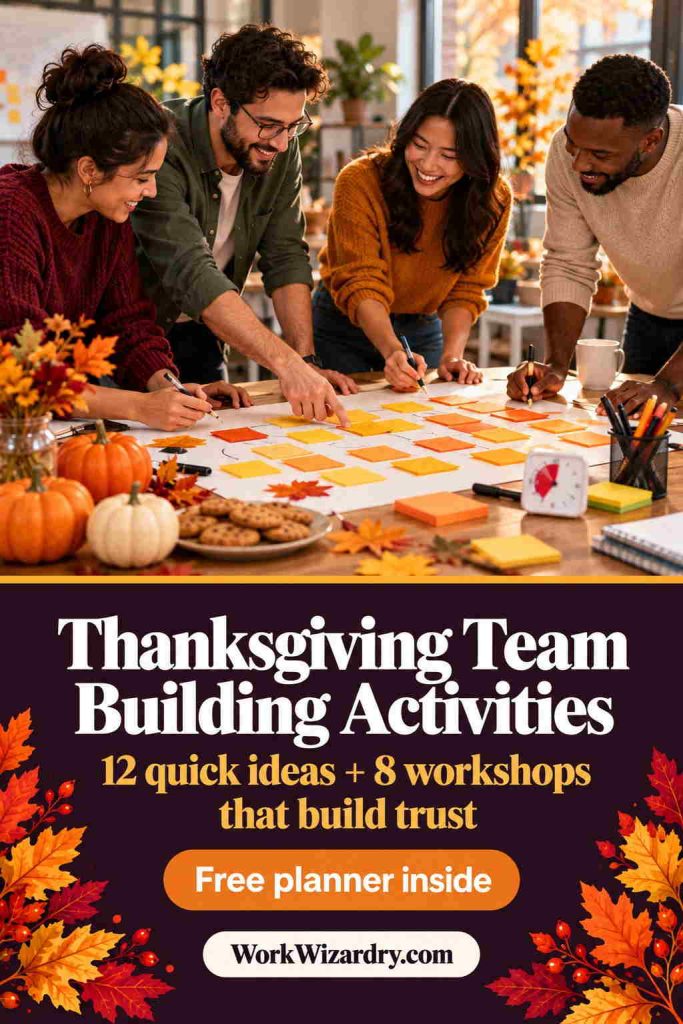
Find Your Thanksgiving Team Building Activity in 30 Seconds
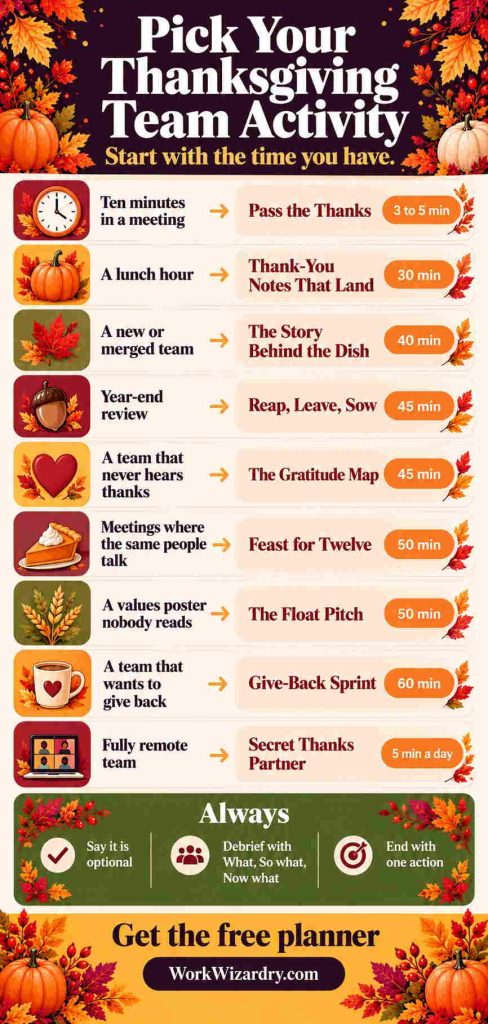
Use this table to pick by time, team type or goal. Details for each are below.
| Your situation | Start with | Time |
|---|---|---|
| Ten minutes in a meeting | Pass the Thanks or One-Word Harvest | 3 to 5 min |
| A lunch hour | Thank-You Notes That Land, then lunch | 30 min |
| A new or merged team | The Story Behind the Dish or The Harvest Table | 40 to 50 min |
| Year-end review | Reap, Leave, Sow | 45 min |
| A team that never hears thanks | The Gratitude Map | 45 min |
| Meetings where the same people talk | Feast for Twelve | 50 min |
| A values poster nobody reads | The Float Pitch | 50 min |
| A team that wants to give back | Give-Back Sprint | 60 min |
| Fully remote team | Thank-You Notes That Land, Secret Thanks Partner | 5 to 30 min |
Why Thanksgiving Works for Team Building
A holiday that is about gratitude gives you permission to do things teams normally skip, and the best team building activities for Thanksgiving use that permission. Thanking a colleague by name feels awkward in March and natural in November. People expect a break from the usual agenda, so a 30-minute session does not feel like a meeting in disguise.
There is research behind gratitude between teammates, with limits. A 2022 study from UC San Diego’s Rady School of Management, reported by the university, paired about 200 students with suitemates, who stood in for coworkers. Teams that briefly thanked each other before a stressful pitch task showed healthier cardiovascular stress responses than teams that did not. It was a lab study with students and a short task, so treat it as encouraging, not as a promise about your team.
On team building in general, a 2009 meta-analysis of team-building studies by Klein and colleagues in Small Group Research found positive effects on team outcomes. Summaries of that work point to role clarification and goal setting as the most useful parts. So the best activities are not the loudest ones. They are the ones that help people see each other’s work, share what they know and agree what happens next.
How This Page Is Organized: Notice, Thank, Build, Give
Thanksgiving gratitude team building is the thread through all eight workshops, and they follow four simple aims:
- Notice. See the work and strengths that usually go unseen. (The Gratitude Map, The Harvest Table)
- Thank. Say thanks in a way people believe. (Thank-You Notes That Land, Reap, Leave, Sow)
- Build. Work, think and decide together. (Feast for Twelve, The Float Pitch, The Story Behind the Dish)
- Give. Do something good together. (Give-Back Sprint)
The best thanksgiving activities for team building all aim at one of those four. If you only run one, run the one that matches the biggest gap on your team. If you are not sure, Thank-You Notes That Land is the easiest first step.
12 Quick Thanksgiving Team Activities (2 to 30 Minutes)
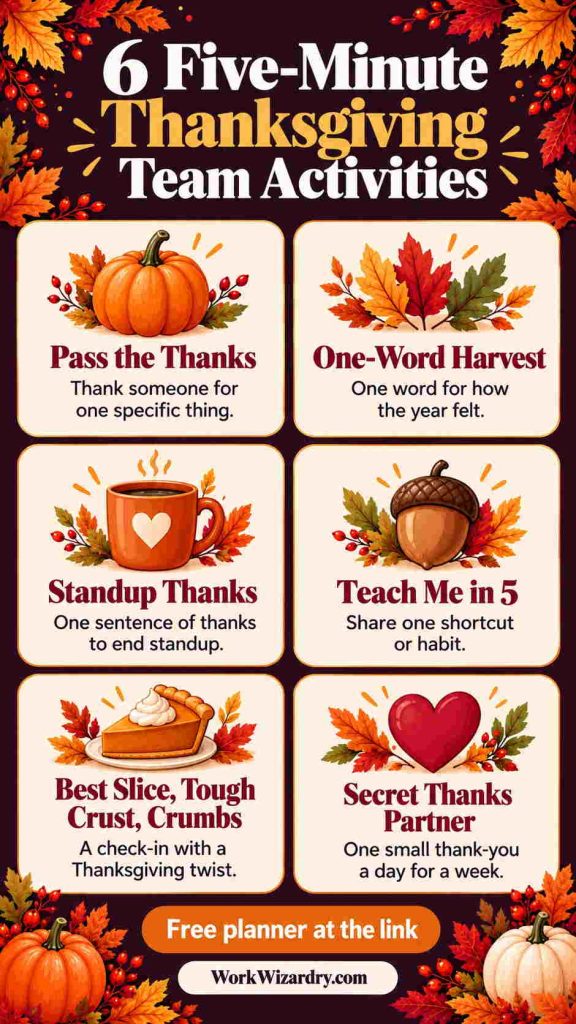
These fit inside a meeting, a standup or a lunch break and need almost no prep. They also make good gratitude team building activities on days when you do not have an hour. Fun Thanksgiving team building activities do not have to be big. Each one is a printable card in the kit.
Quick activities to say thanks
| Activity | How it works | Time and size |
|---|---|---|
| Pass the Thanks | Pass a small pumpkin. The holder thanks someone for one specific thing, then passes it on. | 5 min, 5 to 20 people |
| Appreciation Hot Seat | One person sits ‘in the seat’ per meeting. Teammates give one specific thank-you each. Rotate weekly. | 10 min, 4 to 12 people |
| Secret Thanks Partner | Each person is secretly assigned someone and leaves one small, specific thank-you each day for a week. Reveal on Friday. | 5 min a day, 6 to 40 people |
| Standup Thanks | End the daily standup with one sentence of thanks for a specific thing from the day before. | 2 min a day, 3 to 12 people |
| Desk-Drop Thank You | Leave a note and a small treat at three desks, chosen by a name draw. No names on the notes. | 10 min, any size |
| Thanks Across Teams | Each day, one team receives a short thank-you from another team in a shared channel. Keep a running list. | 5 min a day, two or more teams |
Quick activities to connect and share
| Activity | How it works | Time and size |
|---|---|---|
| One-Word Harvest | Everyone says one word for how the year felt, with no explaining. The leader goes first. | 3 min, any size |
| Teach Me in 5 | One person teaches a shortcut, tool or habit in five minutes. Thank them with a question. | 5 to 15 min, any size |
| Recipe of the Team | In pairs, describe the team as a dish: the ingredients, the cooking method and the secret spice. Share the best three. | 10 min, pairs |
| Best Slice, Tough Crust, Crumbs | Each person names the best slice of their week, the toughest crust and a small crumb they were glad of. | 10 min, any size |
| Trade Places Lunch | Seat people at lunch across teams using a seating draw. Add one conversation card per table. | 30 min, 10 to 60 people |
| Silent Gratitude Gallery | Everyone brings a photo or object they are grateful for. Walk the gallery silently, then talk in pairs. | 15 min, any size |
Remote note: every activity above works over video or chat except Trade Places Lunch and Desk-Drop Thank You, which need a shared space. Replace those with a shared thank-you channel and a mailed note.
8 Thanksgiving Team Building Workshops (30 to 60 Minutes)
Each workshop below has a time, group size, outcome and timed steps, so you can run it without a script. Looking up team building activities for work Thanksgiving week usually returns lists of games. These eight have a point. Debrief questions turn the activity into something the team uses, and every workshop ends with actions that have an owner and a date.
How to use this section: pick one workshop, print the materials or use a whiteboard, read the ground rules aloud and keep the debrief. The kit has the full facilitator script and a ready-made version of every printed item.
1. The Gratitude Map
Make the help nobody sees visible.
- Time: 45 minutes
- Group size: 4 to 24
- Outcome: Recognition of hidden work and who depends on whom
- Best for: Teams where a lot of the work is help given to each other: support, operations, project teams
- You need: Gratitude Map poster (printed large) or a whiteboard; sticky notes in two colors; markers; thank-you note cards (in the kit)
Prep
- Write every team member’s name, and the names of two or three partner teams, around the edge of the map before people arrive. Leave nobody out.
- Decide the period you are looking back on: this year, this quarter or one project.
- Tell the team a few days ahead so nobody is surprised.
How it runs
- Welcome and ground rules (5 min). Say the goal: see who helps whom, and thank people properly. This is not a ranking. Read the ground rules.
- Silent writing (8 min). Everyone writes three notes: Thank you to [name or team] for [one specific thing]. One thing per note. Use color one for people and color two for partner teams.
- Place the notes (10 min). Stick each note next to the name it is for. Read other notes as they go up.
- Read the map (7 min). Stand back. Where are the thick clusters? Which names have almost nothing? Which names appear in many notes (a lot of the team leans on them)?
- Close the loop (10 min). Each person picks one of their notes and says it to the person, or writes it on a thank-you card with the Specific, Seen, Mattered formula. Leaders go first.
- One action (5 min). Agree one change: thank the quiet names, share the load of the person everyone leans on, or write down a hidden task so it gets noticed.
Debrief questions
- What surprised you about the map?
- Who is carrying a lot of invisible help, and how would we know if they were overloaded?
- Which names have few notes, and what might that mean? (Quiet work is not no work.)
Remote version: Use a shared whiteboard with names pre-placed in columns and a sticky color per person. Do the ‘read the map’ step as a screen share and use breakout rooms of three for closing the loop.
Watch out for: Counting notes as a score. Say clearly that the number of notes is not a performance measure.
The printable Gratitude Map poster and thank-you slips are in the Thanksgiving Gratitude Workshop Kit.
2. Thank-You Notes That Land
Learn to thank people so they feel it.
- Time: 30 minutes
- Group size: 3 to 60
- Outcome: A habit of specific, believable appreciation
- Best for: Any team, and especially teams that say thanks a lot but feel generic
- You need: Thank-you note cards (four per page in the kit); specific, seen, mattered formula card; name slips for the draw; pens
Prep
- Print the cards and the formula card. Cut the name slips, one per person.
- Pick a leader who will go first and write a real note in front of the team.
- Plan how the notes will be delivered (by hand, in a folder, or by message).
How it runs
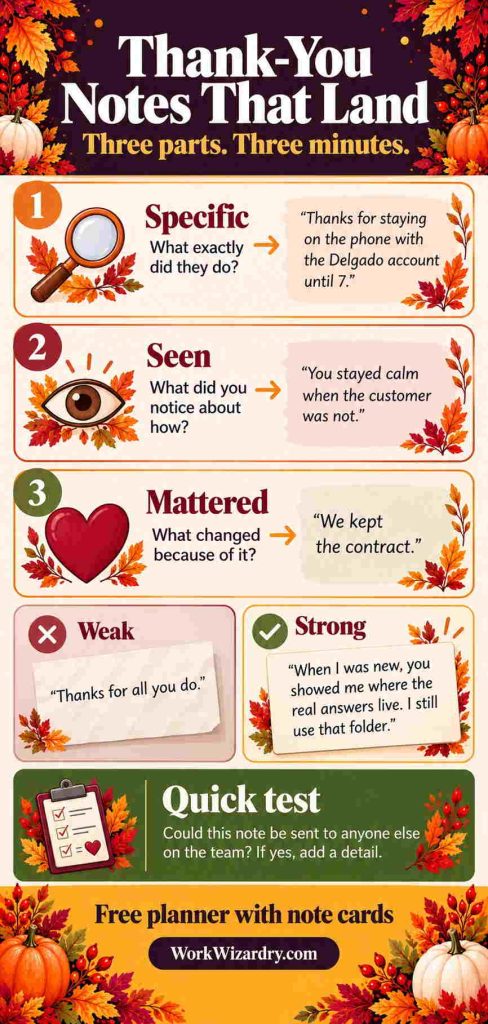
- Show the formula (4 min). Read the formula: Specific (what exactly did they do), Seen (what did I notice about how they did it), Mattered (what changed because of it). Compare a weak note with a strong one.
- Draw names (3 min). Each person draws a name slip. If you draw yourself, swap. Everyone also writes one wild card note to someone outside the team.
- Write (10 min). Write the note using the formula. Aim for three or four sentences, not a paragraph. Write by hand if you can.
- Peer check (5 min). Swap the draft with a partner (not the person it is for). Ask one question: could this have been written about anyone? If yes, add a detail.
- Deliver (5 min). Hand the notes over or send them at the same moment. Leaders deliver first.
- Close (3 min). Share one sentence about how it felt to write, or to receive, a specific note.
Debrief questions
- What made this harder than writing a normal thank-you?
- What did you notice about the person that you had never said out loud?
- Was there a note you received that you will keep? Why?
Remote version: Run the same steps with the notes sent by direct message or email at a set time. For video calls, ask each person to read the first line of the note they received.
Watch out for: Notes that say ‘thanks for all you do’. The peer check step is there to catch these.
The formula card, name slips and eight note cards are in the kit. The free planner has the formula and two cards to try.
3. The Harvest Table
Lay out what each person brings to the team.
- Time: 50 minutes
- Group size: 6 to 30
- Outcome: A shared picture of strengths, gaps and who can help whom
- Best for: New teams, merged teams and teams where people do not know each other’s skills
- You need: Harvest Table poster (printed large); dish cards (in the kit); markers; dot stickers
Prep
- Print the poster at the largest size you can, or draw the five zones on a whiteboard: Starters, Mains, Sides, Desserts, and Wish List.
- Print the dish cards. Four per person is plenty.
- Write one example dish card yourself, such as ‘I bring: calming an angry customer’.
How it runs
- Welcome and ground rules (5 min). Explain the idea: each of us brings a dish to the team table. Show your example card.
- Write your dishes (10 min). Each person writes three dish cards (a skill, a strength or a habit that helps the team) and one wish card: a dish we wish the team had.
- Set the table (10 min). Place the cards in the zones: Starters (getting work going), Mains (core delivery), Sides (support), Desserts (people and culture), and Wish List.
- Look at the table (10 min). Which zone is crowded? Which is bare? Which skills only one person has? Which wishes can someone already fill?
- Trade a dish (10 min). Match each wish card with an offer. Pairs agree a small skill trade: a 30-minute teach-in, a shadow session or a standing question time.
- Close (5 min). Write the trades on the action sheet with names and dates.
Debrief questions
- What surprised you about what teammates bring?
- Which dish are we relying on one person for?
- Which wish did we find we already had on the team?
Remote version: Use a shared whiteboard with the five zones. Each person has a sticky color. Move the match-making step into pairs in breakout rooms.
Watch out for: People writing only job skills. Prompt for habits and personal strengths too.
The Harvest Table poster, dish cards, wish cards and trade sheet are in the kit.
4. Reap, Leave, Sow
A harvest retrospective for the year.
- Time: 45 minutes
- Group size: 4 to 20
- Outcome: A clear review of what worked, what to stop and what to plant
- Best for: The end of a project, quarter or year
- You need: Reap, Leave, Sow poster (printed large); sticky notes in three colors; markers; dot stickers
Prep
- Print the poster or draw three columns on a whiteboard.
- Choose the period you will review.
- Gather two or three facts so the discussion starts from what happened.
How it runs
- Welcome (5 min). Explain the zones: Reaped (what worked and we want more of), Left in the field (what we started and did not finish, or should stop), Sown (seeds to plant for next season).
- Silent writing (10 min). Everyone writes notes for each zone, one idea per note.
- Share and cluster (10 min). Read the notes aloud and group similar ones.
- Vote (8 min). Each person gets three dots for the notes that matter most.
- Turn votes into actions (10 min). Take the top note in each zone and write an action, an owner and a date.
- Close (2 min). Thank people for honest notes and book a date to look at the actions.
Debrief questions
- What is the most important thing to keep doing?
- What are we ready to stop, and who will say so?
- Which seed is worth a small test?
Remote version: Use a shared board with three columns and a voting feature. Allow anonymous notes if the team is cautious.
Watch out for: Too many actions. Pick three.
The retro board and action sheet are in the kit.
5. Feast for Twelve
Solve it together, because nobody holds the full picture.
- Time: 50 minutes
- Group size: 3 to 30
- Outcome: Information sharing and listening in a team
- Best for: Teams that decide in meetings with only some of the information, or where the loudest voice wins
- You need: Puzzle A clue cards: Seats at the Table (12 cards); puzzle b clue cards: the oven schedule (12 cards); team answer sheets (one for each puzzle); answer keys (kept in an envelope)
Prep
- Print and cut the clue cards. Put each puzzle’s cards in a separate envelope for each table of six.
- Keep the answer keys sealed until the end.
- Check table sizes. For a team of fewer than six, deal the 12 cards evenly (see the deal table in the playbook).
How it runs
- Welcome and rules (5 min). Explain that each person holds some of the clues and nobody holds enough to solve it alone. You may read your cards aloud. You may not hand them over or show them. You can write anything on the answer sheet.
- Round one: Seats at the Table (15 min). Six colleagues must be seated in a row. Teams use the clues to find the one correct order. Stop when a team says it is done, or at 15 minutes.
- Check and share (5 min). Hand out the answer key. Teams check themselves. No score is taken, but note how long each team took.
- Round two: The Oven Schedule (12 min). New rule: one person is the Scribe and may write but not speak. Everyone else may speak but not write. Six dishes must go into the oven in the correct order.
- Check (5 min). Check against the key. Compare round one and round two.
- Debrief (8 min). Use the questions to talk about how the team shared information.
Debrief questions
- Did anyone hold back a clue because it seemed small? Why?
- What system did the team find for collecting clues, and how long did it take?
- Who talked most? Who talked least? What would have helped the quiet clues be heard?
Remote version: Send each person their clue cards by private message. Use a shared document for the answer sheet and breakout rooms of six. The Scribe types in the shared document.
Watch out for: Handing out the answer key early. Keep it sealed.
Both puzzles, all 24 clue cards, the answer sheets, a dealing guide and sealed answer keys are in the kit. Each puzzle was checked by computer and has exactly one solution. (The name comes from the twelve clue cards in each puzzle.)
6. The Float Pitch
Design a parade float for what your team stands for.
- Time: 50 minutes
- Group size: 8 to 30
- Outcome: Shared values, made concrete
- Best for: Teams that have a values poster nobody remembers, and new or merged teams
- You need: Float template (in the kit); value cards; colored pens and markers; scrap paper, scissors and tape (optional)
Prep
- Print one float template per team (teams of four or five).
- Print the value cards and spread them on a table.
- Decide the award categories before the session so every team wins something.
How it runs
- Welcome and brief (5 min). Explain: a Thanksgiving parade float shows what a group is proud of. Each team will design one for what the team stands for, using a value card.
- Choose a value (5 min). Teams pick one value card (or write their own) and agree what it looks like on a normal Tuesday.
- Design the float (20 min). Draw the float on the template: what it carries, the banner, a slogan, and one real example from the team’s work.
- Pitch (10 min). Each team has 90 seconds to pitch its float to the others. Everyone else listens for one detail.
- Awards (5 min). Give every team a category, such as Most Thankful, Most Surprising or Best Teamwork. Read the certificates aloud.
- Debrief (5 min). Use the questions to connect the floats to everyday work.
Debrief questions
- What did your float say about how we want to work?
- Which float had a detail you recognized from real life?
- Which value is easiest to say and hardest to do?
Remote version: Use a slide with a blank float template per team and breakout rooms. Pitches are 90 seconds on a screen share.
Watch out for: Awarding one winner and leaving others flat. Every team gets a category.
The float template, 12 value cards, pitch planner and six award certificates are in the kit.
7. The Story Behind the Dish
Share a story that explains something about you.
- Time: 40 minutes
- Group size: 4 to 20
- Outcome: Belonging and understanding across roles and backgrounds
- Best for: Teams that work together every day but know very little about each other
- You need: Story planner cards; listener cards; ‘something i heard’ slips; pens
Prep
- Prepare your own story and go first.
- Print the story planner cards, listener cards and the slips.
- Decide on groups of four, mixing roles.
How it runs
- Welcome and ground rules (5 min). Explain: share a story about a meal, a tradition or an object that means something to you. It can come from any holiday or none. Passing is fine. We keep it about ‘what this taught me’, not about personal pain.
- Plan a story (5 min). Use the card to jot three words: the dish or object, the person or place, and what it taught you.
- Tell stories in groups of four (18 min). Two minutes each. Listeners stay quiet, then each writes one ‘Something I heard’ slip and reads it back in one sentence.
- Whole-group themes (7 min). Each group names one theme it heard, such as patience, hospitality or improvising.
- Close (5 min). Everyone gives their ‘Something I heard’ slip to the storyteller as a keepsake.
Debrief questions
- What did you learn about a teammate that you did not know?
- What themes ran across the stories?
- What helped you feel comfortable sharing?
Remote version: Use breakout rooms of four. Cameras are optional. Slips can be sent as direct messages.
Watch out for: Assuming everyone celebrates Thanksgiving or eats the same foods. Offer ‘a meal that mattered’ or ‘an object’ as choices.
Story planner cards, listener card, ‘Something I heard’ slips and 12 prompt cards are in the kit.
8. Give-Back Sprint
Plan and run a small giving project together in 60 minutes.
- Time: 60 minutes
- Group size: 8 to 40
- Outcome: Shared purpose and cooperation under a deadline
- Best for: Teams that want to do something good together, and not just talk about it
- You need: Sprint plan sheet; role cards (six per team); count tally sheet; supplies for the chosen project
Prep
- Choose the project before the session and ask the receiving organization what it actually needs (see the checklist in the kit).
- Buy or collect supplies within the budget you set.
- Decide if the project is held in work time. It should be.
How it runs
- Welcome and project brief (5 min). Explain what the project is, who it helps and what the receiving group asked for.
- Plan roles (10 min). Teams use the sprint plan to assign six roles: lead, supplies, packing line, quality check, delivery and storyteller.
- Run the sprint (25 min). Assemble or write for 25 minutes. The quality-check person makes sure each item meets the request.
- Count and photograph (5 min). Count what you made. Photograph the items, not the faces.
- Plan delivery and follow-up (5 min). Decide who will deliver, when, and how the team will hear back.
- Debrief (10 min). Talk about how the team worked, as well as what it made.
Debrief questions
- How did the team organize itself in the first five minutes?
- Which role mattered more than we expected?
- What would we change about the planning step next time?
Remote version: Run a remote version where each person assembles a kit at home or writes a card, and the team uses a shared sheet to count. Ship or deliver the items together.
Watch out for: Showing up with goods the charity did not ask for. Always ask first.
The sprint plan, six role cards, count sheet, questions for the organization and a thank-you card are in the kit.
Thanksgiving Team Building Activities by Team Type
Thanksgiving office team building activities should fit the team in the room. Different teams need different starting points. This table is a fast guide.
| Team | Start with |
|---|---|
| New team | The Story Behind the Dish, The Harvest Table, The Float Pitch |
| Remote team | Thank-You Notes That Land, The Gratitude Map, Reap, Leave, Sow |
| Hybrid team | Thank-You Notes That Land, Feast for Twelve (shared document) |
| Managers and leaders | Reap, Leave, Sow, The Gratitude Map, Thank-You Notes That Land |
| Shift or frontline team | Pass the Thanks, Thank-You Notes That Land (15-minute version), Secret Thanks Partner |
| Cross-team group | The Gratitude Map (cross-team), Feast for Twelve, Give-Back Sprint |
| Large group (30 or more) | Any workshop at tables of five or six, with one facilitator per six tables |
Virtual and Remote Thanksgiving Team Building Activities
Remote and hybrid teams often feel the holiday least, so a short session can matter more for them. If you search for thanksgiving team building activities virtual teams can join, look for ones that are short and structured. The best virtual team building activities for Thanksgiving are short, structured and optional, with cameras off if people prefer. Thanksgiving themed virtual team building activities should be about doing something together, not watching one person talk. Remote team building activities Thanksgiving teams enjoy most are the thank-you ones. Here is how each workshop fits, and which tool you need.
| Workshop | Remote fit | What to use |
|---|---|---|
| The Gratitude Map | Works well | Whiteboard with names in columns |
| Thank-You Notes That Land | Best remote option | Direct message or email at a set time |
| The Harvest Table | Works well | Whiteboard with five zones |
| Reap, Leave, Sow | Works well | Board with a voting feature |
| Feast for Twelve | Works well | Breakout rooms of six and a shared document |
| The Float Pitch | Works well | One slide per team |
| The Story Behind the Dish | Works well | Breakout rooms of four, cameras optional |
| Give-Back Sprint | Needs a twist | Each person builds a kit at home, count in a shared sheet |
Five tips for virtual Thanksgiving team building:
- Keep it under 45 minutes. Thanksgiving online team building activities need less talking and more doing, because video tires people faster than a room does.
- Use breakout rooms of three or four with a clear task and a timer.
- Make cameras optional. Never require them.
- Send materials in advance. PDFs and a link to the board remove delays.
- Mail one thing. A small card or treat to every remote person makes a remote team building activity feel real. Keep it the same for everyone.
Thanksgiving Team Building for a Large Group
Large group team building activities Thanksgiving week work best at tables of five or six, with the same task at every table. Plan one facilitator for every six tables and a shared timer on a screen. Feast for Twelve and The Float Pitch both work well for larger groups, because the thinking happens in small teams and only the pitches or answers are shared. For 30 or more people, use two-minute table summaries so the debrief stays short.
Three Sample Thanksgiving Team Building Agendas
A good team building activity for Thanksgiving fits the time you actually have. These three agendas show how.
30-minute lunch session
| Minutes | Step | Notes |
|---|---|---|
| 3 | Welcome and ground rules | Say the outcome and that it is optional |
| 4 | The formula | Specific, Seen, Mattered with examples |
| 13 | Write notes | Draw names and write by hand |
| 5 | Peer check and delivery | Leader goes first |
| 5 | Debrief and close | Pick a day to repeat it |
60-minute team hour
| Minutes | Step | Notes |
|---|---|---|
| 5 | Welcome, rules and One-Word Harvest | Leader goes first |
| 35 | Reap, Leave, Sow (shortened) | Silent writing, cluster and vote |
| 15 | Actions and close | Three actions, owners and dates |
| 5 | Thank-you round | Pass the Thanks |
90-minute team half-session
| Minutes | Step | Notes |
|---|---|---|
| 5 | Welcome and ground rules | Outcome in one sentence |
| 10 | Recipe of the Team | Pairs warm-up |
| 40 | Feast for Twelve | Two puzzle rounds |
| 10 | Break | Stretch and refill |
| 20 | Debrief and action planning | What, So what, Now what |
| 5 | Close | Say thanks |
A Four-Week Thanksgiving Team Building Plan
If you have a month, spread the work out. Short, regular activities build a habit that one big event cannot.
| Week | Run | Between |
|---|---|---|
| Week of Nov 2 | Notice the work: The Gratitude Map | Start Secret Thanks Partner for the week |
| Week of Nov 9 | Say thanks well: Thank-You Notes That Land and The Story Behind the Dish | Standup Thanks all week |
| Week of Nov 16 | Work together: Feast for Twelve or The Harvest Table | One Teach Me in 5 session |
| Week of Nov 23 | Give back and look ahead: Give-Back Sprint or Reap, Leave, Sow | Send the follow-up email and repeat the survey one week later |
How to Run Thanksgiving Team Building Well
Thanksgiving team building activities work best when someone facilitates them well. Good facilitation matters as much as the activity, and these six habits do most of the work:
- Say the outcome in one sentence. “Today we are going to make sure everyone’s help gets noticed.”
- Say it is optional, and mean it. Pass is always allowed.
- Read the ground rules. We talk about situations, not blame. What is said here stays here. What is learned leaves with us.
- Go first. In any sharing step, the leader goes first and keeps it small.
- Debrief with three questions. What happened? So what? Now what?
- Write the actions down. Owner, date and a date to check.
What, So what, Now what
- What? What happened? What did you notice?
- So what? Why does it matter? What did it show us?
- Now what? What will we do differently? Who, what, by when?
Make It Inclusive
Thanksgiving means different things to different people. A few simple choices keep thanksgiving workplace team building welcoming:
- Call it a gratitude session, not a holiday party, and say plainly that it is optional.
- Do not assume everyone celebrates or has family to be with. Offer ‘a meal that mattered’ or ‘an object’ as storytelling choices.
- Do not ask people to dress as Pilgrims or Native Americans, and avoid decorations that turn a culture into a costume. November is Native American Heritage Month, and some people mark Thanksgiving as a National Day of Mourning.
- Check food: allergies, religious diets and budgets. Keep food optional.
- Include shift workers. Run a short session on each shift, or pay for their time.
- Avoid personal questions about family, health, religion, politics or money.
- Check accessibility: seating, reading, hearing and mobility.
Fun Thanksgiving Office Team Bonding Activities Without the Cringe
Thanksgiving team bonding activities do not have to be cringe. If your team groans at forced fun, lean on these three principles. And if you want Thanksgiving team building activities games, Feast for Twelve and The Float Pitch are the two playful ones.
- Small groups, not performances. Pairs and fours feel safer than speaking to the room.
- A task, not a confession. Feast for Twelve and The Float Pitch give people something to do.
- An easy exit. Pass should always be allowed and no explanation needed.
How to Tell If It Worked
Ask five anonymous questions before the first session and again a week after the last one, rating each from 1 to 5:
- I know what my teammates appreciate about my work.
- I feel comfortable telling a teammate when I need help.
- Our team thanks people for specific things, not only big wins.
- I know who to ask when I get stuck.
- I feel part of this team.
Compare the averages. Small changes are normal. With fewer than five responses, do not read individual patterns. The free planner has a page for this, and the kit includes an Excel analyzer. Also watch what people do: more specific thank-yous, fewer repeated conversations and actions that get done.
Free Thanksgiving Team Building Planner (Printable)
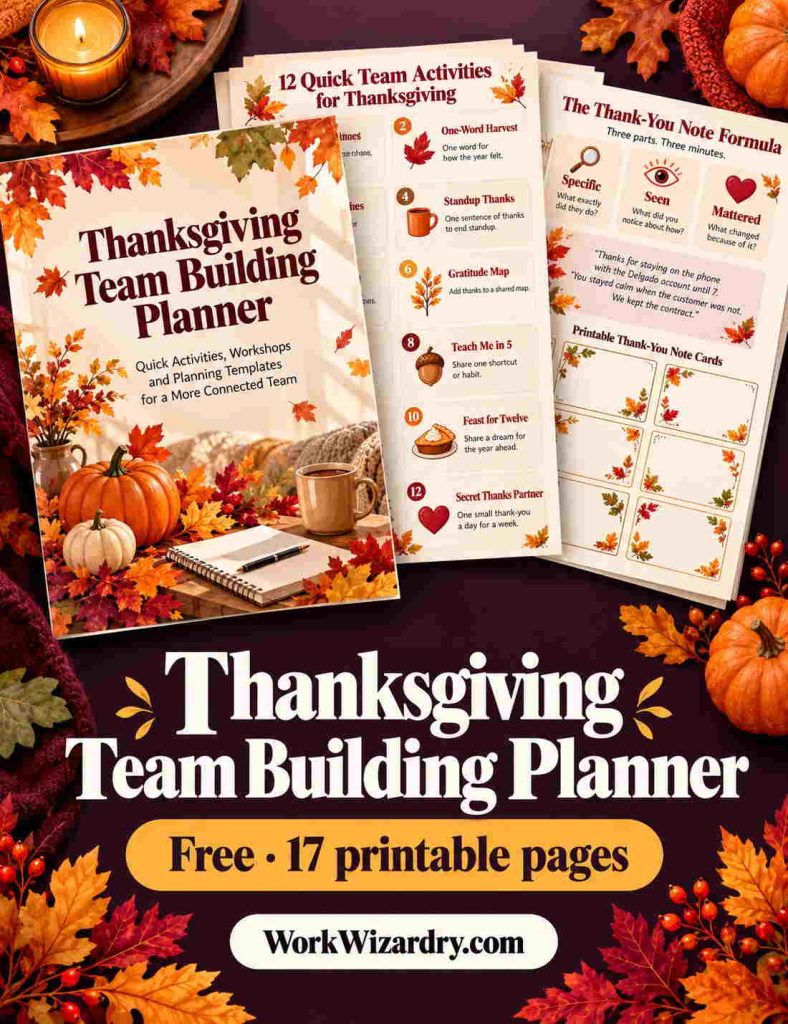
Want to plan a session today? The free Thanksgiving Team Building Planner has 17 pages in US Letter and A4:
- A goal chooser for all eight workshops
- The 12 quick activities on one page
- The thank-you note formula and two note cards to try
- A session planner and ground rules card
- Debrief cards and a pulse survey
- 30, 60 and 90-minute agendas
- An invitation message and a four-week calendar
- An action tracker, an accessibility and inclusion checklist and a feedback form
The Thanksgiving Gratitude Workshop Kit ($14.99)
If you want to run the workshops without building materials, the Thanksgiving Gratitude Workshop Kit has everything:
- 8 workshop playbooks with scripts, debriefs and a dealing guide
- Printable materials: the Gratitude Map, note cards, Harvest Table, retro board, two puzzles with 24 clue cards and sealed answer keys, a float template, value cards, award certificates, story cards and a give-back planner
- A facilitator handbook with method, ground rules, difficult moments, remote delivery and inclusion checks
- Workshop screens in 16:9 for screen share or projector
- A pulse survey Excel analyzer to compare before and after
- Word templates for the invitation, reminder, manager brief, follow-up, action plan and survey
- 12 quick activity cards
Every PDF comes in US Letter and A4. For use with your own team. A free four-page preview is available before you buy.
More Thanksgiving Ideas for Work
- Thanksgiving ideas for employees: the planning hub, with 57 ideas by budget, time and team
- Thanksgiving potluck ideas for the office: dishes, amounts and a sign-up plan
- Thanksgiving quotes for work: quotes and captions for cards and posts
- Thanksgiving messages to employees: messages for staff and teams
- Thanksgiving trivia for work and Thanksgiving ice breaker questions for work: quick conversation starters
- Thanksgiving contest ideas for work: friendly competitions
If you are planning a giving project, Feeding America’s food bank finder lets you search by zip code, and a call to your local food bank will tell you what they need most.
Frequently Asked Questions About Thanksgiving Team Building Activities
What are good Thanksgiving team building activities for work?
The best ones build something your team will use after the holiday: appreciation, shared strengths or better information sharing. Good options are a gratitude map, a thank-you note exercise with a formula, a harvest-style retrospective and a small giving project. A potluck is a good lunch, but on its own it is not team building.
How long should a Thanksgiving team building activity be?
Between 3 and 60 minutes. Quick activities such as Pass the Thanks take 3 to 5 minutes inside a normal meeting. The full workshops run 30 to 60 minutes. Anything longer than an hour usually needs a break and a bigger commitment from the team.
What are the best Thanksgiving team building activities for adults?
Choose activities with a point and an easy way to opt out. Thank-You Notes That Land, The Harvest Table and Reap, Leave, Sow suit adult teams because they are practical and nobody has to perform. Avoid forced sharing, costumes and anything that asks about family.
What are some virtual Thanksgiving team building activities?
Thank-You Notes That Land, Secret Thanks Partner and The Harvest Table all work well online. Use a shared whiteboard for the maps and boards, breakout rooms of three or four for conversation and direct messages for notes. Keep cameras optional and the session under 45 minutes.
How do I run Thanksgiving team building with a large group?
Split people into tables of five or six and give each table the same task. Use one facilitator for every six tables, run a shared timer on a screen and gather one idea per table at the end. Feast for Twelve and The Float Pitch both scale well because the work happens in small groups.
What are fun Thanksgiving team building games?
Feast for Twelve is a clue-sharing puzzle where each person holds part of the information. The Float Pitch is a design challenge with 90-second pitches. Both are playful, and both end with a debrief that links the game to real work.
Can we do team building if not everyone celebrates Thanksgiving?
Yes, and you should plan for it. Call the session a gratitude or team session rather than a holiday event, make it optional, avoid assumptions about family and food, and offer choices in storytelling such as ‘a meal that mattered’ or ‘an object from home’. Do not ask people to dress as Pilgrims or Native Americans.
How much do Thanksgiving team building activities cost?
Most need pens, paper and sticky notes, so usually $0 to $3 per person. The Give-Back Sprint costs whatever you set as the project budget. The biggest cost is paid time, and you should run sessions during work hours.
Does team building actually work?
It can, when it is tied to a clear goal and followed up. A 2009 meta-analysis of team-building studies by Klein and colleagues found positive effects, with role clarification and goal setting among the most useful parts. A one-off fun afternoon with no follow-up tends to fade.
How do I know if a team session worked?
Ask the same five questions before and after, anonymously, and compare the averages. The free planner has a pulse survey page, and the kit has an Excel analyzer. Also look for behavior: more specific thank-yous, fewer repeated meetings and actions that get done.
What is the difference between team building and a Thanksgiving party?
A party is about enjoying time together. Team building has an outcome, such as clearer roles, better thanks or shared goals, and a debrief that turns the activity into action. You can do both on the same day: run a 30-minute session and then eat.
Can I use these with a team of three or four?
Yes. Quick activities work for any size. Among the workshops, Thank-You Notes That Land, The Story Behind the Dish and Reap, Leave, Sow suit small teams. For Feast for Twelve, deal the clue cards evenly, so each person holds three or four.
Sources: UC San Diego, Gratitude expressions between co-workers improve cardiovascular responses to stress (2022), read through the university’s summary; Klein, DeRouin, Salas and colleagues, Does team building work? Small Group Research (2009), read through secondary summaries; Feeding America food bank finder. The workshops, puzzles and cards are original to Work Wizardry.
