
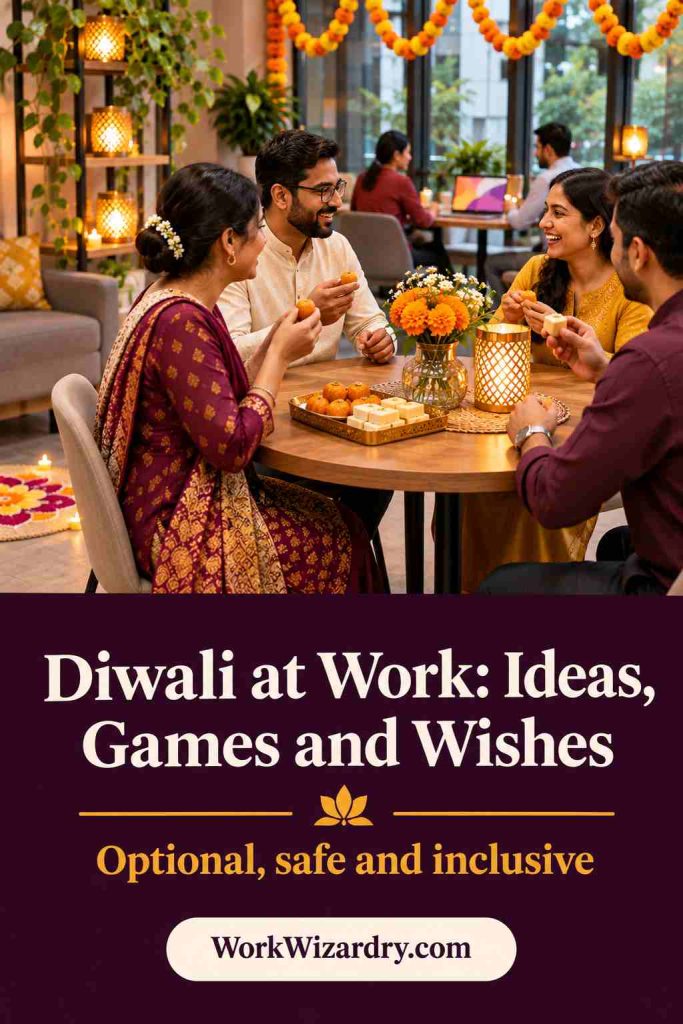
Diwali 2026 is Sunday, November 8. That is a weekend, so the office celebration happens before it (Thursday, November 5 or Friday, November 6) or just after it (Monday, November 9 or later). This guide gives you 30 Diwali celebration ideas for office and work, games that actually work, wishes and emails for colleagues and clients, gift rules, safety and food advice, and the US policy answers HR teams ask about. Everything here is meant to be optional, respectful and easy to run.
Key takeaways
- Date: Diwali is Sunday, Nov 8, 2026. Hold the office event on Thu Nov 5, Fri Nov 6 or Mon Nov 9.
- Optional by default. No one should be required to join, wear anything or explain their beliefs.
- Volunteers, not assignments. Never name the one Indian or Hindu colleague as the organizer or spokesperson.
- Safety first. Use flameless diyas, keep exits clear and ask facilities before you decorate.
- Food: vegetarian by default, labels for allergens, and no alcohol at the center.
- Law: Diwali is not a federal holiday and no federal law makes private employers pay for it. Employers may need to consider time off as a religious accommodation.
Want everything ready to run? The Diwali at Work Celebration Kit has 250+ wishes, 20 emails, a tambola ticket generator, a 100-question quiz and more. Both are optional: this article is complete on its own.
Find Your Best Diwali Celebration Idea in a Minute
| You are | Start with | First move |
|---|---|---|
| An HR or people team | A one-page explainer, a respectful-celebration checklist, a potluck sheet | Send the explainer this week |
| A manager of a small team | A team lunch, a card exchange, a shared wish board | Ask your team what they would like |
| A mixed US office | A short lunch, a rangoli corner, LED diyas, a quiz | Pick a weekday near Diwali |
| An Indian or South Asian-led team | A full potluck, tambola, antakshari, a mithai table | Plan for Thursday or Friday |
| A remote or hybrid team | Bingo, a 10-minute light moment, a recipe swap | Open a channel today |
| A tight budget | Flameless diyas, a card exchange, a wish board | Spend under $50 |
| Frontline or shift workers | A pass-around sweets box and a thank-you card | Give to every shift |
| A business with customers | A short greeting post, a small offer and a charity tie-in | Keep it simple and respectful |
Diwali 2026 Date at a Glance: The Five Days, the Sunday Problem and What It Means
Diwali, also called Deepavali, is the festival of lights. It is widely understood as the victory of light over darkness, and it is observed over five days. In 2026 the main day falls on Sunday, November 8, with the Lakshmi Puja in the evening. The days around it in the United States, Canada and the United Kingdom are:
| Day | Name | What it is |
|---|---|---|
| Fri Nov 6 | Dhanteras | Often seen as the start of the festival, associated with wealth and new purchases |
| Sat Nov 7 | Naraka Chaturdashi (Choti Diwali) | The day before Diwali, with lamps and sweets in many homes |
| Sun Nov 8 | Diwali (Lakshmi Puja) | The main day, with the evening puja and lamps |
| Mon Nov 9 | Govardhan Puja | Observed in many regions the day after Diwali; some communities mark a new year around now |
| Tue Nov 10 | Bhai Dooj | Siblings celebrate their bond |
Calendars in India can differ by a day for some of these days, and the exact puja time depends on the city, so tell colleagues who observe to check a local panchang rather than relying on a general calendar.
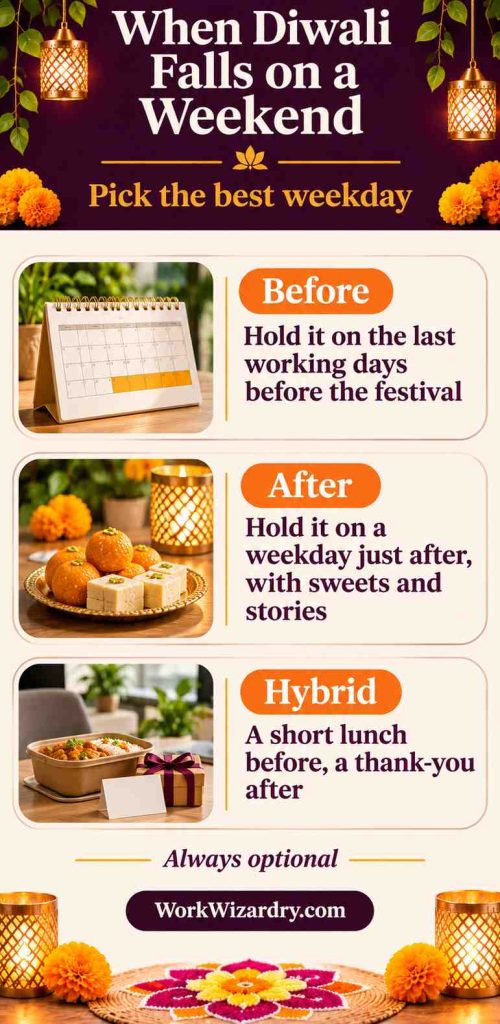
The Sunday problem. Because Diwali is on a weekend, the question is not “should we close” but “when do we celebrate?” The practical answer is to choose a working day close to the festival:
| Option | When | Why |
|---|---|---|
| Before Diwali | Thu Nov 5 or Fri Nov 6 | Many people leave early to prepare at home |
| After Diwali | Mon Nov 9 to Wed Nov 11 | Colleagues come back with sweets and stories |
| Hybrid | Both, short | A small lunch before and a thank-you after |
A Diwali celebration in office hours is easiest on a weekday. A workplace Diwali celebration on a weekend should be family-friendly, optional and clearly outside work time. Avoid Saturday or Sunday unless the event is family-friendly, optional and clearly outside work time. Tell people at least a week ahead, because many colleagues plan travel or family visits around the festival.
It is not only one tradition. Diwali is a festival with many meanings. Do not describe it as one religion’s story.
| Community | What Diwali means |
|---|---|
| Hindu | Festival of lights; stories differ by region, including the return of Rama to Ayodhya and the worship of Lakshmi |
| Jain | Marks the nirvana of Mahavira; observed with prayer and reflection |
| Sikh | Bandi Chhor Divas, remembering the release of Guru Hargobind |
| Newar (Nepal) | Swanti, the Newar festival of lights, is observed around the same time |
| Nepali | Tihar, a five-day festival of lights |
That variety is why a good office celebration focuses on light, food, stories and thanks, and lets colleagues who celebrate say what it means to them if they wish.
Diwali Dos and Don’ts at Work: Eight Rules for a Respectful Celebration
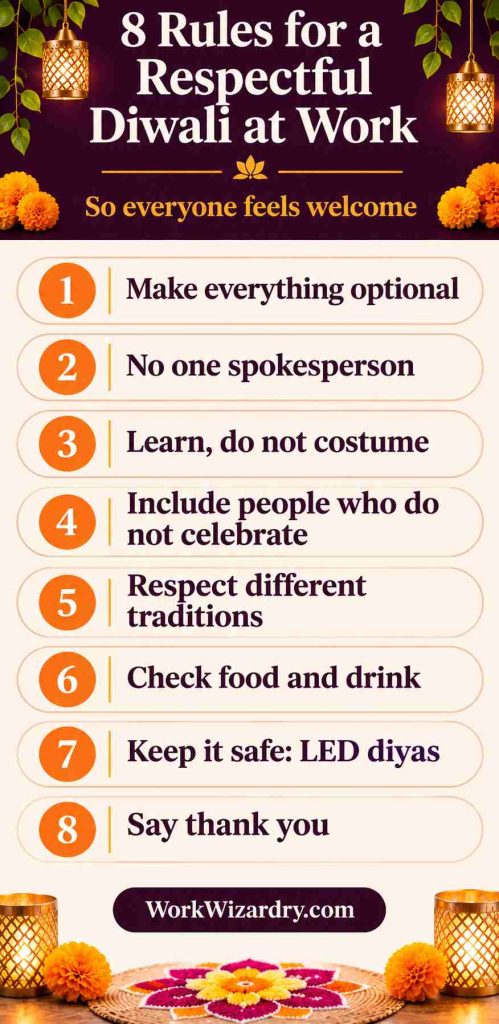
These rules matter more than any single idea, and they are what make an inclusive Diwali celebration possible. They are what separates a celebration that colleagues enjoy from one that feels awkward.
- Make everything optional. No one should be asked to participate, wear anything or explain their beliefs.
- Do not make one person the spokesperson. Ask for volunteers. Never assign the only Indian or Hindu colleague to run it.
- Learn, do not costume. Invite festive clothes if people wish. Do not dress up as a culture or hand out stereotypes.
- Include people who do not celebrate. Frame it as a team celebration of light, food or stories, not a religious ritual for all.
- Respect different traditions. Hindu, Jain, Sikh and Buddhist communities observe it differently. Say so.
- Check food and drink. Vegetarian by default, labels for allergens, no alcohol at the center.
- Keep it safe. Flameless diyas, clear exits, facilities approval.
- Give credit and thanks. Thank the colleagues who helped in public, with their permission.
A simple test: if a colleague who does not celebrate Diwali could join comfortably, and a colleague who does would feel respected, you are on the right track.
Diwali Celebration Ideas for Office and Work, by What They Do
Light and decor: make the space feel like Diwali
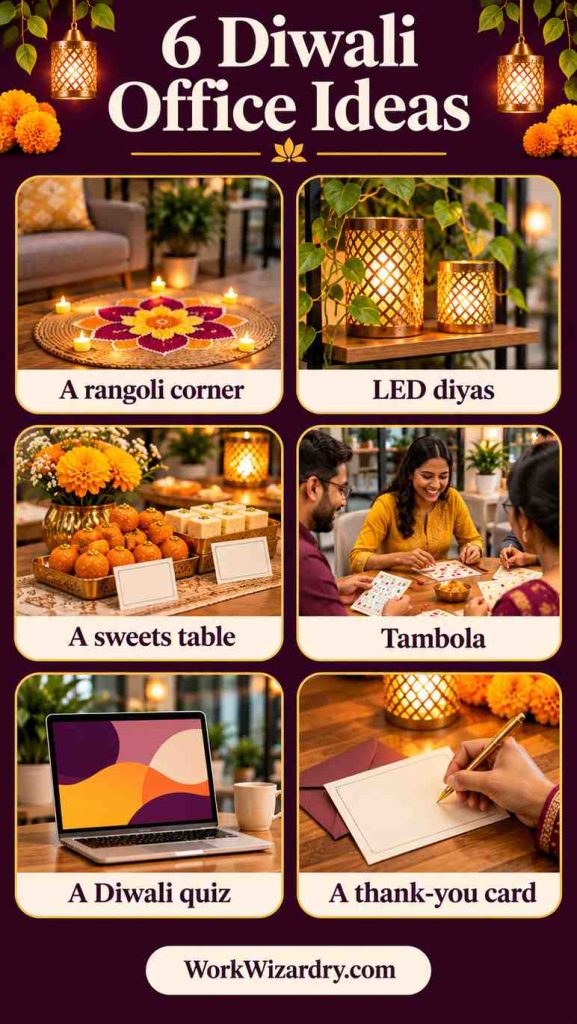
Diwali is the festival of lights, so decor is the easiest place to start and the part most colleagues notice first. Rangoli ideas for office corners, LED diyas and lights all start here. Keep every piece safe, reusable and easy to take down.
At a glance
| Idea | Cost | Time |
|---|---|---|
| A compact rangoli corner at reception | $10 to $40 | 1 to 2 hours |
| Flameless diya display | $15 to $50 | 30 minutes |
| A string-light and marigold garland entrance | $20 to $60 | 1 hour |
| A photo backdrop with a diya and lights | $20 to $80 | 1 hour |
| Employee-made rangoli designs on paper | $5 to $20 | 45 minutes |
| Desk-level lights and a ‘light a lamp’ sign | $10 to $30 | 30 minutes |
| A thank-you torana for the door | $15 to $40 | 1 hour |
| A shared ‘wishes’ tree or board | $5 to $15 | 30 minutes |
1. A compact rangoli corner at reception
Make one small rangoli near the entrance or break area using colored rice flour, flower petals or a reusable rangoli mat. Keep it to a corner or a table top, not the walkway. A set of reusable rangoli stencils helps people who have never made one.
- Why it works: Rangoli is the most recognizable Diwali decoration, and a small one is welcoming without creating a trip hazard.
- Cost: $10 to $40 · Time: 1 to 2 hours
- Best for: Offices of any size
- Watch out: Floor powders get tracked around and can stain carpet. Use a mat, a tray or a table.
- Sample line: “Come and see the rangoli by reception. Everyone is welcome to add a flower petal.”
2. Flameless diya display
Set out battery-powered or LED diyas (a set of 12 LED lotus diyas works well, or flameless LED tea lights on a smaller budget) on a shelf, window ledge or reception desk. Group them in odd numbers and add a short card saying what a diya is.
- Why it works: Real flames are often against fire rules indoors. LED diyas give the same glow with no risk and can be reused every year.
- Cost: $15 to $50 · Time: 30 minutes
- Best for: Any workplace with fire rules
- Watch out: Check the batteries the day before, and never leave real candles unattended.
- Sample line: “These lamps are called diyas. Traditionally they are lit to welcome light and good fortune.”
3. A string-light and marigold garland entrance
Hang warm white battery-powered fairy lights and a marigold garland (real or artificial) around the entrance door or a feature wall.
- Why it works: Marigold garlands are widely used at Diwali in many homes and temples. They are cheap and look festive straight away.
- Cost: $20 to $60 · Time: 1 hour
- Best for: Reception and open-plan areas
- Watch out: Do not overload sockets, cover exits or tape cords across a walkway. Ask facilities first.
- Sample line: “Our entrance has its Diwali lights up from today.”
4. A photo backdrop with a diya and lights
Make a plain backdrop with fairy lights, a fabric drape and a few LED diyas. Invite people to take a photo, in work clothes or festive clothes, entirely optional.
- Why it works: A backdrop gives remote and office staff a shared photo moment and gives marketing something respectful to post.
- Cost: $20 to $80 · Time: 1 hour
- Best for: Hybrid teams and social teams
- Watch out: Photos should be opt-in. Ask before posting any picture of a colleague.
- Sample line: “Photo corner is open until 3. Come as you are.”
5. Employee-made rangoli designs on paper
Print rangoli outlines or give out dotted grids and colored pencils. Colleagues color a design and pin it to a Diwali board.
- Why it works: It gives people who do not celebrate a low-pressure way to join, and costs almost nothing.
- Cost: $5 to $20 · Time: 45 minutes
- Best for: Teams that want participation
- Watch out: Do not ask a Hindu colleague to explain every design. Put a short note on the board instead.
- Sample line: “Pick up a sheet, color a design and pin it to the board.”
6. Desk-level lights and a ‘light a lamp’ sign
Invite people to put a lamp, string light or candle-style LED on their desk or home workspace for the day, and share a photo in a team channel if they wish.
- Why it works: It lets remote colleagues take part without a shared room.
- Cost: $10 to $30 · Time: 30 minutes
- Best for: Remote-first and hybrid teams
- Watch out: Say clearly that it is optional and that LED lights are fine.
- Sample line: “Put a little light on your desk today if you like.”
7. A thank-you torana for the door
Hang a torana, a decorative door hanging often used at the entrance of homes at festivals, at the main door. Fabric or paper versions both work.
- Why it works: Toranas are a traditional welcome. A simple one adds meaning without taking space.
- Cost: $15 to $40 · Time: 1 hour
- Best for: Offices that like a visual theme
- Watch out: Buy from a seller who knows the tradition. Avoid novelty items that look like costumes.
- Sample line: “A torana is a traditional door hanging that welcomes guests.”
8. A shared ‘wishes’ tree or board
Pin a branch or a board in the break room with paper leaves. Colleagues write a short wish for the year ahead for the team, not about religion.
- Why it works: It turns the day into a team moment that everyone can share, whether or not they celebrate Diwali.
- Cost: $5 to $15 · Time: 30 minutes
- Best for: Any size
- Watch out: Do not read wishes aloud without permission.
- Sample line: “Write a wish for the year ahead on a leaf.”
Food and sweets: the potluck and mithai
Food is how most offices celebrate Diwali. It is also where most mistakes happen: allergens, vegetarian and Jain needs, alcohol and unlabeled dishes.
At a glance
| Idea | Cost | Time |
|---|---|---|
| A Diwali potluck with labels | $0 to $10 each | 2 hours |
| A mithai (sweets) table | $30 to $120 | 1 hour |
| A vegetarian-first catered lunch | $12 to $25 per person | 1 lunch |
| A recipe swap, not a recipe show | Free | 20 minutes |
| A snack-and-learn about festive foods | $20 to $60 | 40 minutes |
| A mocktail and chai station | $20 to $50 | 1 hour |
9. A Diwali potluck with labels
Ask people to bring a dish, vegetarian by default, and fill in a sign-up sheet that lists dish, main ingredients and allergens. Print a card for each dish.
- Why it works: A potluck lets colleagues share their own food and recipes and creates real conversation.
- Cost: $0 to $10 each · Time: 2 hours
- Best for: Teams of 10 to 100
- Watch out: Do not require anyone to cook. Offer a ‘bring cups or plates’ option.
- Sample line: “Add your dish to the sheet by Wednesday so we have a mix.”
10. A mithai (sweets) table
Order or buy a selection of Indian sweets from a local shop and set them out with labels. Include at least one sugar-free and one nut-free option.
- Why it works: Sharing sweets is central to Diwali in many homes, and a mithai table is the simplest way to offer it.
- Cost: $30 to $120 · Time: 1 hour
- Best for: Offices of 20 or more
- Watch out: Check nuts, milk, gluten and food coloring. Keep ingredients labeled.
- Sample line: “Please help yourself to sweets. Labels show nuts and dairy.”
11. A vegetarian-first catered lunch
Order lunch from a local Indian restaurant. Choose a vegetarian spread by default, with labels for vegan, gluten-free and common allergens.
- Why it works: Many people who celebrate Diwali eat vegetarian, and a vegetarian default avoids a divided table.
- Cost: $12 to $25 per person · Time: 1 lunch
- Best for: Larger offices
- Watch out: Jain dietary practice often avoids root vegetables. Ask your Jain colleagues if they would like options.
- Sample line: “Lunch is vegetarian by default. Labels list the main allergens.”
12. A recipe swap, not a recipe show
Open a channel or shared document where colleagues post a favorite festival recipe or a family sweet, if they wish. No one is asked to cook.
- Why it works: Recipes travel across teams and time zones, and nobody needs to be in a room.
- Cost: Free · Time: 20 minutes
- Best for: Remote and hybrid teams
- Watch out: Never single someone out to contribute because of their background.
- Sample line: “Add a recipe to the swap if you would like to share one.”
13. A snack-and-learn about festive foods
A volunteer, never a draftee, explains three Diwali foods in five minutes each, with a tasting. Put the sources on a handout.
- Why it works: It adds meaning and gives people a conversation topic.
- Cost: $20 to $60 · Time: 40 minutes
- Best for: Teams that like to learn
- Watch out: Make clear that regions differ. Do not call any dish ‘the’ Diwali food.
- Sample line: “Three foods, five minutes each, and a taste.”
14. A mocktail and chai station
Offer masala chai and a couple of alcohol-free drinks next to the sweets. Make the station the main drinks option.
- Why it works: Alcohol-free is inclusive of the many colleagues who do not drink, whatever their reasons.
- Cost: $20 to $50 · Time: 1 hour
- Best for: Offices that mix groups
- Watch out: Do not put alcohol at the center of a Diwali event.
- Sample line: “Chai and mocktails are on the table by the window.”
Games and activities: fun that works at any size
Games are the most searched Diwali office idea. These work in a break room, an all-hands or a video call, and can be won by anyone.
At a glance
| Idea | Cost | Time |
|---|---|---|
| Tambola (housie) with printed tickets | $0 to $30 | 30 to 40 minutes |
| A Diwali quiz in teams | Free | 20 to 30 minutes |
| Diwali bingo | $0 to $10 | 20 minutes |
| Diwali rangoli competition, team against team | $10 to $50 | 45 minutes |
| Bollywood charades or music guessing | Free | 20 minutes |
| Antakshari, the song chain game | Free | 20 minutes |
| A scavenger hunt for lights and colors | $0 to $20 | 30 minutes |
| A hybrid ‘light one for the team’ moment | Free | 10 minutes |
15. Tambola (housie) with printed tickets
Hand out tambola tickets (3 rows by 9 columns, 15 numbers from 1 to 90) and call numbers from a shuffled set. Prizes for early five, each line and full house.
- Why it works: Tambola is a familiar housie-style game for many Indian offices and simple to explain to everyone else.
- Cost: $0 to $30 · Time: 30 to 40 minutes
- Best for: 10 to 200 people
- Watch out: Keep prizes small and say how ties are handled before starting.
- Sample line: “Mark off numbers as I call them. First to complete a line shouts.”
16. A Diwali quiz in teams
Run a quiz of 15 to 25 questions on the festival, traditions and facts. Mix easy and harder questions and let teams choose their names.
- Why it works: A quiz teaches without lecturing, and mixed teams meet people they do not usually work with.
- Cost: Free · Time: 20 to 30 minutes
- Best for: Teams of any size
- Watch out: Use verified answers. Do not make anyone answer alone.
- Sample line: “Round one is easy. Round two is trickier.”
17. Diwali bingo
Give each person a 5 by 5 card with items like ‘diya’, ‘rangoli’, ‘mithai’ and ‘lantern’. Call out items or share images and let people mark them.
- Why it works: Bingo works on a video call and on paper, and needs no knowledge of the festival.
- Cost: $0 to $10 · Time: 20 minutes
- Best for: Remote and hybrid teams
- Watch out: Make the free space a generous one.
- Sample line: “Mark any square you see in the pictures.”
18. Diwali rangoli competition, team against team
Give each team a mat, colors and 20 minutes. Judge on kindness and teamwork, not artistic skill, and let everyone vote with a sticker.
- Why it works: It is a group activity that creates a visible, shared result.
- Cost: $10 to $50 · Time: 45 minutes
- Best for: Mid-size teams
- Watch out: Do not rank culturally. Judge on effort and teamwork.
- Sample line: “Twenty minutes, one mat, one design.”
19. Bollywood charades or music guessing
Teams act out or hum film or song titles. Use a mixed list of songs your team enjoys, and let colleagues contribute titles.
- Why it works: It is lively and low pressure. People who know the songs shine and everyone else laughs.
- Cost: Free · Time: 20 minutes
- Best for: Social teams
- Watch out: Do not use stereotypes. Let teams skip a card they do not like.
- Sample line: “No talking. Act it out.”
20. Antakshari, the song chain game
Teams take turns singing a song that starts with the last letter of the previous song. Allow lyrics on the screen and any language.
- Why it works: Antakshari is a well-loved Indian party game and creates warm, noisy energy.
- Cost: Free · Time: 20 minutes
- Best for: Teams that love music
- Watch out: Offer the option to hum, clap or just cheer. Singing is optional.
- Sample line: “Next song must start with the letter I just sang.”
21. A scavenger hunt for lights and colors
Teams find ten items around the office: something gold, something red, a lamp, a flower, something that smells good, something from a colleague’s culture.
- Why it works: A hunt gets people moving and talking in mixed groups.
- Cost: $0 to $20 · Time: 30 minutes
- Best for: Offices with several rooms
- Watch out: Keep items safe and accessible. Offer a seated version.
- Sample line: “Find something warm, something gold and something that makes you smile.”
22. A hybrid ‘light one for the team’ moment
On a video call, each person turns on a lamp or holds up a light and says one wish for the team. Anyone can pass.
- Why it works: A short, shared ritual that works across time zones.
- Cost: Free · Time: 10 minutes
- Best for: Distributed teams
- Watch out: Keep it under ten minutes and make passing easy.
- Sample line: “Light on and one wish, or just smile.”
Learn and share: culture without performance
The best Diwali learning is invited, short and led by volunteers. It should deepen understanding, not turn a colleague into a spokesperson.
At a glance
| Idea | Cost | Time |
|---|---|---|
| A five-minute story from a volunteer | Free | 10 minutes |
| A one-page Diwali explainer in the bulletin | Free | 1 hour to write |
| A greeting-card exchange | $5 to $20 | 30 minutes |
| A ‘what Diwali means to me’ wall | Free | 1 week |
23. A five-minute story from a volunteer
Ask for volunteers, never name one, to share a family memory or a tradition of the festival in five minutes.
- Why it works: A personal story is more engaging than a lecture and more accurate than a generic explanation.
- Cost: Free · Time: 10 minutes
- Best for: All teams
- Watch out: Never assume who celebrates. Ask the whole team.
- Sample line: “If you celebrate and would like to share a memory, tell me.”
24. A one-page Diwali explainer in the bulletin
Share a short note: what Diwali is, when it falls, that traditions differ across Hindu, Jain, Sikh and Buddhist communities and regions, and how to greet someone.
- Why it works: A short, accurate note prevents mistakes and lets people greet colleagues with confidence.
- Cost: Free · Time: 1 hour to write
- Best for: All offices
- Watch out: Use verified sources and avoid sweeping statements about any religion.
- Sample line: “Diwali is a festival of lights observed by many communities. Here is a short guide.”
25. A greeting-card exchange
Offer printable Diwali cards. Colleagues write a short note to a colleague they work with, to be handed out on the day.
- Why it works: A handwritten note is more memorable than a mass email.
- Cost: $5 to $20 · Time: 30 minutes
- Best for: Any size
- Watch out: Do not make anyone write to a named person. Let people choose.
- Sample line: “Pick up a card and write a line to someone you work with.”
26. A ‘what Diwali means to me’ wall
A board or channel where colleagues who wish to can post what the festival means to them, with a photo or a sentence. Open it to the whole team.
- Why it works: It builds awareness gently and spreads the invitation across the team.
- Cost: Free · Time: 1 week
- Best for: Teams with several celebrating colleagues
- Watch out: Participation must be optional. Do not ask only one group.
- Sample line: “If you’d like to, add a line about what the festival means to you.”
Give back: Diwali and generosity
Many people link Diwali with sharing and giving. Giving back fits the festival, as long as it is optional and the charity is checked.
At a glance
| Idea | Cost | Time |
|---|---|---|
| A drive for a local food bank | $0 to $200 | 1 week |
| A diya-painting fundraiser | $20 to $100 | 1 hour |
| Matching a donation to a cause staff choose | $100 to $1,000 | 1 week |
| A volunteering hour for colleagues who wish to | Free | 1 to 2 hours |
27. A drive for a local food bank
Collect shelf-stable food for a local food bank. Check its current needs list first.
- Why it works: Food banks are always in demand and a drive is simple to run.
- Cost: $0 to $200 · Time: 1 week
- Best for: Mid-size and large teams
- Watch out: Collect what the food bank asks for, not what you want to clear out.
- Sample line: “Donate items from the food bank’s needs list by Friday.”
28. A diya-painting fundraiser
Offer unpainted clay diyas at a small cost, with a shared acrylic paint set and brushes. Colleagues paint them, display them and donate the proceeds to a checked charity.
- Why it works: It combines craft, decor and giving in a single activity.
- Cost: $20 to $100 · Time: 1 hour
- Best for: Teams with a creative side
- Watch out: Be clear where the money goes. Pay for supplies from the budget, not from donations.
- Sample line: “Paint a diya and put a donation in the jar.”
29. Matching a donation to a cause staff choose
Let the team vote on a cause and match donations up to a set amount.
- Why it works: Matching increases giving and gives colleagues a voice.
- Cost: $100 to $1,000 · Time: 1 week
- Best for: Employers who can budget
- Watch out: Set the limit before you announce it. Check your tax and payroll rules.
- Sample line: “We will match your gifts up to the limit we have set.”
30. A volunteering hour for colleagues who wish to
Offer paid time to volunteer within the week, for example at a food kitchen or a community center.
- Why it works: Time is a gift that does not require money from staff.
- Cost: Free · Time: 1 to 2 hours
- Best for: All teams
- Watch out: Make it voluntary and never penalize those who cannot.
- Sample line: “You can take an hour of paid time to volunteer this week.”
Diwali Games for Office: Rules That Work
Diwali games for office are the most searched part of the topic, and the part where clear rules save the most time. These Diwali activities for employees work in a break room, an all-hands or a video call. Keep each game to 10 to 20 minutes, use mixed teams and make singing, acting and speaking optional.
How to Run a Diwali Tambola Game (Housie)
Tambola is a bingo-style game. Each ticket has 3 rows and 9 columns with 15 numbers between 1 and 90. The caller draws numbers one at a time from a shuffled set (no repeats) and announces them. Players mark numbers on their tickets. Agree the prizes before you start:
| Prize | Rule |
|---|---|
| Early Five | First to mark any five numbers |
| Top Line | All numbers in the top row |
| Middle Line | All numbers in the middle row |
| Bottom Line | All numbers in the bottom row |
| Full House | All fifteen numbers on the ticket |
Tips: give each person one ticket (or two for fun), keep a written list of called numbers so you can check claims, and decide how ties are handled before the first number is called. A tambola ticket generator in Excel is in the kit.
Sample Diwali quiz questions
A quiz teaches without lecturing. Use these ten questions to start, with answers on a separate slide.
| Question | Answer |
|---|---|
| Diwali is also known by what Sanskrit-derived name meaning a row of lamps? | Deepavali |
| What is a diya? | A small clay lamp, traditionally with oil and a wick |
| What colorful floor art is made at the entrance of many homes at Diwali? | Rangoli |
| How many days is Diwali traditionally celebrated? | Five |
| Which goddess is widely worshipped on the main night of Diwali in many Hindu homes? | Lakshmi |
| Which Sikh observance falls around Diwali? | Bandi Chhor Divas |
| What is the usual word for Indian sweets? | Mithai |
| What is the Nepali festival of lights called? | Tihar |
| The festival is often said to celebrate the triumph of what over what? | Light over darkness |
| Which small clay container holds the oil and wick of a diya lamp? | The diya itself, usually made of clay |
Tips: say that traditions differ, put the answers on a separate slide, allow team names and keep the tone friendly. The kit has a 100-question bank with answers, by difficulty.
Bingo, charades and antakshari
- Diwali bingo: a 5 by 5 card with items like diya, rangoli, mithai, lantern and string lights. Works on paper or on a video call.
- Charades: teams act out song or film titles from a list built by volunteers, in any language. Allow passes.
- Antakshari: teams sing a song starting with the last letter of the previous one. Lyrics on screen, humming allowed.
Diwali Decoration Ideas for Office: How to Decorate Safely
Decor creates the mood, and safety keeps the day trouble-free. The most common concern is flames. Many building rules and fire codes restrict open flames indoors, so the safe default is flameless.
- Use LED or battery diyas. They give the glow without the risk. Store spare batteries.
- Keep exits and walkways clear. Rangoli and decor should never block a door, a corridor or a fire extinguisher.
- Avoid overloading sockets. Use one string of lights per outlet or a surge-protected strip, and keep cords out of walkways.
- Keep decor away from electrical panels and heaters.
- Ask facilities in advance. If you want to use real flames, ask your facilities team or fire safety officer, in writing, before you decide. Most offices will say no.
- Use reusable pieces. Fabric toranas, LED lamps and a rangoli mat can be stored for next year.
- Take it down on time. Remove decor within a few days after the festival so it does not become clutter.
Diwali decor and craft supplies worth buying
Everything here is optional, reusable and safe for an office. Each item is also linked in the idea shown in the last column.
| Product | Use it for | Idea |
|---|---|---|
| HOWAF 16 reusable rangoli stencils | Reception rangoli with no floor powder | 1 |
| 12 LED lotus diya lights | Flameless glow on shelves and desks | 2 |
| 24 flameless LED tea lights with remote | Budget flameless lighting, remote included | 2 |
| Decoration Craft 5 marigold garlands | Entrance, torana or garland wall | 3 |
| 33 ft battery fairy lights, warm white | Battery-powered entrance lighting | 3 |
| 21 plain clay diyas | Painting fundraiser | 28 |
| Caliart 24-color acrylic paint set with brushes | Painting fundraiser | 28 |
Diwali Potluck Ideas for Office and the Sweets Table
Food is the heart of most office Diwali events, so Diwali food for office events needs the most planning. A few simple rules prevent most problems:
| Need | What to do |
|---|---|
| Vegetarian | Make vegetarian the default for everything on the table |
| Allergens | Label nuts, milk, gluten and food coloring on each dish |
| Jain colleagues | Many avoid root vegetables, so ask what would suit |
| Alcohol-free | Offer chai, juices and mocktails, with no alcohol at the center |
| Sugar-free | Include one sugar-free option |
| Hygiene | Use serving spoons, a handwashing note and a food-safety check for hot and cold dishes |
For a potluck: use a sign-up sheet with dish, main ingredients and allergens, and print a label for each dish. Do not assume anyone will cook. Let people bring cups, plates or fruit instead.
For a catered event: order from a local Indian restaurant, choose a vegetarian spread by default and ask the caterer for an allergen list in writing.
Diwali Wishes for Colleagues and Diwali Messages for Employees: 20 You Can Send
The best workplace Diwali wishes are short, warm and faith-neutral enough to suit a mixed team. Choose one that fits your relationship, and add a specific thank-you if you can.
- “Happy Diwali. Wishing you and your family light, health and a good year ahead.”
- “Wishing you a bright Diwali and a year full of good news.”
- “Happy Diwali to you and everyone you love. Thank you for working with us this year.”
- “May your Diwali be full of light and sweets. Thank you for your help this year.”
- “Wishing you joy and ease this Diwali, and a gentle start to the new year.”
- “Wishing you a warm and happy festival of lights.”
- “Happy Diwali. Enjoy time with family and friends, and rest well.”
- “Thank you for the way you help this team. Wishing you a lovely Diwali.”
- “Hope your Diwali is full of light, laughter and good food.”
- “Happy Diwali to our whole team. We are glad you are here.”
- “Wishing you a Diwali that brings light to every corner of your year.”
- “Happy Diwali. May the year ahead be kind to you.”
- “Wishing you and your family peace and prosperity this Diwali.”
- “Happy Diwali. Thank you for your trust and partnership this year.”
- “To our clients and partners: Happy Diwali, and thank you for a good year.”
- “Wishing our customers a happy, bright and safe Diwali.”
- “Happy Diwali to everyone who celebrates. Wishing everyone else a bright week.”
- “Light, health and good company to you this Diwali.”
- “Happy Diwali. We will be closed on [day] and back on [day].”
- “Wishing you a Diwali full of warmth. See you after the break.”
Tips:
- Use “Happy Diwali” for colleagues who celebrate.
- For a mixed team, a general wish such as “Wishing everyone a bright week” works.
- For clients and partners, keep it short and add thanks for the relationship.
- Add one specific line about the person or the work. A generic text feels like a mass message.
The paid kit has 250+ more wishes, sorted by audience (boss, team, client, remote team) and by channel (email, WhatsApp, Slack, LinkedIn).
Diwali Greetings for Clients and Partners
Keep a client greeting to two lines: the festival wish and a thank-you for the relationship. For example: “Happy Diwali. Thank you for a good year of working together, and best wishes for the year ahead.” Do not mix the greeting with a sales offer.
A Diwali Email to Employees
Copy and edit this announcement.
“` Subject: Our Diwali celebration on [day]
Hello team,
Diwali, the festival of lights, falls on [date] this year. We will mark it on [day and date] at [time] in [place]. It is open to everyone and entirely optional.
What to expect: sweets and chai, a short quiz, and a rangoli corner. Everything is vegetarian by default, and labels list allergens.
If you celebrate and would like to share a story, a dish or a song, tell [name] by [day]. If you would rather not take part, that is fine.
If you need time off to observe Diwali, speak to your manager or [HR contact] as early as you can.
Thank you, [Name] “`
A Thank-You Email After the Celebration
“` Subject: Thank you for a lovely Diwali celebration
Hello team,
Thank you to everyone who took part in our Diwali celebration. Special thanks to [names] for the food, the rangoli and the quiz.
We heard what worked and what we could do next year. If you have any thoughts, please share them with [name].
Wishing you all a bright year, [Name] “`
Diwali Gifts for Employees and Clients: What to Give and What to Avoid
Gifts are common at Diwali, but they need care at work.
| Gift | Notes |
|---|---|
| Sweets or dry fruits | Pick a box with clear labels. Offer a nut-free option. |
| Diya sets | Flameless or clay lamps with a short card. |
| Plants or succulents | Neutral and long-lasting. |
| Stationery or notebooks | Useful and quiet. |
| Gift cards | Simple, and let the person choose. |
| A donation in their name | Check the charity first. |
Rules:
- Keep it modest and useful. Large or lavish gifts can create awkwardness, especially with clients.
- Check the client’s gift policy. Anti-bribery and procurement rules can make a gift a problem.
- Avoid alcohol, leather and non-vegetarian items. Many guides recommend this for a mixed audience.
- Do not overbrand. A heavy logo makes a gift feel like marketing.
- Send early. A few days before the festival is better than after it.
- Label allergens on any food.
- Say thank you. A short handwritten note matters more than the gift.
Employee gifts can have tax and payroll implications in the US, so check with your accountant before giving cash or gift cards. The kit includes a gift planner that tracks the budget and a client gift log.
Virtual Diwali Celebration Ideas for Remote and Hybrid Teams
A Diwali celebration for remote teams is mostly about small shared moments, and a hybrid Diwali celebration works best when the remote people get the same moments as the room. A few simple moves:
- Send an e-card or a small package. A box of sweets or a diya set arrives with a note.
- Run a short call. Ten minutes: a light moment, a quiz or bingo, and a wish for the team.
- Invite people to light a lamp at their desk. An LED or a string light is enough.
- Open a channel for photos, recipes and wishes. Make it optional.
- Schedule for the time zones. Record the main moment for people who cannot attend.
- Do not make attendance a test of belonging. Some colleagues will be with family and offline.
Is Diwali a Paid Holiday in the US? Time Off and the Law
Diwali is not a federal holiday, and no federal law requires private employers to close or pay for it. Here is what applies:
| Question | Answer |
|---|---|
| Must a private employer give a paid day? | No. Paid holidays are set by company policy or contract |
| Must an employer consider time off? | Often yes, as a religious accommodation |
| Who is covered? | Employers with 15 or more employees under Title VII |
| What is the limit? | Undue hardship: a burden that is substantial in the overall context of the business |
| Must the time be paid? | Not necessarily. It can be unpaid, PTO or a shift swap |
Religious accommodation for Diwali follows the same rules as for any religious observance. The EEOC’s guidance says employers must reasonably accommodate an employee’s sincerely held religious beliefs or practices unless doing so would cause undue hardship, and gives flexible scheduling, voluntary shift swaps and similar changes as examples. The Supreme Court’s decision in Groff v. DeJoy raised the bar for undue hardship: it is more than a minimal cost.
State recognition. Pennsylvania, Connecticut and California have recognized Diwali as a state holiday. California’s AB 268 was signed in October 2025 and took effect on January 1, 2026. These laws mostly affect public schools and state employees. They do not require private employers to pay for the day.
What employers can do:
- Offer a floating holiday that employees can use for any faith or culture.
- Allow flexible schedules or shift swaps around Diwali.
- Tell staff how to request time off, and respond quickly.
- Train managers to treat the request as a normal accommodation request.
This is general information, not legal advice. Check your state’s rules and speak to an employment lawyer for specific cases.
How to Celebrate Diwali at Work: A Budget, a Run Sheet and a Plan
Good Diwali party ideas for office teams do not need a big budget.
What it costs: three levels (estimates for 50 people)
| Level | Budget | What you get |
|---|---|---|
| Light | Under $100 | Flameless diyas, a card exchange, a quiz, chai |
| Standard | $250 to $500 | Sweets table, rangoli corner, tambola, decor |
| Full | $1,000 or more | Catered vegetarian lunch, decor, prizes, photo corner |
These are estimates. Prices vary by city. Get quotes first.
A 45-minute run sheet
| Time | Activity | What to do |
|---|---|---|
| 0:00 | Welcome and explain | Say what Diwali is, in one minute. Thank those who helped. State that it is optional. |
| 0:05 | Light a lamp (LED) | One person turns on the LED diya. Anyone can say a wish. |
| 0:10 | Food and chat | Sweets, chai and snacks. Labels visible. |
| 0:25 | Quiz or tambola | Mixed teams. Prizes small. |
| 0:40 | Thanks and close | Thank the helpers, remind about next steps and clean-up. |
A 9-step plan, counted back from the celebration
| When | Task | Detail |
|---|---|---|
| 7 days before | Decide format and date | Pick a weekday near Diwali, before or after it. Check the venue, budget and fire rules. |
| 6 days before | Send the explainer | Share the one-page guide and ask for volunteers. |
| 5 days before | Open the potluck sheet | Ask for dishes with allergens and names. |
| 4 days before | Order sweets and decor | Flameless diyas, lights, labels. |
| 3 days before | Confirm facilities | Check exits, power and room. |
| 2 days before | Send the invitation | Optional, with time off note. |
| 1 day before | Set up and test | Test the quiz, the sound and the camera for remote. |
| Day of | Run the celebration | Follow the run sheet. |
| After | Thank and review | Send thanks and gather feedback. |

Common Mistakes When Celebrating Diwali at Work
- Holding it on the weekend without a clear, optional, family-friendly plan.
- Naming one colleague as the organizer or expert because of their background.
- Using costumes or stereotypes. Invite festive clothes, but do not mandate them.
- Serving food without labels. Allergens and vegetarian status must be visible.
- Making alcohol the centerpiece.
- Using real flames indoors without approval.
- Treating Diwali as only a Hindu festival, and ignoring Jain, Sikh and other communities.
- Forgetting people who do not celebrate. Make a warm, light-based team moment, not a ritual.
- Doing it once and forgetting. Real inclusion includes policy, time off and year-round respect.
Check These Before the Day
- [ ] Date: Is the celebration on a weekday close to Diwali?
- [ ] Optional: Does the invitation say it is optional?
- [ ] Food: Are dishes labeled with allergens and vegetarian status?
- [ ] Alcohol: Is alcohol absent or clearly secondary?
- [ ] Safety: Are diyas flameless and exits clear?
- [ ] Volunteers: Did people volunteer rather than being assigned?
- [ ] Remote: Is there a way for remote colleagues to join?
- [ ] Time off: Does your team know how to ask for time off?
After Diwali: Say Thanks and Keep the Habit
On the next working day, send a short thank-you to everyone who helped, post a few photos with permission, and ask for feedback. Note what worked and what to change, and put next year’s date in the calendar now. Diwali in 2027 is expected in late October, so check the date in a reliable calendar.
Diwali at Work Celebration Kit: What the Paid Kit Adds
The article above is complete on its own. If you would rather have everything prepared in one place, the paid Diwali at Work Celebration Kit adds:
- 250+ wishes and messages by audience (boss, team, client, remote) and channel (email, WhatsApp, Slack, LinkedIn).
- 20 editable emails for announcements, invitations, thanks and client greetings.
- Games: an Excel tambola ticket generator, a 100-question quiz with answers, bingo cards, charades and a treasure hunt.
- Print set: rangoli grids, signs, invitations, food labels and certificates in Letter and A4.
- Planners: a potluck tracker with a dietary check, a gift and budget planner, run sheets for 30, 60 and 120 minutes, and a hybrid version.
- For managers: a briefing, a Q&A and accommodation reply templates (general information, not legal advice).
Related Guides
- November themes for work: every awareness day in the month.
- Thanksgiving employee appreciation ideas: thank your whole team.
- Professional thank-you messages for appreciation: more notes you can use.
Frequently Asked Questions About Diwali at Work
When is Diwali in 2026?
Diwali in 2026 falls on Sunday, November 8, with the main Lakshmi Puja in the evening. In the United States, Canada and the United Kingdom the five days run from Dhanteras on Friday, November 6 to Bhai Dooj on Tuesday, November 10. Calendars in India can differ by a day for some of the days, and puja times vary by city, so check a local panchang for ritual timings.
When should we hold the office Diwali celebration if Diwali is on a Sunday?
Hold it on a working day close to the festival. Thursday, November 5 or Friday, November 6 works well because many people celebrate at home from Friday evening, and some offices prefer Monday, November 9. Avoid Saturday and Sunday unless the event is family-friendly and entirely optional, and tell people early so they can plan.
Is Diwali a paid holiday in the US?
No. Diwali is not a federal holiday, and no federal law requires private employers to close or pay for it. Pennsylvania, Connecticut and California have recognized Diwali as a state holiday, which affects public schools and state employees under their laws. Private employers decide their own paid holidays, and many offer a floating holiday or flexible leave instead.
Do employers have to give time off for Diwali?
Under Title VII of the Civil Rights Act, employers with 15 or more employees must reasonably accommodate an employee’s sincerely held religious belief or practice unless it would cause undue hardship. The EEOC says undue hardship means a burden that is substantial in the overall context of the business. That can include time off for a religious observance, but the time off is not necessarily paid. Check state law and talk to an employment lawyer for specific cases.
How do we celebrate Diwali in the office without making it religious or awkward?
Make everything optional, invite volunteers instead of assigning a spokesperson, and frame the celebration around light, food and stories. Explain briefly what the festival is and that traditions differ by community and region. Avoid costumes, stereotypes and any requirement to take part in a ritual, and offer ways for people who do not celebrate to join.
What are good Diwali celebration ideas for a small office?
For a small office, the best ideas are a shared lunch or sweets table, a small rangoli corner, LED diyas, a short quiz or tambola game and a card exchange. Spend under $50 and run it for 30 to 45 minutes. Ask the team what they would like and let colleagues who celebrate guide the details.
What games can we play for Diwali at work?
The most popular office Diwali games are tambola (housie), a Diwali quiz, bingo, charades, antakshari and a scavenger hunt. Mix quieter and livelier options, keep each to 10 to 20 minutes, use mixed teams and make singing, acting and speaking optional. Online teams can play bingo, quizzes and virtual tambola.
How do we include remote employees in Diwali celebrations?
Send a care package or an e-card, run a short video call with a quiz or bingo, invite people to light a lamp or a string light at their desk, and create a channel for photos, recipes and wishes. Schedule across time zones and record the main moment so people who cannot attend can watch.
What should we write in a Diwali greeting for colleagues?
Keep it short, warm and specific. Something like ‘Happy Diwali. Wishing you light, health and a good year ahead. Thank you for working with us’ works for most colleagues. For clients, add thanks for the partnership. Use ‘Happy Diwali’ for those who celebrate, and a general festive wish for others.
Can we give Diwali gifts to employees and clients?
Yes, if you keep them modest, useful and policy-compliant. Sweets, dry fruits, plants, stationery and gift cards are common. Check the recipient’s gift policy before sending to clients, avoid alcohol, leather and non-vegetarian items, label allergens and send gifts a few days before the festival. Never use a gift to influence a decision.
Is it safe to use diyas or candles in the office?
Use flameless or LED diyas. Many fire codes and building rules restrict open flames indoors, and flames near decorations, paper or electrical equipment create real risk. Keep exits and electrical panels clear, avoid overloading sockets with string lights and check with your facilities team or fire safety officer before you decorate.
What food should we serve at a Diwali celebration at work?
Serve vegetarian food by default, label allergens such as nuts, milk and gluten, and include a sugar-free and a nut-free option. Many people avoid meat and alcohol at Diwali, and Jain colleagues may avoid root vegetables, so ask. Offer chai and alcohol-free drinks, and ask colleagues who celebrate to guide the menu.
Sources: ideas, wishes and checklists are original to Work Wizardry. Law: the EEOC on religious discrimination and accommodation, Title VII and Groff v. DeJoy (2023). State recognition: Indiaspora on California AB 268. Dates from several calendar sites that agree on Nov 6 to 10 for US observers; check a local panchang for puja times.
