
This post contains affiliate links. As an Amazon Associate I earn from qualifying purchases, and Work Wizardry may earn a small commission at no extra cost to you. Prices and stock change, so check each listing before you buy.
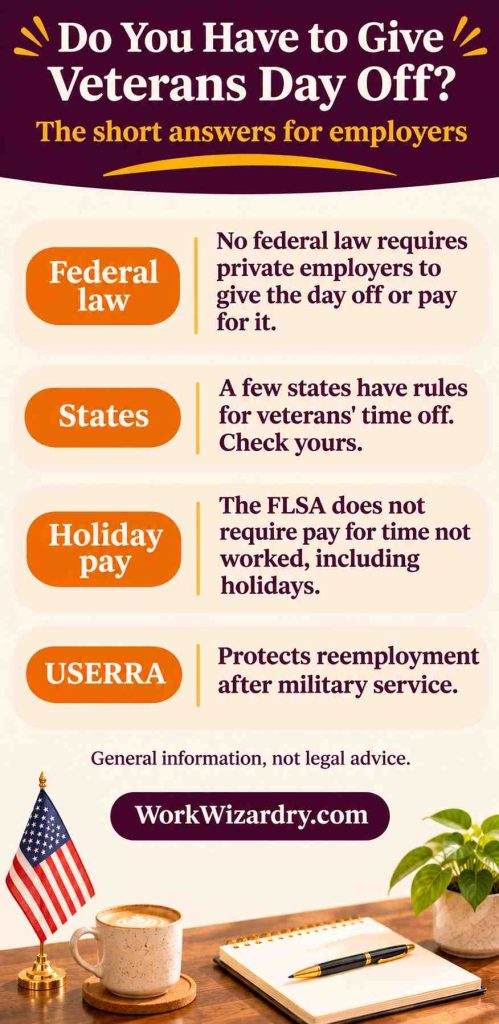
Veterans Day 2026 is Wednesday, November 11. It honors everyone who has served in the US armed forces. It is a federal holiday, but no federal law requires private employers to close or to pay for the day, so most workplaces decide for themselves.
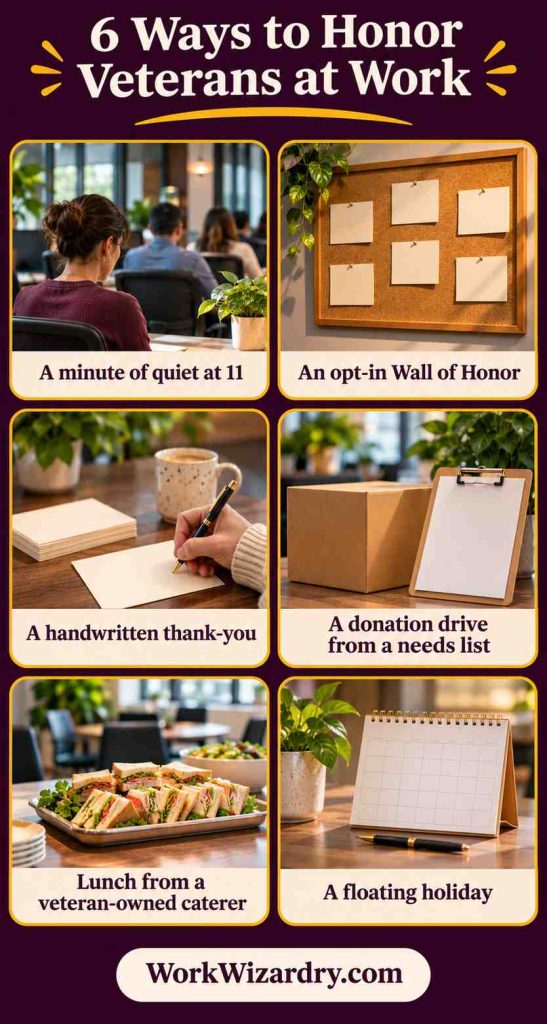
The best Veterans Day ideas for work are personal, optional and specific: a sincere thank-you, a minute of quiet at 11 a.m., a Wall of Honor that people choose to add to, a floating holiday for staff who have to work and a donation to a charity you have checked. This page gives you the policy answers, 30 Veterans Day ideas for your company, the office and remote teams (ways to honor veteran employees),, messages you can use, and a free HR kit.
Key takeaways
- The law: no federal law requires private employers to give Veterans Day off or to pay for it. A few states have rules about veterans’ time off, so check yours.
- Ask first. Ask the veterans on your team how, or whether, they want the day marked.
- Make everything optional. Never require anyone to say they served, speak or stand.
- Be specific and brief. “Thank you for your service” plus one true sentence beats a long speech.
- Give carefully. Check any veterans charity before you give, and give what is on its needs list.
- Do more than one day. Leave policy, hiring and mentoring is what changes working life.
Want the planning sheets? The free Veterans Day Planner for HR and Managers has a policy cost calculator in Excel, a short survey to ask veterans what they want, a run sheet, announcements, printable cards and a charity checklist.

Find Your Best Veterans Day Ideas in a Minute
| You are | Start with | First move |
|---|---|---|
| HR or people team | Policy decision, a veteran input survey, a floating holiday | Decide the policy this week |
| A manager with a small team | A personal thank-you, a card signed by the team, a moment of quiet | Ask your veterans what they would like |
| A small business owner | A veteran-owned lunch order, a respectful offer, a team thank-you | Choose one way to say thank you |
| A remote or hybrid team | A virtual moment at 11 a.m., a digital Wall of Honor, a mailed card | Send the invitation today |
| A shift or frontline team | Shift-start recognition, a floating holiday | Brief your supervisors |
| A veteran employee | Tell your manager what you would and would not like | Choose how you want to take part |
| A colleague who wants to help | A short thank-you in person, a coffee, a card | Be sincere and brief |
Veterans Day Basics: The Date, the Meaning and What Is Closed
Veterans Day is November 11 every year. On Wednesday, November 11, 2026 there is no weekend shift: federal offices are closed, the US Postal Service does not deliver regular mail and the Federal Reserve Banks are closed. Banks, schools and private employers vary, so check your own. One source reports the New York Stock Exchange stays open, which is worth checking on the exchange’s own calendar.
Veterans Day vs Memorial Day and the days around it
| Day | Date | What it honors |
|---|---|---|
| Veterans Day (US) | Wednesday, November 11 | Honors all who served in the US armed forces, living or dead; a federal holiday |
| Memorial Day (US) | Last Monday in May | Honors those who died while serving |
| Armed Forces Day (US) | A Saturday in May | Honors people currently serving |
| Remembrance Day (Canada, UK, Commonwealth) | Wednesday, November 11 | Marks the end of World War I and remembers the fallen |
| Remembrance Sunday (UK) | Sunday, November 8 | The Sunday closest to November 11 |
A short history. Major fighting in World War I ended at the eleventh hour of the eleventh day of the eleventh month, in 1918. Congress made November 11 a legal holiday in 1938 and named it Armistice Day. In 1954 President Eisenhower signed a bill, amended days later, that replaced “Armistice” with “Veterans” so the day would honor all who served. From 1971 to 1977 the holiday was observed on a Monday under the Uniform Monday Holiday Act, and it returned to November 11 in 1978, as Wikipedia’s history summarizes. The distinction matters at work: Memorial Day honors those who died, and Veterans Day honors everyone who served.
The people behind the day. The Bureau of Labor Statistics reports 17.3 million veterans in 2025, with an unemployment rate of 3.5% compared with 4.2% for nonveterans (annual averages; one month of data was not collected because of the government shutdown). The Census Bureau counted 15.7 million veterans in 2024. The two numbers differ because the surveys and definitions differ. About 5.6 million were Gulf War-era II veterans, and the BLS found that half of them report a service-connected disability, which is why accessibility matters when you plan. Sources: BLS and the Census Bureau.
Do Employers Have to Give Veterans Day Off? The Policy Answers
Federal law. No federal law requires a private employer to give Veterans Day off or to pay for it. The Department of Labor says the Fair Labor Standards Act does not require payment for time not worked, such as holidays, and that these benefits are a matter of agreement between employer and employee (DOL holiday pay). Federal employees are off with pay because it is a federal holiday. A 2018 BLS fact sheet found that 11% of private-industry workers and 70% of state and local government workers had it as a paid holiday. The figure is old, so treat it as a rough guide.
State laws. A handful of states have rules about veterans’ time off on November 11. SHRM lists Iowa, Massachusetts, New Hampshire, Oregon and Tennessee. Details differ by state: notice periods, whether the leave is paid, and exceptions for serious disruption. Littler’s 2019 summary lists four states and says Tennessee only encourages paid time off, while later guidance says Tennessee requires unpaid time off for qualifying veterans. Because the sources disagree, check your state labor department before you rely on any of this.
Military service leave: USERRA. The Uniformed Services Employment and Reemployment Rights Act protects people who leave a job for military service. Employers must promptly reemploy returning service members in the position they would have held, with the same seniority, status and pay, and may not discriminate because of past, present or future military service. See the DOL’s USERRA page. Family and Medical Leave Act rules also cover qualifying exigency leave when a spouse, child or parent is called to active duty. None of this is about November 11 itself, but it is the policy that matters most to veterans and reservists on your team.
Your Veterans Day policy: the decision in five options
| Option | Cost formula | Watch out |
|---|---|---|
| Close for everyone with pay | Headcount x daily pay x (1 + payroll costs) | Not required by law. The most generous and the most expensive option, and not possible for every business. |
| A paid day off for veterans only | Veterans x daily pay x (1 + payroll costs) | Common, but check with counsel. Do not ask for proof in public, and apply it to everyone who qualifies. |
| A floating holiday for veterans and people who work that day | (Veterans + staff who work) x daily pay x (1 + payroll costs) | Keeps the business open and recognizes the day. Write the rules down. |
| Unpaid leave on request for veterans | Direct cost is $0, plus cover for the shift | Required in a few states. Check yours. An employer may choose to pay. |
| No day off, but an observance and volunteer time | Hours of volunteer time x hourly pay | Fine if the business cannot close. Be clear that it is a choice. |
Example: what each option costs. The numbers assume 200 staff, 12 veterans, 60 people who must work that day, pay of $28 an hour for 8 hours and 20% payroll costs, so a day costs about $269 per person. They count wages only and ignore lost output. Use your own numbers in the free calculator.
| Option | Example cost |
|---|---|
| Close for everyone with pay | $53,760 |
| A paid day off for veterans only | $3,226 |
| A floating holiday for veterans and people who work that day | $19,354 |
| Unpaid leave on request for veterans | $0 direct |
| No day off, an observance and 4 hours of volunteer time for 30 staff | $4,032 |
Sample policy wording. Veterans Day. Employees who have served in the armed forces may take November 11 as paid time off [or: as unpaid time off, with notice of [number] days]. Employees who work that day receive a floating holiday to use within [number] days. Taking part in any observance is optional. Identifying as a veteran is voluntary. Replace the brackets, check it against your state’s law and have counsel review it. This is general information, not legal advice.
How to Honor Veterans at Work: Respect Rules to Follow
A well-meant event can still go wrong. These six rules come from the common advice in what we read and from basic good manners.
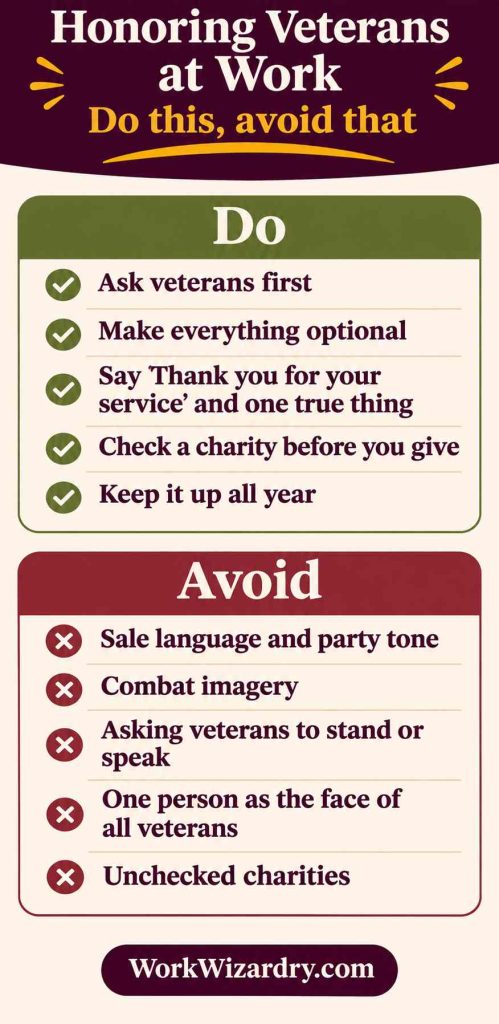
- Ask veterans first. A short, optional note (“How, if at all, would you like the day to be marked?”) tells you more than any list. The planner has a three-question survey.
- Make everything opt-in. Never require anyone to say they served, speak, stand or attend. Let people add their own names to a board.
- Do not tokenize. One person should not become the face of every veteran. Avoid inviting one veteran to represent the whole group.
- Keep the tone right. It is an observance, not a sale or a party. Avoid combat imagery, jokes and promotions.
- Include everyone. Military spouses, families, Gold Star families, reservists and people with disabilities belong in the plan.
- Do it all year. A day is a symbol. Leave policy, hiring and mentoring are what matter.
What to say. A short, sincere “Thank you for your service” is the most widely recommended. Opinion is split on “Happy Veterans Day”: CareerBuilder advises against it because some veterans feel it trivializes their service, while others, such as BraunAbility, say it is fine because Veterans Day is not a day of mourning. If you are not sure, thank the person and add one specific thing about their work. Do not ask about combat or experiences unless they bring it up, and say “welcome home” only if it fits.
Veterans Day Ideas for Work, by What They Do
These Veterans Day ideas for the office, for remote teams and for frontline staff each show cost, time, who they suit and one thing to watch. Pick two or three, not thirty.
Recognition: ways to say thank you that veterans actually want
Recognition works when it is personal, optional and specific. Most veterans do not want a spotlight. They want to be thanked by someone who means it, and left alone if they would rather not.
At a glance
| Idea | Cost | Time |
|---|---|---|
| A personal thank-you from a leader | Free | 30 minutes |
| An opt-in Wall of Honor | Free to $50 | 1 hour |
| Thank-a-veteran coffee | $20 to $50 | 30 minutes |
| A veteran story, told by the veteran | Free | 2 hours |
| A Veterans Day floating holiday for people who must work | Cost of a day of pay | 1 hour to set up |
| A thank-you card signed by the whole team | $10 to $30 | 1 hour |
| A recognition moment at an all-hands | Free | 10 minutes |
| Veterans Day gifts for employees: something small and useful | $5 to $25 | 1 hour |
1. A personal thank-you from a leader
A senior leader or a direct manager writes a short, handwritten note to each veteran on the team, or says thank you in person, and says one specific thing about their work.
- Why it works: A personal note from someone who knows the person’s work carries more weight than a company-wide post.
- Cost: Free · Time: 30 minutes
- Best for: Any workplace
- Watch out: Do not make assumptions about someone’s service. If you do not know whether a person served, do not guess.
- Sample line: “Thank you for your service, and for what you do for this team every day.”
2. An opt-in Wall of Honor
Invite staff to submit, if they choose, the name, branch and years of service of a veteran they want to honor, including themselves or a family member. Show the entries on a board, an intranet page or a shared slide.
- Why it works: It lets people honor those who matter to them, and it works for teams with few veterans because most people know one.
- Cost: Free to $50 · Time: 1 hour
- Best for: Offices and remote teams
- Watch out: Make it voluntary and let people choose what to share. Never post a person’s service without their permission.
- Sample line: “Add the name of a veteran you want to honor. It can be you, or someone you love.”
3. Thank-a-veteran coffee
Set up a 15-minute coffee break and invite anyone who wants to thank a veteran colleague in person. Keep attendance optional and the tone relaxed.
- Why it works: A short, informal conversation is often easier than a ceremony, and it gives staff a chance to say what they would not say in a speech.
- Cost: $20 to $50 · Time: 30 minutes
- Best for: Teams with veteran colleagues
- Watch out: Never single out a veteran to speak. Let them join the conversation as they wish.
- Sample line: “Coffee at 10. If you’d like to thank a veteran colleague, come and do it.”
4. A veteran story, told by the veteran
Invite veterans on your team to share a short story if they would like to, in their own words, and let them approve every edit.
- Why it works: People learn what service meant to the person, and the story belongs to the one telling it.
- Cost: Free · Time: 2 hours
- Best for: Newsletters and intranets
- Watch out: Ask privately. Some veterans prefer not to share, and no one should feel obliged to.
- Sample line: “In my own words: what the job taught me about teamwork.”
5. A Veterans Day floating holiday for people who must work
If your business has to stay open on Veterans Day, offer veterans, and those who work that day, a floating holiday they can take another day.
- Why it works: It recognizes the day without closing the business, and it is fair to staff who cannot take the date.
- Cost: Cost of a day of pay · Time: 1 hour to set up
- Best for: Retail, healthcare, manufacturing, shift teams
- Watch out: State the rules in writing: who is eligible, how long they have to use it and how to book it.
- Sample line: “You worked on Veterans Day. Take another day with our thanks.”
6. A thank-you card signed by the whole team
Pass a single card (a box of blank thank-you cards works) around for every team member to sign, with one specific sentence each, and give it to each veteran on the team in private.
- Why it works: A card from the whole team shows the person that colleagues noticed, and it takes only a few minutes of everyone’s time.
- Cost: $10 to $30 · Time: 1 hour
- Best for: Small and medium teams
- Watch out: Give it privately, not in front of the whole office.
- Sample line: “From all of us: thank you for what you did, and what you do.”
7. A recognition moment at an all-hands
Open an existing meeting with a short, sincere thank-you from a leader, and a moment of quiet. Do not ask veterans to stand.
- Why it works: It acknowledges the day without adding another event to the calendar.
- Cost: Free · Time: 10 minutes
- Best for: Companies with an all-hands meeting
- Watch out: Keep it under two minutes. Do not ask veterans to stand or speak unless they have said they would like to.
- Sample line: “Today is Veterans Day. Thank you to everyone here who has served.”
8. Veterans Day gifts for employees: something small and useful
Give each veteran a small, useful gift such as a good notebook (a Field Notes 3-pack is a classic) or a coffee voucher from a local business, with a note.
- Why it works: A useful gift with a personal note says more than a generic item with a logo.
- Cost: $5 to $25 · Time: 1 hour
- Best for: Employers with a budget
- Watch out: Offer it to those who want it, and do not make the gift conditional on attending anything.
- Sample line: “A coffee on us, with our thanks.”
Learning and remembrance: observe the day, not just celebrate it
Veterans Day honors all who served. A short moment of reflection and a chance to learn is often better than a party, and it keeps the tone right.
At a glance
| Idea | Cost | Time |
|---|---|---|
| A moment of quiet at 11 a.m. | Free | 5 minutes |
| A short history briefing | Free | 15 minutes |
| A veteran guest, with a proper brief | $0 to $300 | Half a day |
| A veterans benefits and resources lunch | $50 to $200 | 2 hours |
| A reading or listening list | Free | 1 hour |
| A visit to a local memorial or museum | $0 to $200 | Half a day |
9. A moment of quiet at 11 a.m.
Pause at 11 a.m. for one minute of quiet. The armistice that ended World War I took effect at the eleventh hour of the eleventh day of the eleventh month, which is where Veterans Day began.
- Why it works: A minute of quiet is simple and universal, and it works in an office, a warehouse or a video call.
- Cost: Free · Time: 5 minutes
- Best for: Any workplace, including remote
- Watch out: Say the time zone for remote teams, and make participation optional.
- Sample line: “At 11 a.m. we’ll pause for one minute. Join us if you’d like to.”
10. A short history briefing
Share a three-minute explanation of what Veterans Day is, how it began as Armistice Day and how it differs from Memorial Day and Armed Forces Day.
- Why it works: Many people confuse the three days, and a clear explanation avoids awkward mistakes.
- Cost: Free · Time: 15 minutes
- Best for: Teams that want context
- Watch out: Use a reliable source such as the VA, and keep it short.
- Sample line: “Memorial Day honors those who died. Veterans Day honors everyone who served.”
11. A veteran guest, with a proper brief
Invite a veteran from your community or a local veterans group to speak, with a clear brief, a fee if appropriate and a Q&A that is optional.
- Why it works: A guest speaker gives the day substance and links the team to the community.
- Cost: $0 to $300 · Time: Half a day
- Best for: Companies that can host a speaker
- Watch out: Agree beforehand the length, topics and tone, and never ask a guest to relive trauma. Do not invite a speaker only to perform.
- Sample line: “A 20-minute talk, then questions if you have them.”
12. A veterans benefits and resources lunch
Invite a local veterans service organization to explain the benefits, healthcare and job support available to veterans and their families.
- Why it works: Many veterans and families do not use benefits they have earned, and a clear introduction helps.
- Cost: $50 to $200 · Time: 2 hours
- Best for: Employers with veterans or military families
- Watch out: Make it open to staff and families, and do not require anyone to identify themselves.
- Sample line: “A lunch for anyone who wants to learn what is available to veterans and families.”
13. A reading or listening list
Share a short list of books, essays or podcasts by veterans, and invite staff to add their own.
- Why it works: It lets people learn at their own pace, and it supports veteran writers.
- Cost: Free · Time: 1 hour
- Best for: Remote teams and busy offices
- Watch out: Check each recommendation before sharing, and avoid graphic content.
- Sample line: “Three things written by veterans that are worth your time.”
14. A visit to a local memorial or museum
Take a team to a local veterans memorial or museum for an hour, with transport arranged and the visit optional.
- Why it works: A shared visit connects the team to local history and gives a quiet setting for reflection.
- Cost: $0 to $200 · Time: Half a day
- Best for: Teams within reach of a site
- Watch out: Check accessibility and opening hours, and keep it paid time.
- Sample line: “An hour at the memorial on Oak Street.”
Veterans Day volunteer ideas and donations: help in a way veterans have asked for
Giving is among the most common ideas, and the one where it is easiest to get things wrong. Ask what is actually needed, and check the charity before you give.
At a glance
| Idea | Cost | Time |
|---|---|---|
| A volunteer afternoon with a veterans group | Paid time | Half a day |
| A donation drive from a needs list | $0 to $200 | 1 day |
| Letters to veterans in care | Free | 1 hour |
| A matching gift for staff donations | Budget you set | 1 hour to set up |
| A Veterans Day lunch from a veteran-owned business | $100 to $500 | 1 hour |
| A care package drive through a vetted group | $100 to $500 | 1 week |
15. A volunteer afternoon with a veterans group
Offer paid time for staff to volunteer with a local veterans organization, doing the work the organization needs.
- Why it works: Time and hands are often more valuable than a donation, and shared work builds the team.
- Cost: Paid time · Time: Half a day
- Best for: Teams that can leave the office
- Watch out: Ask the organization what it needs. Do not turn up with a plan of your own.
- Sample line: “Four hours with the local veterans center, as paid time.”
16. A donation drive from a needs list
Ask a vetted veterans organization for a list of items it needs, then collect those items for a week.
- Why it works: Giving what is needed is more useful than giving what is convenient.
- Cost: $0 to $200 · Time: 1 day
- Best for: Offices and warehouses
- Watch out: Check the organization first (see the charity checklist below). Do not collect used clothing or food unless the organization asks for it.
- Sample line: “This week we’re collecting the items on the shelter’s list.”
17. Letters to veterans in care
Write letters or cards to veterans in a care facility, through an organization that coordinates the delivery.
- Why it works: A real letter from a stranger can mean a lot to someone who has few visitors.
- Cost: Free · Time: 1 hour
- Best for: Any workplace
- Watch out: Use a coordinator. Do not send unsolicited items to individuals or facilities.
- Sample line: “Thank you for your service. Here’s what we’re grateful for.”
18. A matching gift for staff donations
Match, up to a limit, what staff give to a vetted veterans charity on the day, and announce the total afterwards.
- Why it works: A match gives staff a reason to give, and it multiplies the result.
- Cost: Budget you set · Time: 1 hour to set up
- Best for: Employers with a giving budget
- Watch out: Set the cap and the list of eligible charities in writing before you announce it.
- Sample line: “We’ll match what you give today, up to $2,000.”
19. A Veterans Day lunch from a veteran-owned business
Order the team’s lunch or coffee from a veteran-owned business, and pay promptly.
- Why it works: It turns appreciation into business for veterans, and the team meets the owner.
- Cost: $100 to $500 · Time: 1 hour
- Best for: Offices that order food
- Watch out: Ask about the business’s own claims and allergens, and order in good time.
- Sample line: “Lunch for 30 from a veteran-owned caterer.”
20. A care package drive through a vetted group
Collect items for a care package program run by an established veterans or military charity, using their approved list.
- Why it works: Established programs know what recipients actually need and how to deliver it.
- Cost: $100 to $500 · Time: 1 week
- Best for: Larger offices
- Watch out: Follow the program’s rules on contents and shipping, and pack nothing yourselves without checking.
- Sample line: “Items on the program’s list go in the box by Friday.”
Veterans Day for remote teams, hybrid teams and shift workers: include everyone
A team that is spread across time zones or shifts needs a plan that does not rely on a room.
At a glance
| Idea | Cost | Time |
|---|---|---|
| A virtual moment at 11 a.m. local time | Free | 10 minutes |
| A digital Wall of Honor | Free | 1 hour |
| A virtual coffee to thank veteran colleagues | Free | 30 minutes |
| Shift-start recognition | Free | 10 minutes per shift |
| A card mailed to remote veterans | $5 to $15 each | 1 hour |
21. A virtual moment at 11 a.m. local time
Send a message that invites staff to pause at 11 a.m. in their own time zone for a minute of quiet, and post a short thank-you.
- Why it works: It lets every person take part wherever they are, at the same local moment.
- Cost: Free · Time: 10 minutes
- Best for: Remote teams
- Watch out: Do not require video. Keep it optional.
- Sample line: “At 11 a.m. wherever you are, take a minute.”
22. A digital Wall of Honor
Use a shared board, a Slack channel or an intranet page where staff can add the name of a veteran they want to honor, with permission.
- Why it works: It gives people in different places the same way to take part.
- Cost: Free · Time: 1 hour
- Best for: Remote and hybrid teams
- Watch out: Moderate the board, make entries optional and let people remove their own.
- Sample line: “Add a veteran you want to honor. It can be you.”
23. A virtual coffee to thank veteran colleagues
Host a short video call, optional, for anyone who wants to thank a veteran colleague, with no agenda and no speeches.
- Why it works: A relaxed call makes it easy for people to say what they want to say.
- Cost: Free · Time: 30 minutes
- Best for: Remote teams
- Watch out: Do not ask veterans to speak. Let people join and listen if they prefer.
- Sample line: “A 20-minute call. Come if you’d like to say thank you.”
24. Shift-start recognition
Open each shift on Veterans Day with a short thank-you from the supervisor and a note that a floating holiday is available.
- Why it works: It reaches people who cannot attend an event, and takes almost no time.
- Cost: Free · Time: 10 minutes per shift
- Best for: Factories, hospitals, shops and call centers
- Watch out: Keep it brief and sincere, and do not make people stand or speak.
- Sample line: “Before we start: thank you to everyone here who has served.”
25. A card mailed to remote veterans
Ask remote veterans if they would like a card, then mail a handwritten one signed by their team on a plain thank-you card.
- Why it works: A physical card in the post feels more personal than another message in the inbox.
- Cost: $5 to $15 each · Time: 1 hour
- Best for: Distributed teams
- Watch out: Ask first. Many people prefer to keep their home address private.
- Sample line: “A card is on its way, with thanks from all of us.”
Year-round: the things that matter more than one day
Veterans Day is a symbol. What changes working life for veterans is what an employer does for the other 364 days.
At a glance
| Idea | Cost | Time |
|---|---|---|
| A veteran employee resource group | Time | Several weeks |
| A clear military leave policy | Time | A few days |
| Mentoring for people leaving the military | Time | A day to set up |
| Veteran hiring outreach | Time | A day |
| Support for military families and spouses | Time | A few days |
26. A veteran employee resource group
Help staff who want to start a group for veterans, reservists and supporters: involve HR, find an executive sponsor and let members shape the aims.
- Why it works: A group gives veterans a voice and a network, and it can plan the day better than anyone.
- Cost: Time · Time: Several weeks
- Best for: Companies with 50 or more staff
- Watch out: Let members decide the group’s purpose. Start small, and do not make joining a requirement.
- Sample line: “The group meets on the first Thursday. Everyone is welcome.”
27. A clear military leave policy
Write down what your company does for reservists and others called to service: how leave works, how to request it and how reemployment is handled. Check it against USERRA.
- Why it works: A clear policy removes uncertainty for people called to service and their managers.
- Cost: Time · Time: A few days
- Best for: Every employer
- Watch out: The law is about reemployment and non-discrimination for military service. Check details with HR or counsel.
- Sample line: “If you are called to service, here is what we do.”
28. Mentoring for people leaving the military
Pair staff who have left the military with a volunteer mentor for three conversations in a month.
- Why it works: Moving into a civilian workplace is a real change, and a mentor helps with unwritten rules.
- Cost: Time · Time: A day to set up
- Best for: Companies with experienced staff
- Watch out: Ask volunteers to listen first. Keep it voluntary and short.
- Sample line: “Three conversations, one month, one mentor.”
29. Veteran hiring outreach
Post jobs where veterans look, and review your job descriptions for requirements that do not match real needs. Make sure recruiters can read a military resume.
- Why it works: Many job ads miss skilled veterans because they use language that does not translate.
- Cost: Time · Time: A day
- Best for: Employers who recruit
- Watch out: Do not promise preferences you cannot honor. Check hiring rules with counsel.
- Sample line: “We read military resumes, and we hire on skills.”
30. Support for military families and spouses
Offer flexibility for the spouses and partners of service members, such as remote work after a relocation and time off around deployments.
- Why it works: Military families move often, and flexibility keeps talented people.
- Cost: Time · Time: A few days
- Best for: Employers with military families
- Watch out: Offer the same rules fairly to all staff. Check with HR.
- Sample line: “If your family is posted, talk to us before you decide.”
Veterans Day Messages for Employees, Emails and Cards
Short and sincere beats long and polished. Keep your own voice and change the details.
A company-wide Veterans Day email to employees
Subject: Today is Veterans Day
Today we honor everyone who has served in the armed forces. Thank you to the veterans on our team, and to everyone whose family and friends have served.
At 11 a.m. we invite you to pause for a minute of quiet. Joining is optional. If you would like to add the name of a veteran you want to honor, you can do so on the board in the kitchen or in the shared channel. Entries are voluntary.
If you are working today, a floating holiday is available. Your manager has the details.
Thank you.
Veterans Day thank you messages for veteran employees
- Thank you for your service, and for what you do for this team. We’re glad you’re here.
- Today we want to say thank you. There’s no event and nothing you need to do, just our thanks.
- We know what service can cost. Thank you, and let us know if there is ever anything the team can do.
- Thank you for the skills you brought from service. We use them every day.
- If you’d like to talk about the day, I’m happy to listen. If not, thank you, and enjoy the day.
- Your service helps all of us. Thank you.
A manager’s note to a veteran on the team
- I want to thank you for your service in person. Is there anything you’d like us to do today, or not do?
- Thank you for serving. I’d like to ask how you’d like to mark the day, if at all.
- I’m grateful for what you’ve done, and for the way you work with this team.
- There’s no pressure to join anything. I wanted you to know that I notice and I’m thankful.
- Please take the time you need on Veterans Day. Let me know if I can cover anything.
- Thank you for the example you set for the rest of us.
Lines for Veterans Day cards
- Thank you for your service.
- We’re glad you’re on our team.
- Thank you for what you’ve done, and what you do.
- Wishing you a quiet, good day.
- With our gratitude, from all of us.
- Your service matters to us.
Veterans Day social media posts for a business
Use real people and real facts, with permission. Avoid stock combat photos.
A plain thank-you
Today is Veterans Day.
Thank you to everyone who has served, and to the families who served alongside them.
We’ll be quiet at 11 a.m. for a minute.
About the team
Three of our team have served in the armed forces.
We’re grateful to them, today and every day.
Thank you.
A veteran-owned partner
We ordered lunch today from a veteran-owned bakery two streets from our office.
If you’re looking for a place to order from, try them.
A donation
Today we’re giving to the local veterans center on Oak Street, which gave us a list of what it needs.
We’ll post the total tomorrow.
A closing note
Our shop will open at noon on Veterans Day so our team can attend the ceremony in town.
Thank you for understanding.
A story, with permission
Maria served six years in the Navy before she joined us.
She asked us to share this: ‘The job taught me to listen first.’
Thank you, Maria.
A hiring note
We read military resumes and we hire on skills.
If you are leaving the service and looking for a role in logistics or customer support, we’d like to hear from you.
An offer, with respect
This Veterans Day, veterans and active service members get a free coffee with a military ID, a veteran ID card or a driver’s license with a veteran designation.
No sale. Just thanks.
Veterans Day Donation Drives and Charities: Check Before You Give
Many Veterans Day ideas include a donation drive, and scammers know it. The FTC warns that some sham charities use “veterans” in their names, and that veterans charity scams tug at the heart strings. Before you collect or give anything, work through this list.
- Search the charity’s name with words like “complaint”, “fraud” and “scam”.
- Check its rating on a watchdog site: BBB Wise Giving Alliance, Charity Navigator, CharityWatch or GuideStar.
- Check that it is registered with your state’s charity regulator (usually the attorney general or secretary of state).
- Use the IRS Tax Exempt Organization Search to confirm tax-exempt status.
- Do not trust a name just because it includes “veterans”. Some sham charities use it.
- Ask where the money goes, and ask for the needs list in writing.
- Pay by credit card or check made out to the charity. Never by gift card, cash or wire.
- Do not give to an unsolicited caller or a social media post you cannot verify.
If you suspect a scam, report it at ReportFraud.ftc.gov and to your state charity regulator. The FTC’s military consumer site and its page on charities have more advice. Most veterans charities do good work. The goal is to give to the real ones.
Veterans Day Small Business Ideas: Offers and Posts That Respect the Day
If you serve customers, you will see competitors post “Veterans Day sales”. Most veterans find the day is better marked than marketed. These ideas keep it respectful.
| Idea | How to verify | Watch out |
|---|---|---|
| A free coffee or meal with ID | Military ID, a veteran ID card or a driver’s license with a veteran designation | Keep it simple, and do not call it a sale. |
| A donation tied to the day | Not needed | Say exactly what percent of what, and name the charity. Check it first. |
| Hiring outreach | Not needed | Do not promise preferences you cannot honor. |
| A team story, with permission | Not needed | Quote the person exactly and let them approve it. |
| Opening later so staff can attend a ceremony | Not needed | Tell customers in advance. |
| Ordering from veteran-owned suppliers | Ask the supplier | Check the claim before you advertise it. |
Keep any claim true, including the exact discount, the end time and any donation. Our guides to Small Business Saturday ideas and Cyber Monday ideas for small business have the margin math for any offer that costs you money.
A 60-Minute Veterans Day Observance at Work
If you want one simple plan, this one needs a room or a call, a timer and a few cards. Everything is optional.
| Time | Activity | What to do |
|---|---|---|
| 0:00 to 0:05 | Welcome | A leader thanks the team and explains that taking part is optional. |
| 0:05 to 0:10 | Why we mark the day | Explain what Veterans Day is and how it differs from Memorial Day and Armed Forces Day. |
| 0:10 to 0:15 | A minute of quiet | Pause for one minute, in the room or on the call. |
| 0:15 to 0:35 | Thank-you coffee or card signing | Informal. Veterans are not asked to speak. |
| 0:35 to 0:50 | Optional stories | Only from people who volunteered beforehand. |
| 0:50 to 1:00 | Next steps | Share the donation drive, the floating holiday and the Wall of Honor. |
Your 11-Day Veterans Day Plan
From October 31 there are 11 days to Wednesday, November 11. If you are starting late, do the first row, the “Announce” row and the last three.
| When | Focus | What to do |
|---|---|---|
| 11 to 9 days out | Decide and ask | Decide the policy. Send a short, optional note asking veterans how they would like the day to be marked. |
| 8 to 7 days out | Plan and book | Choose two or three ideas. Book any guest, charity partner or room. Get the charity needs list. |
| 6 to 5 days out | Announce | Send the announcement. Open the Wall of Honor. Brief managers and supervisors. |
| 4 to 2 days out | Prepare | Print cards, order lunch or coffee from a veteran-owned business and confirm the schedule. |
| 1 day out | Final checks | Confirm attendance rules, floating-holiday cover and the 11 a.m. message. |
| Nov 11 | The day | Run the observance. Send the thank-you. Take photos only with permission. |
| The next two days | Follow up | Thank everyone. Post the donation total. Send a short feedback form. |
| Within two weeks | Review | Ask veterans what worked. Update the policy and the plan for next year. |
Check These Before the Day
This is general information, not legal advice. Rules differ by state, so ask HR or counsel if you are unsure.
| Check | What to do |
|---|---|
| State law | Check your state’s rules on veterans’ time off on November 11. A few states require it. Your state labor department can confirm. |
| Military leave and USERRA | Make sure your policy on military service leave and reemployment matches USERRA. DOL VETS can help. |
| Voluntary identification | Never require staff to say whether they have served. Let people choose. |
| Charity check | Check any charity before you give, using the checklist in this guide. Do not give to unsolicited callers. |
| Accessibility | Make sure events are accessible. Half of Gulf War-era II veterans report a service-connected disability (BLS). |
| Fair rules | Apply any leave or recognition rule consistently, and put it in writing. |
| Tone | Avoid sale language, party tone and combat imagery. Keep it respectful. |
| Time and pay | If an activity takes place at work, say whether attendance is optional and paid. |
How to Tell Whether It Worked
Judge it by what veterans say, not by how big the event was.
- Ask veterans privately what worked and what did not, with a short optional form.
- Count who took part, and what share said they liked it.
- Check that policy changes happened: a written floating holiday, a military leave policy, a charity you can name.
- Look at the year: did hiring outreach, mentoring or a veterans group start?
Free Veterans Day Planner for HR and Managers
Plan it in an afternoon. The free kit includes:
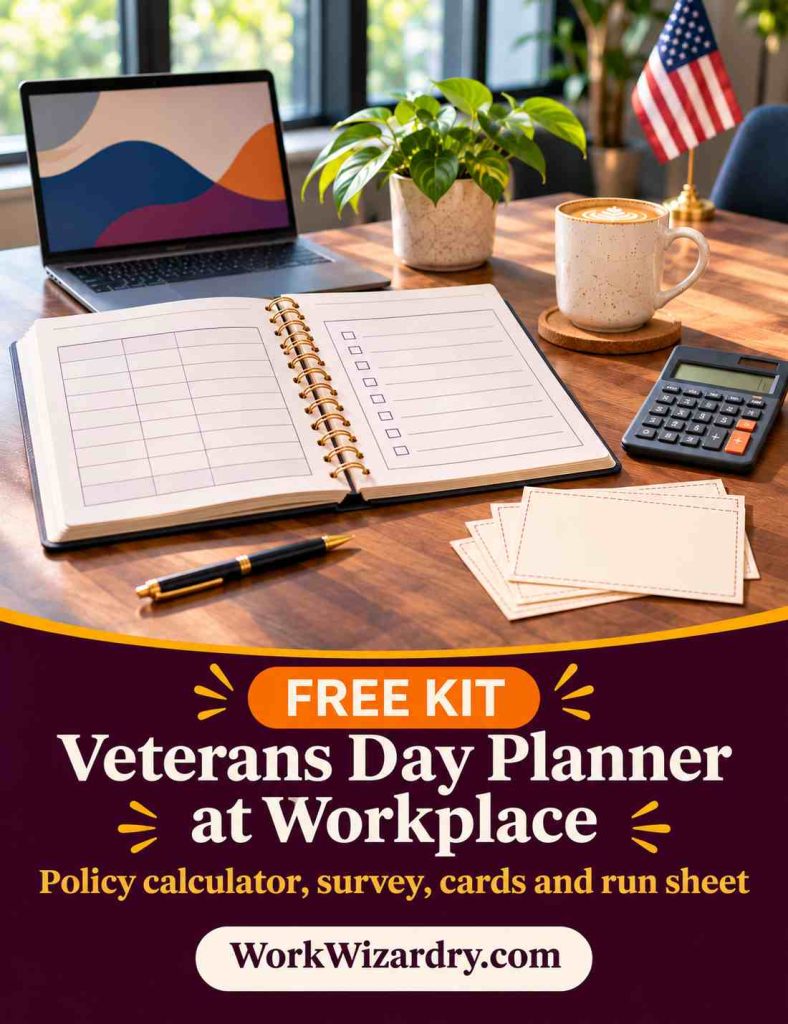
- A policy cost calculator in Excel. Enter headcount, veterans, staff who work that day, pay and payroll costs and compare the five options.
- A three-question survey to ask veterans what they would like, anonymous and optional.
- A one-page policy decision sheet with sample wording.
- A 60-minute run sheet, announcements and a thank-you email.
- Printable thank-you cards and a Wall of Honor entry form (Letter and A4).
- A charity checklist, an 11-day plan and a results sheet.
Related Guides
- November themes for work: every awareness day in the month.
- Memorial Day workplace ideas: the other day, for those who died.
- National Entrepreneurs’ Day ideas: ten days later.
- Thanksgiving employee appreciation ideas: thank your whole team.
- Thanksgiving messages to employees: more ready-to-use notes.
Frequently Asked Questions About Veterans Day at Work
When is Veterans Day in 2026?
Veterans Day is Wednesday, November 11, 2026. It is always on November 11. When the date falls on a weekend, the federal observance moves to the Friday or the Monday. It began as Armistice Day in 1918 and was renamed Veterans Day in 1954. It honors all who served in the US armed forces.
Is Veterans Day a paid holiday at work?
It is a federal holiday, so federal employees are off with pay, but no federal law requires private employers to give the day off or to pay for it. A 2018 Bureau of Labor Statistics fact sheet found that 11% of private-industry workers and 70% of state and local government workers had it as a paid holiday.
Do employers have to give veterans Veterans Day off?
Not under federal law. A few states, including Iowa, Massachusetts, New Hampshire and Oregon, have rules about veterans’ time off on November 11, and sources disagree about Tennessee. Details such as notice and pay differ, and an employer can often choose paid or unpaid leave. Check your state labor department.
Do I get holiday pay if I work on Veterans Day?
Federal law, through the Fair Labor Standards Act, does not require holiday pay or a premium for working on a holiday. Pay is set by the employment agreement, the company policy or a union contract. Some employers offer a floating holiday or premium pay to staff who have to work that day.
What is the difference between Veterans Day, Memorial Day and Armed Forces Day?
Veterans Day, on November 11, honors everyone who has served in the US armed forces. Memorial Day, on the last Monday in May, honors those who died while serving. Armed Forces Day, in May, honors people currently serving. Canada, the UK and other Commonwealth countries mark Remembrance Day on November 11.
How can I honor veterans at work?
Ask veterans first, make everything optional and be specific. Good ideas include a personal thank-you, an opt-in Wall of Honor, a minute of quiet at 11 a.m., a donation drive from a vetted charity’s needs list, a floating holiday for people who work, and year-round steps such as a veterans group and clear military leave policy.
What should I say to a veteran coworker on Veterans Day?
A short, sincere ‘Thank you for your service’ is the most widely recommended. Opinion is split on ‘Happy Veterans Day’: some veterans find it trivializes service, others do not mind. If you are not sure, thank them, add something specific about their work and do not ask about their service unless they bring it up.
What Veterans Day ideas work for remote teams?
Invite staff to pause for a minute at 11 a.m. in their own time zone, use a digital Wall of Honor with entries by choice, host an optional virtual coffee to thank veteran colleagues and mail a card to remote veterans who want one. Do not require video, and ask before you use anyone’s address or story.
Should I ask employees whether they are veterans?
Do not require anyone to say. Invite people to share if they would like to, for example by letting staff add a name to the Wall of Honor or tell their manager how they want to be thanked. Keep any data separate and private, and ask HR or counsel about voluntary self-identification rules.
What should companies avoid on Veterans Day?
Avoid sale-style marketing, party tone, combat imagery and pressuring veterans to speak or stand. Do not tokenize one person, forget military spouses and families, or give to a charity you have not checked. Do not make participation compulsory or assume everyone’s experience was the same.
How many veterans are there in the US?
The Bureau of Labor Statistics reported 17.3 million veterans in 2025, with an unemployment rate of 3.5% against 4.2% for nonveterans. The Census Bureau counted 15.7 million in 2024. The estimates differ because the surveys use different definitions and years. About 5.6 million were Gulf War-era II veterans.
How do I check a veterans charity before giving?
Search its name with ‘complaint’ or ‘scam’, check its rating on BBB Wise Giving Alliance, Charity Navigator, CharityWatch or GuideStar, confirm its state registration and IRS tax-exempt status, and ask for its needs list. Do not rely on ‘veterans’ in the name. Pay by card or check, never gift cards, cash or wire.
Sources: ideas, messages and checklists are original to Work Wizardry. Data: BLS Employment Situation of Veterans (2025) and the Census Bureau (2024). History and weekend rule: Wikipedia. Policy: DOL holiday pay, DOL USERRA, SHRM and Littler for state laws, and the BLS 2018 fact sheet. Charities: FTC consumer alert. Etiquette: CareerBuilder and BraunAbility. State-law details and the closure details for the stock market are reported by secondary sources and should be checked. This page is general information, not legal advice.
