
This post contains affiliate links. As an Amazon Associate I earn from qualifying purchases, and Work Wizardry may earn a small commission at no extra cost to you. Prices and stock change, so check each listing before you buy.
The best fundraising ideas for the workplace are the ones your team can run in a week, for a small cost, with a clear goal and the rules checked. A jeans day, a bake sale, a quiz night, a change jar and a step challenge all work for most offices. This guide gives you 50 workplace fundraising ideas with costs, time, people and worked example math, plain-English rules on raffles, food and permission, a goal table, a 6-week plan, ready messages, a section on raising money for a sick coworker, and a version for remote teams and the holidays.
We read what ranks before writing this. The top pages are lists of 8 to 25 ideas from fundraising platforms and charities. Almost none say how much an idea costs or can raise, whether you need permission, what the law says about raffles and bake sales, or how to handle cash. This page answers those first, then gives you the ideas.
Key takeaways
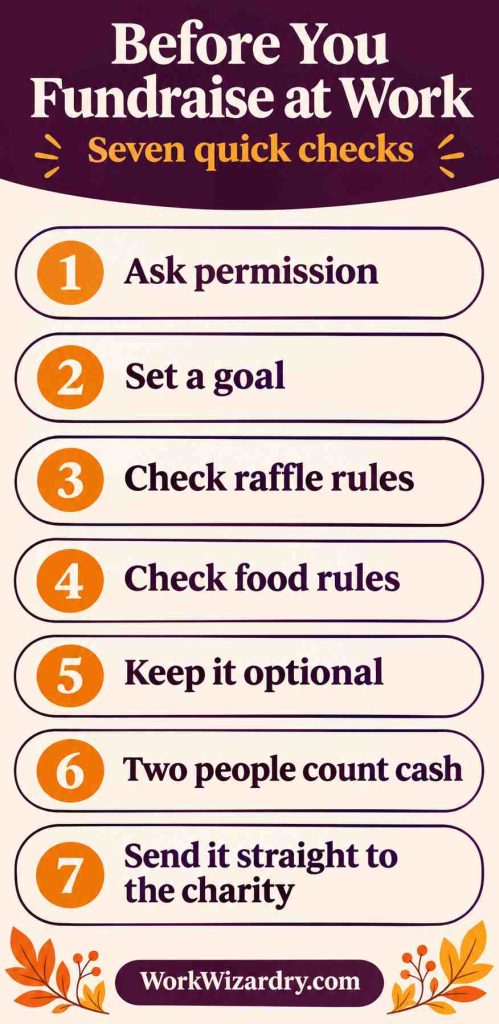
- Ask permission first. Many employers limit fundraising to breaks and need approval for events.
- Set a goal and do the math before you pick an event. Use the goal table below.
- Check the rules: raffles and 50/50s vary by state, and food sales follow local health rules.
- Keep it optional and private. No one should be asked how much they gave.
- Count cash with two people and send the money straight to a charity you have checked.
- Report the real total and thank everyone.
Want everything ready to run? The Workplace Fundraiser Kit has a goal and cost calculator in Excel, run sheets for 16 events, emails, sponsor letters, printable signs, tickets and checklists. This article is complete on its own.

Find Your Best Workplace Fundraising Idea in a Minute
| Your team | Start with | First move |
|---|---|---|
| A small office (under 20) | A bake sale, jeans day, a quiz or a change jar | Pick one and set a $200 goal |
| A mid-size company (20 to 100) | A raffle, a silent auction, a cook-off or a challenge | Form a small committee |
| A large company (100+) | Department challenges, a match day, a talent show | Ask leadership to match |
| A remote or hybrid team | Virtual quiz, step challenge, online auction | Choose one tool |
| A tiny budget | Jeans day, change jar, skills auction, book sale | Spend under $25 |
| A hospital or school staff | A jeans day, bake sale, potluck, step challenge | Check shift schedules |
| A team raising money in December | Ugly sweater day, gift wrapping, reverse advent calendar | Start 6 weeks ahead |
| A team that dislikes pressure | A change jar, a payday round-up, a match day | Keep everything optional |
Set a Goal First: What Each Fundraiser Can Raise and Cost
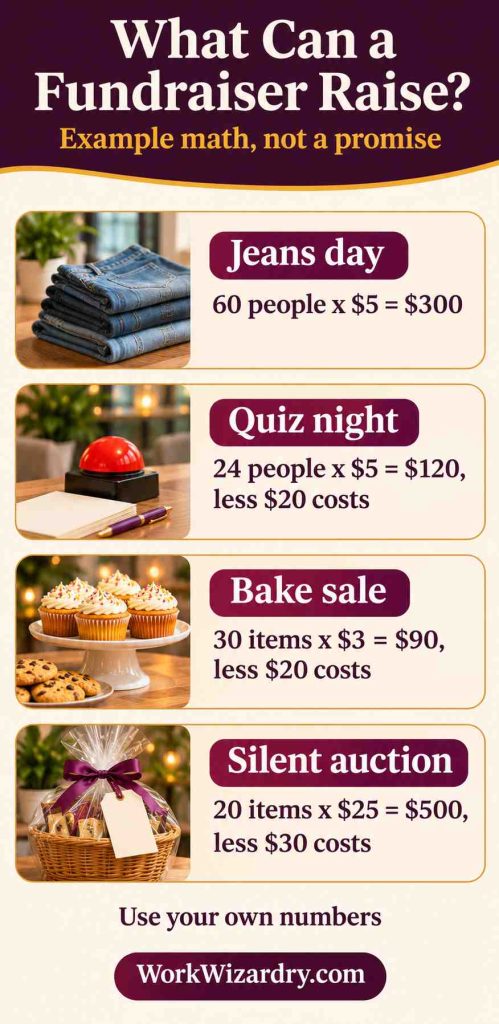
Money raising ideas for work are easier to choose once you know the target. Pick the goal before the event. A goal gives the team a target, helps you choose an idea and tells you whether the work is worth it. These are example calculations to show how to do the math with your own numbers. They are not averages, and your results will differ.
| Fundraiser | Example math | What reaches the charity |
|---|---|---|
| Bake sale | 30 items at $3 each = $90, less $20 supplies | $70 |
| Quiz night | 6 teams of 4 (24 people) at $5 each = $120, less $20 for prizes and printing | $100 |
| Jeans day | 60 people at $5 each = $300, less $0 | $300 |
| Silent auction | 20 items at $25 average = $500, less $30 for signs and sheets | $470 |
The formula: (people who take part x average gift) minus costs = what reaches the charity. Then ask whether the number is worth the effort. A jeans day with no costs and a bake sale with ten bakers can both raise a few hundred dollars, but they take very different amounts of work. If your goal is larger than your team can reach, split it across two small events or ask leadership to match.
How to Ask Coworkers for Donations Without Pressure
How you ask matters as much as what you run, and it is the heart of how to fundraise at work. Staff fundraising ideas succeed when the ask is light. These habits keep people comfortable:
- Send one clear message. One email or one sign with the charity, the date, the price and the words “entirely optional”.
- Offer a private way to give. A jar, an envelope or the charity’s own page, so no one has to say what they gave.
- Do not track who gave. Report totals and participation, never names and amounts.
- Do not let managers ask the people they manage. Peers can ask. Leaders can match.
- Do not nag. Send a reminder and a thank-you, then stop.
- Give a way to join without money. Helping, sharing or lending a skill counts.
The Rules in Plain English (This Is Not Legal Advice)
Fundraising at work looks simple, but a few rules catch teams out. Check each one for your own state, county and company.
- Get permission first. Ask your manager or HR before you start. Many employers have a workplace solicitation policy that limits fundraising to breaks or non-work time and may need approval for events.
- Keep it optional and private. No one should be asked how much they gave. Supervisors should not ask people they manage. Offer a way to give anonymously.
- Check raffle and 50/50 rules. A 50/50 raffle at work, and any other raffle, falls under state law. Raffle and 50/50 laws differ by state and may need a license or ban them. A workplace is not automatically a charity. Ask your state gaming regulator before you sell a ticket, and never spend money raised on prizes.
- Follow food safety rules. Local health departments set the rules for selling food, including bake sales. Many places allow wrapped, non-perishable baked goods and require a sign if the food was made at home. Label allergens and check with your county health department.
- Know who the donor is. A gift to a charity may be deductible for the person who makes it, but buying raffle tickets or bingo cards is not. Gifts to an individual, such as a sick coworker, are not deductible. Ask the charity for a receipt for larger gifts.
- Handle cash safely. Two people should count and record all cash and sign the log. A locking cash box keeps it safe between counts. Deposit or hand over the money quickly and keep the charity’s receipt.
- Send the money straight to the charity. Use the charity’s own donation page or a check payable to the charity. Do not hold funds for months.
- Include everyone. Offer a way to take part for people who cannot attend, cannot eat the food or cannot pay. Keep prices low and optional.
- Avoid alcohol and risky dares. Alcohol creates insurance and safety problems at work, and dares must be safe.
- Report the real total. Share the actual amount, the date it was sent and what it will do.
For tax, see IRS Publication 526: it says purchases of raffle or bingo tickets and gifts to specific individuals are not deductible. For food, ask your county health department what it allows for bake sales, since requirements are set locally and often depend on whether the food needs refrigeration. For raffles, contact your state’s gaming or lottery regulator.
How to Choose and Check a Charity
A workplace fundraiser puts your company’s name beside a charity’s name. Workplace charity event ideas all start with one question: who is the money for? Spend ten minutes checking the answer.
- Check the status. Confirm in the IRS Tax Exempt Organization Search that the group is a recognized charity.
- Look at the finances. Open its Candid profile or Form 990.
- Read the ratings. Check Charity Navigator and Give.org.
- Find the mission. Read what it does in plain words.
- Ask what it needs. Ask whether it wants cash, goods or volunteers.
- Ask about names and logos. Get written permission to use its name.
- Ask for a receipt. Ask how it will acknowledge a larger gift.
A simple test: could you visit the charity, explain what it does in one sentence and send the gift directly to it? If not, choose another.
Fun Fundraising Ideas for Workplace Teams: Office Fundraising Ideas and Easy Fundraisers by Type
Food and drink fundraisers
Food is the easiest way to get people to part with a few dollars at work. It also carries the most rules, so check food safety before you plan.
At a glance
| Idea | Cost | Time |
|---|---|---|
| A bake sale | $20 to $60 | 3 to 4 hours |
| A chili cook-off fundraiser or soup cook-off | $30 to $80 | 1 lunch hour |
| A potluck lunch with a suggested donation | $10 to $30 | 1 lunch hour |
| A donation coffee or tea cart | $20 to $50 | 30 minutes a day for 1 week |
| An ice cream or pancake social | $40 to $100 | 1 hour |
| A bake-off competition | $20 to $50 | 1 hour |
| A cookie-gram or candy-gram delivery | $30 to $80 | 2 hours |
| A bring-your-own-lunch swap | $0 to $10 | 1 lunch hour |
1. A bake sale
Ask colleagues to bake or buy items, set a price card for each item, label allergens and sell at a break time near the kitchen or lobby.
- Example math (assumptions, not a benchmark): 30 items at $3 = $90, less $20 in supplies
- Cost: $20 to $60 · Time: 3 to 4 hours · People: 4 to 8 bakers
- Best for: Offices of 20 or more
- Watch out: Local health rules decide what you may sell. Many places allow wrapped, non-perishable baked goods and require a sign if the food was made at home.
- Sample line: “Bake sale at the break room on [day]. Everything is $3 and labeled.”
2. A chili cook-off fundraiser or soup cook-off
Cooks bring a slow cooker, tasters pay to try each entry and vote with a coin or a ticket. Offer a vegetarian entry and label allergens.
- Example math (assumptions, not a benchmark): 20 tasters at $5 = $100, less $20 for cups and spoons
- Cost: $30 to $80 · Time: 1 lunch hour · People: 6 to 12 cooks
- Best for: Teams that like a contest
- Watch out: Keep hot food at a safe temperature and offer small cups. Avoid alcohol.
- Sample line: “Taste six chilis for $5 and vote for your favorite.”
3. A potluck lunch with a suggested donation
Everyone brings a dish and puts a suggested donation in a jar. Print dish labels with allergens.
- Example math (assumptions, not a benchmark): 25 people at $4 = $100
- Cost: $10 to $30 · Time: 1 lunch hour · People: 10 to 40 people
- Best for: Any size
- Watch out: Make the donation suggested, not required, and never track who gave.
- Sample line: “Potluck on [day]. Bring a dish and give what you like.”
4. A donation coffee or tea cart
Set up a cart with good coffee, tea and cookies and ask for a donation per cup.
- Example math (assumptions, not a benchmark): 30 cups a day at $2 over 5 days = $300 less $50 supplies
- Cost: $20 to $50 · Time: 30 minutes a day for 1 week · People: 2 to 4 people
- Best for: Offices with no good coffee
- Watch out: Check kitchen rules and use clean equipment.
- Sample line: “Good coffee by donation, all week, for [charity].”
5. An ice cream or pancake social
Serve toppings and charge a flat price. Offer a dairy-free option.
- Example math (assumptions, not a benchmark): 40 servings at $4 = $160 less $60 supplies
- Cost: $40 to $100 · Time: 1 hour · People: 4 to 6 helpers
- Best for: Summer or weekend events
- Watch out: Count allergens and keep cold items cold.
- Sample line: “Ice cream sundaes at 3, $4 each.”
6. A bake-off competition
Bakers enter, colleagues buy tasting tickets and vote, and the top bakers get a certificate.
- Example math (assumptions, not a benchmark): 30 voters at $3 per vote = $90
- Cost: $20 to $50 · Time: 1 hour · People: 6 to 10 bakers, 3 judges
- Best for: Teams that enjoy a contest
- Watch out: Judge on a simple rule so no one feels singled out.
- Sample line: “Vote with your dollars for the best bake.”
7. A cookie-gram or candy-gram delivery
Colleagues buy a note and a treat to be delivered to a coworker on the day.
- Example math (assumptions, not a benchmark): 40 grams at $3 = $120 less $40
- Cost: $30 to $80 · Time: 2 hours · People: 3 to 5 helpers
- Best for: Holiday or Valentine season
- Watch out: Keep notes kind and let people opt out of receiving them.
- Sample line: “Send a treat and a note for $3.”
8. A bring-your-own-lunch swap
Colleagues pay a small amount to swap a home-made lunch dish with a colleague, with labels.
- Example math (assumptions, not a benchmark): 20 people at $3 = $60
- Cost: $0 to $10 · Time: 1 lunch hour · People: Any
- Best for: Teams that like a simple event
- Watch out: Food safety and allergens as above.
- Sample line: “Swap your lunch for a colleague’s. $3 to join.”
Games, contests and shows
Games bring people together and cost almost nothing. A good contest asks for a small entry fee and gives out certificates, not cash.
At a glance
| Idea | Cost | Time |
|---|---|---|
| A trivia night fundraiser or quiz night | $20 to $60 | 1 hour |
| Office bingo | $20 to $50 | 45 minutes |
| A scavenger hunt | $10 to $30 | 1 hour |
| A bracket challenge for charity | $0 to $20 | 3 weeks |
| A game tournament | $20 to $60 | 2 hours |
| A karaoke or lip sync battle | $30 to $100 | 1 hour |
| A talent show | $30 to $100 | 1.5 hours |
| Office Olympics | $20 to $80 | 2 hours |
9. A trivia night fundraiser or quiz night
Teams pay to enter, play 4 to 6 rounds and win certificates or a donated prize.
- Example math (assumptions, not a benchmark): 6 teams of 4 at $5 per person = $120
- Cost: $20 to $60 · Time: 1 hour · People: 1 host, 4 to 8 teams
- Best for: Any size
- Watch out: Prepare a fair question list and keep a tiebreaker.
- Sample line: “Quiz night at 5, teams of four, $5 each.”
10. Office bingo
Sell cards, call numbers and give prizes donated by colleagues or local shops.
- Example math (assumptions, not a benchmark): 30 cards at $2 = $60
- Cost: $20 to $50 · Time: 45 minutes · People: 1 caller
- Best for: Teams that like a relaxed game
- Watch out: Check the rules on bingo and prizes before you start.
- Sample line: “Bingo at 3, cards $2.”
11. A scavenger hunt
Teams pay to enter, then race to find or photograph 20 items.
- Example math (assumptions, not a benchmark): 8 teams at $20 = $160
- Cost: $10 to $30 · Time: 1 hour · People: 1 organizer
- Best for: Large offices or campuses
- Watch out: Keep clues accessible and avoid risky areas.
- Sample line: “Teams of four, one hour, $20 per team.”
12. A bracket challenge for charity
Colleagues pay to enter a bracket with a donation and bragging rights.
- Example math (assumptions, not a benchmark): 50 entries at $5 = $250
- Cost: $0 to $20 · Time: 3 weeks · People: 1 organizer
- Best for: March or football season
- Watch out: Cash prizes from entry fees can count as gambling in many states, so give a certificate or a donated prize and check your state.
- Sample line: “Join the bracket for $5 and support [charity].”
13. A game tournament
Run a ping-pong, cornhole, mini-golf or video game tournament with an entry fee.
- Example math (assumptions, not a benchmark): 16 players at $5 = $80
- Cost: $20 to $60 · Time: 2 hours · People: 1 referee
- Best for: Teams that like sport
- Watch out: Keep it safe and accessible and offer a game anyone can play.
- Sample line: “Cornhole tournament, $5 to play.”
14. A karaoke or lip sync battle
Colleagues buy tickets and vote with dollars for their favorite performance.
- Example math (assumptions, not a benchmark): 40 tickets at $3 = $120
- Cost: $30 to $100 · Time: 1 hour · People: 1 host
- Best for: Social teams
- Watch out: Make performing optional.
- Sample line: “Lip sync battle at 4. Tickets $3.”
15. A talent show
Colleagues perform and the audience pays an entry fee.
- Example math (assumptions, not a benchmark): 50 tickets at $4 = $200
- Cost: $30 to $100 · Time: 1.5 hours · People: 1 host, 6 to 10 acts
- Best for: Larger teams
- Watch out: Allow any talent, including a joke or a poem.
- Sample line: “Talent show, $4 at the door.”
16. Office Olympics
Run silly events such as paper airplanes and stapler relay with an entry fee per team.
- Example math (assumptions, not a benchmark): 30 players at $5 = $150
- Cost: $20 to $80 · Time: 2 hours · People: 3 helpers
- Best for: Teams with some energy
- Watch out: Keep events safe and funny.
- Sample line: “Office Olympics at 3. $5 per player.”
Dress and spirit days
Spirit days are the lowest-effort fundraisers there are. Each person pays a small amount to take part.
At a glance
| Idea | Cost | Time |
|---|---|---|
| A jeans day fundraiser (dress-down day) | $0 | 1 day |
| A crazy socks day | $0 | 1 day |
| A pajama day | $0 | 1 day |
| An ugly sweater day | $0 to $20 | 1 day |
| A hat or team jersey day | $0 | 1 day |
| A pet photo contest | $0 to $15 | 1 week |
17. A jeans day fundraiser (dress-down day)
Charge a donation to wear jeans or casual clothes for a day.
- Example math (assumptions, not a benchmark): 60 people at $5 = $300
- Cost: $0 · Time: 1 day · People: 1 organizer
- Best for: Offices with a dress code
- Watch out: Make it optional, and keep dress guidelines clear.
- Sample line: “Jeans day on [day] for $5.”
18. A crazy socks day
Charge a small amount to wear fun socks.
- Example math (assumptions, not a benchmark): 40 people at $3 = $120
- Cost: $0 · Time: 1 day · People: 1 organizer
- Best for: Any size
- Watch out: Keep it inclusive and optional.
- Sample line: “Wear your craziest socks for $3.”
19. A pajama day
Colleagues pay to wear comfortable clothes.
- Example math (assumptions, not a benchmark): 40 people at $5 = $200
- Cost: $0 · Time: 1 day · People: 1 organizer
- Best for: Teams that work from home some days
- Watch out: Check safety rules for certain roles.
- Sample line: “Pajama day for [charity].”
20. An ugly sweater day
Collect a donation to wear a festive sweater, with a vote for the best one.
- Example math (assumptions, not a benchmark): 40 people at $5 = $200
- Cost: $0 to $20 · Time: 1 day · People: 1 organizer
- Best for: Holiday season
- Watch out: Offer a simple ribbon or hat for people without a sweater.
- Sample line: “Ugly sweater day, $5.”
21. A hat or team jersey day
Charge a donation to wear a hat or a favorite team shirt.
- Example math (assumptions, not a benchmark): 40 people at $3 = $120
- Cost: $0 · Time: 1 day · People: 1 organizer
- Best for: Sports seasons
- Watch out: Keep rival jokes friendly.
- Sample line: “Wear your team colors for $3.”
22. A pet photo contest
Colleagues pay to enter a pet photo and the office votes.
- Example math (assumptions, not a benchmark): 30 photos at $3 = $90
- Cost: $0 to $15 · Time: 1 week · People: 1 organizer
- Best for: Pet lovers
- Watch out: Use opt-in photos only.
- Sample line: “Enter your pet for $3.”

Raffles, auctions and sales
Office raffle ideas and auctions can raise the most, but they are also where the rules matter most. Read the rules section before you sell a ticket.
At a glance
| Idea | Cost | Time |
|---|---|---|
| An office raffle with donated prizes | $0 to $50 | 2 weeks |
| A 50/50 raffle | $10 to $30 | 2 weeks |
| A silent auction | $20 to $80 | 3 weeks |
| A book or media sale | $0 to $20 | 3 days |
| A clothing or household swap sale | $0 to $30 | 1 day |
| A plant or craft sale | $20 to $80 | 3 days |
| A holiday gift-wrapping station | $20 to $50 | 2 days |
| A skills auction or rent-a-boss | $0 | 2 weeks |
| A lunch-and-learn with a ticket | $0 to $20 | 1 hour |
| A parking spot raffle | $0 | 1 week |
23. An office raffle with donated prizes
Ask local shops and colleagues for prizes, sell numbered tickets (a roll of 2,000 double raffle tickets covers most offices) and draw publicly.
- Example math (assumptions, not a benchmark): 100 tickets at $2 = $200
- Cost: $0 to $50 · Time: 2 weeks · People: 2 to 3 organizers
- Best for: Larger teams
- Watch out: Raffle laws vary by state, so ask the state gaming regulator. Do not buy prizes with the money raised.
- Sample line: “Raffle tickets $2 each. Draw on [day].”
24. A 50/50 raffle
Sell tickets, draw one winner and split the pot. The same double-roll raffle tickets work, but check the 50/50 rules for your state first.
- Example math (assumptions, not a benchmark): 100 tickets at $2 = $200, half to charity
- Cost: $10 to $30 · Time: 2 weeks · People: 2 organizers
- Best for: Teams that like a classic
- Watch out: 50/50 raffles are illegal or limited in some states. Check before you sell.
- Sample line: “Half the pot goes to charity.”
25. A silent auction
Collect donated items and services, display them with bid sheets and close at a set time.
- Example math (assumptions, not a benchmark): 20 items averaging $25 = $500
- Cost: $20 to $80 · Time: 3 weeks · People: 3 to 5 organizers
- Best for: Larger offices
- Watch out: Collect only items people actually want, and photograph items for remote bidders.
- Sample line: “Silent auction closes at 4 on [day].”
26. A book or media sale
Colleagues donate books and sell them at a table.
- Example math (assumptions, not a benchmark): 60 books at $2 = $120
- Cost: $0 to $20 · Time: 3 days · People: 2 organizers
- Best for: Any size
- Watch out: Price items simply.
- Sample line: “Books $2 each.”
27. A clothing or household swap sale
Colleagues donate clean items and sell them at a table.
- Example math (assumptions, not a benchmark): 40 items at $5 = $200
- Cost: $0 to $30 · Time: 1 day · People: 2 organizers
- Best for: Any size
- Watch out: Keep items clean and price them fairly.
- Sample line: “Everything $5.”
28. A plant or craft sale
Colleagues sell plants or handmade items and donate the proceeds.
- Example math (assumptions, not a benchmark): 30 items at $8 = $240
- Cost: $20 to $80 · Time: 3 days · People: 3 organizers
- Best for: Teams with makers
- Watch out: Avoid items that need permits.
- Sample line: “Handmade, all for [charity].”
29. A holiday gift-wrapping station
Set up a table with paper and ribbon and wrap gifts for a donation.
- Example math (assumptions, not a benchmark): 40 gifts at $3 = $120
- Cost: $20 to $50 · Time: 2 days · People: 3 helpers
- Best for: December
- Watch out: Offer plain wrapping for everyone.
- Sample line: “Gift wrapping for a donation.”
30. A skills auction or rent-a-boss
Colleagues offer an hour of a skill, a lunch or a favor and bidders pay for it.
- Example math (assumptions, not a benchmark): 10 lots at $30 = $300
- Cost: $0 · Time: 2 weeks · People: 1 organizer
- Best for: Teams with skills to share
- Watch out: Keep offers optional and safe.
- Sample line: “Bid for an hour of [skill].”
31. A lunch-and-learn with a ticket
A colleague teaches a short class (Excel tips, knitting, a language, first aid) and attendees pay what they like.
- Example math (assumptions, not a benchmark): 20 people at $5 = $100
- Cost: $0 to $20 · Time: 1 hour · People: 1 teacher
- Best for: Teams with skills to share
- Watch out: Choose a topic people want and keep it short.
- Sample line: “Learn [skill] in an hour. $5 to join.”
32. A parking spot raffle
Raffle a best parking spot for a month with tickets sold.
- Example math (assumptions, not a benchmark): 50 tickets at $3 = $150
- Cost: $0 · Time: 1 week · People: 1 organizer
- Best for: Offices with limited parking
- Watch out: Check with facilities and the rules.
- Sample line: “Win a prime parking spot for a month.”
Challenges and sponsored events
Challenges work because people sponsor each other. Keep targets small enough that everyone can join.
At a glance
| Idea | Cost | Time |
|---|---|---|
| A step challenge for charity | $0 to $50 | 2 to 4 weeks |
| A walk, run or bike-to-work week | $0 to $50 | 1 week |
| A no-shave or goal-based dare | $0 | 1 month |
| A reading or learning challenge | $0 | 1 month |
| A plank or fitness challenge | $0 to $30 | 1 week |
| A quiet-day or silent challenge | $0 | 1 day |
33. A step challenge for charity
Teams count steps and collect pledges, with a weekly team total.
- Example math (assumptions, not a benchmark): 20 people each raising $20 = $400
- Cost: $0 to $50 · Time: 2 to 4 weeks · People: 1 organizer
- Best for: Any size
- Watch out: Offer a different way to take part for people who cannot walk much.
- Sample line: “Walk 10,000 steps a day for 2 weeks.”
34. A walk, run or bike-to-work week
Colleagues log trips and gather small pledges.
- Example math (assumptions, not a benchmark): 15 people at $20 = $300
- Cost: $0 to $50 · Time: 1 week · People: 1 organizer
- Best for: Active teams
- Watch out: Keep it safe and optional.
- Sample line: “Bike or walk to work this week for [charity].”
35. A no-shave or goal-based dare
Colleagues pledge a dare when the team hits a goal.
- Example math (assumptions, not a benchmark): 10 people at $25 = $250
- Cost: $0 · Time: 1 month · People: 1 organizer
- Best for: Teams with a sense of humor
- Watch out: Dares must be safe and optional.
- Sample line: “If we reach $500, [leader] gets pied.”
36. A reading or learning challenge
Colleagues pledge for each book or course finished.
- Example math (assumptions, not a benchmark): 20 people at $10 = $200
- Cost: $0 · Time: 1 month · People: 1 organizer
- Best for: Teams that like books
- Watch out: Allow any format.
- Sample line: “Read a book, raise $10.”
37. A plank or fitness challenge
Colleagues try a daily challenge and share a count.
- Example math (assumptions, not a benchmark): 20 people at $10 = $200
- Cost: $0 to $30 · Time: 1 week · People: 1 organizer
- Best for: Fit teams
- Watch out: Always give a lower-intensity option.
- Sample line: “Plank for a minute and pledge $5.”
38. A quiet-day or silent challenge
Colleagues pledge to not use meetings or email for a day.
- Example math (assumptions, not a benchmark): 20 people at $5 = $100
- Cost: $0 · Time: 1 day · People: 1 organizer
- Best for: Teams that talk a lot
- Watch out: Only where it is safe and suitable for work.
- Sample line: “A day without meetings for [charity].”

Giving and matching ideas
Some of the best workplace fundraisers do not look like events at all. They make giving small, regular and easy.
At a glance
| Idea | Cost | Time |
|---|---|---|
| A leadership match day | Match amount | 1 day |
| A change-for-charity jar | $0 | Ongoing |
| A department versus department challenge | $0 to $20 | 2 weeks |
| A payday round-up | Setup time | Ongoing |
| A reverse advent calendar | $0 | 1 month |
| Secret Santa for charity | $0 to $20 | 1 month |
39. A leadership match day
A leader promises to match what staff raise on a set day, up to a cap.
- Example math (assumptions, not a benchmark): A $500 match on $500 raised = $1,000
- Cost: Match amount · Time: 1 day · People: 1 leader
- Best for: Any size
- Watch out: Set the cap and tell staff.
- Sample line: “We will match every dollar today up to $500.”
40. A change-for-charity jar
Set a jar or a lockable donation box at the entrance and empty it on a set date with two people present.
- Example math (assumptions, not a benchmark): 20 people, $5 a month = $100
- Cost: $0 · Time: Ongoing · People: 1 organizer
- Best for: Any size
- Watch out: Count with two people and keep a log.
- Sample line: “Spare change, big difference.”
41. A department versus department challenge
Departments compete to raise the most, with a certificate for the winner.
- Example math (assumptions, not a benchmark): 3 teams at $150 = $450
- Cost: $0 to $20 · Time: 2 weeks · People: 1 organizer per team
- Best for: Larger offices
- Watch out: Compare participation rates, not individual donations.
- Sample line: “Which team will lead?”
42. A payday round-up
Staff choose to round up their pay to the next dollar and send it to a charity.
- Example math (assumptions, not a benchmark): 30 staff at $1 per pay = $30 per pay
- Cost: Setup time · Time: Ongoing · People: HR
- Best for: Companies with payroll tools
- Watch out: Make it opt-in and ask HR and payroll first.
- Sample line: “Round up your pay for [charity].”
43. A reverse advent calendar
Collect one item a day for a food bank and deliver them.
- Example math (assumptions, not a benchmark): 30 days, 1 item each = 30 items
- Cost: $0 · Time: 1 month · People: 1 organizer
- Best for: Holiday season
- Watch out: Use the charity’s list.
- Sample line: “Give one item a day in December.”
44. Secret Santa for charity
Staff give a gift to a charity in a colleague’s name instead of swapping gifts.
- Example math (assumptions, not a benchmark): 20 people at $10 = $200
- Cost: $0 to $20 · Time: 1 month · People: 1 organizer
- Best for: Holiday season
- Watch out: Keep it optional.
- Sample line: “Give to a charity in a colleague’s name.”
Virtual and hybrid fundraisers
Remote and hybrid teams can raise money together with simple online tools. Pick one platform and keep the rules short.
At a glance
| Idea | Cost | Time |
|---|---|---|
| A virtual trivia night | $0 to $20 | 1 hour |
| A virtual bake-off | $0 to $20 | 1 hour |
| Online bingo or game night | $0 | 1 hour |
| A virtual coffee morning | $0 | 30 minutes |
| A step challenge app | $0 | 2 weeks |
| An online auction or raffle | Platform fees | 2 weeks |
45. A virtual trivia night
Teams join a video call, answer questions on a shared screen and pay to enter.
- Example math (assumptions, not a benchmark): 12 people at $5 = $60
- Cost: $0 to $20 · Time: 1 hour · People: 1 host
- Best for: Remote teams
- Watch out: Test the tech and agree how entry gifts are collected.
- Sample line: “Virtual quiz on [day]. $5 to join.”
46. A virtual bake-off
Bakers show their bake on camera and viewers vote with a donation.
- Example math (assumptions, not a benchmark): 10 bakers, 20 voters at $3 = $60
- Cost: $0 to $20 · Time: 1 hour · People: 1 host
- Best for: Remote teams
- Watch out: Share recipes and allergens.
- Sample line: “Show us your bake and vote.”
47. Online bingo or game night
Play a free online game and collect a small entry gift.
- Example math (assumptions, not a benchmark): 15 people at $5 = $75
- Cost: $0 · Time: 1 hour · People: 1 host
- Best for: Remote teams
- Watch out: Choose a tool everyone can use.
- Sample line: “Game night on [day]. Entry $5.”
48. A virtual coffee morning
Colleagues meet for coffee and give an optional gift.
- Example math (assumptions, not a benchmark): 15 people at $5 = $75
- Cost: $0 · Time: 30 minutes · People: 1 host
- Best for: Remote teams
- Watch out: Keep it low pressure.
- Sample line: “Join us for coffee and give what you like.”
49. A step challenge app
Use a free step app, set a team goal and gather pledges.
- Example math (assumptions, not a benchmark): 20 people at $15 = $300
- Cost: $0 · Time: 2 weeks · People: 1 organizer
- Best for: Remote teams
- Watch out: Offer an alternative for people who cannot walk.
- Sample line: “Step challenge, $15 pledge.”
50. An online auction or raffle
Use a tool that handles payment and tickets and send the link by email.
- Example math (assumptions, not a benchmark): 30 items averaging $20 = $600
- Cost: Platform fees · Time: 2 weeks · People: 2 organizers
- Best for: Remote or hybrid teams
- Watch out: Check the rules and fees. Avoid sending cash apps without clear records.
- Sample line: “Bid online until [time].”
Raising Money for a Sick Coworker: A Fundraiser for a Colleague in Need
A fundraiser for a sick coworker is different from fundraising for a charity, and it needs more care.
- Check first. Ask the colleague, or their family, whether they would like help. Ask HR whether there are rules and whether the company can contribute.
- Keep it private. Share only what the colleague has agreed to share. Do not post health details.
- Make it optional. Use a card and an envelope or a link. No one should be asked how much they gave.
- Know the tax rule. Gifts to an individual are not tax-deductible for the giver, even through a charity, unless a recognized charity runs it and the person gets no say. Ask a tax adviser or HR.
- Hand it over simply. Two people count the cash and give it with a card. Offer to help in other ways, such as meals or time.
Virtual and Hybrid Fundraising Ideas for Workplace Teams
Fundraising ideas for remote teams work best when the format is simple. Pick one platform, share the charity’s own link, keep entry fees small and offer a time that works across time zones. The virtual quiz, the step challenge, the virtual bake-off and the online auction in the list above cover most teams. Many online tools charge card processing fees or ask for an optional tip, so check the fees before you choose and tell donors where their money goes.
Holiday and Giving Tuesday Fundraising Ideas for Work
December is the busiest time for charity asks, so keep it simple and start about six weeks ahead. An ugly sweater day, a gift-wrapping station, a reverse advent calendar, Secret Santa for charity and a potluck with a suggested donation all suit the season. Giving Tuesday, the Tuesday after Thanksgiving, is a good day for a match from leadership. Check that the charity can take donations at that time of year and what it needs most.
How to Raise Money at Work: A 6-Week Plan, Counted Back From the Event
Counting back from the event keeps the plan working every year.
| When | Task | What to do |
|---|---|---|
| 6 weeks before | Get permission and set the goal | Ask your manager or HR. Choose the charity, the event and a goal using the goal table. |
| 5 weeks before | Form the team | Pick 3 to 5 volunteers and give each a job: money, food, publicity, prizes. |
| 4 weeks before | Check the rules | Check solicitation policy, raffle rules and food rules. Book the space. |
| 3 weeks before | Ask for prizes and sponsors | Send prize and sponsor requests. Order supplies. |
| 2 weeks before | Announce | Send the invitation. Post signs and the goal thermometer. |
| 1 week before | Sell and remind | Send a reminder, sell tickets and confirm helpers. |
| The day | Run the event | Follow the run sheet. Two people count the cash. |
| The next day | Report and send the gift | Send the money to the charity. Post the total and thank everyone. |
| 2 weeks after | Review | Note what worked and save the numbers for next time. |
A run sheet for the day
| When | Task | What to do |
|---|---|---|
| Before | Set up | Put up signs, set tables, check supplies, assign roles. |
| Start | Welcome | Say what you are raising money for and how it works. Remind people it is optional. |
| During | Run the event | Keep cash in one place. Announce progress at the halfway point. |
| End | Close | Count with two people. Record the total and thank everyone. |
| After | Clean up and report | Return the space, send the gift, post the result. |
Messages You Can Copy: Emails, a Sponsor Letter and Posts
A fundraising email to coworkers (the invitation)
“` Subject: Join us for [event] to support [charity]
Hi team,
We are raising money for [charity], which [one line], with [event] on [day] at [time] in [place].
It costs [price] to take part and everything goes to [charity]. Joining is entirely optional, and you can also give directly at [link].
If you would like to help, tell [name] by [day].
Thank you, [Name] “`
A prize or sponsor request
“` Subject: Could you donate a prize for our charity [event]?
Hello [name],
We are a team at [company] and we are raising money for [charity] with [event] on [day]. We would be grateful if [business] could donate [a prize, a gift card or a service]. We will thank you at the event and in our posts.
If you can help, please reply by [day] and we can collect the item.
Thank you, [Name] [Company] “`
A thank-you and report email
“` Subject: Thank you: we raised [total] for [charity]
Hi team,
Thank you to everyone who took part in [event]. Together we raised [total], and the gift went to [charity] on [date].
Thank you to [names] for helping and to [donors] for the prizes. We will tell you what it makes possible.
[Name] “`
Eight posts for your intranet or chat
- “We are raising money for [charity] with [event] on [day]. Join in or give directly: [link].”
- “Today is [event]. Every [price] goes to [charity]. Thank you for taking part.”
- “Halfway to our goal of [amount]. Thank you. We still have [time] to go.”
- “We have prizes from [donor]. Thank you for supporting [charity].”
- “Cannot join today? You can still give: [link].”
- “Thank you. We raised [total] for [charity]. Here is what it will do.”
- “Meet [charity]. They [one line]. This is why we chose them.”
- “Next up: [next idea]. Tell us what you would like.”
Fundraising Ideas for Hospitals, Schools and Large Companies
Shift workers and school staff have different calendars. Use a jeans day, a change jar, a potluck or a step challenge that people can join on any shift, and give a way to take part before or after work. Large companies can run department challenges, compare participation rates, and ask leadership for a match. Small offices do well with a bake sale or a quiz that everyone can attend.
Mistakes to Avoid
- Starting without permission or asking people for money at work time.
- Selling raffle tickets without checking your state’s rules.
- Selling food that needs a permit or cold storage.
- Letting managers ask the people they manage.
- Counting cash alone or leaving it unattended.
- Spending money raised on prizes or supplies.
- Holding the money for months instead of sending it.
- Choosing a charity without checking it.
- Setting a goal that is too big for the team.
- Using alcohol or risky dares.
- Forgetting a way to join for people who are remote or cannot attend.
- Not reporting the real total.
Workplace Fundraising Checklist
- [ ] Permission: Do you have your manager’s or HR’s approval?
- [ ] Charity: Have you checked the charity and asked what it needs?
- [ ] Goal: Have you set a goal and worked out the cost?
- [ ] Rules: Have you checked raffle, food and solicitation rules?
- [ ] Team: Do you have helpers and clear jobs?
- [ ] Cash: Do two people count the cash and sign a log?
- [ ] Inclusion: Is there a way for everyone to take part or give anonymously?
- [ ] Report: Have you set the date to send the gift and share the total?
Workplace Fundraiser Kit: What the Paid Kit Adds
The article above is complete on its own. If you would rather have everything prepared, the paid Workplace Fundraiser Kit adds:
- A goal and cost calculator in Excel: an event picker, budget, ticket and cash logs, a bake sale pricer, an auction tracker, team participation and a results report, all as formulas.
- Run sheets for 16 events: what to buy, who does what, the steps, rules to check and sign text.
- Copy ready to edit: a proposal for your manager, invitations, sponsor and prize letters, posts, a coworker-in-need pack, thank-yous and a report.
- Rules and safety checklists: raffle questions, food safety, cash handling, inclusion and accessibility, photos and privacy (general information, not legal advice).
- A print set (Letter and A4): flyers, a thermometer, numbered tickets, bid sheets, trivia sheets, price and allergen cards, sign-up sheets, certificates and a results board.
Related Guides
- November themes for work: every awareness day in the month.
- Giving Tuesday ideas for small businesses: giving that involves customers.
- Workplace giving: matching, payroll giving and paid volunteer time.
- Thanksgiving employee appreciation ideas: thank your team too.
Frequently Asked Questions About Workplace Fundraising
What are good fundraising ideas for the workplace?
The easiest workplace fundraisers are a jeans or dress-down day, a bake sale, a quiz night, a change jar, a potluck with a suggested donation and a step challenge. Choose one that fits your team’s size and budget, set a goal, ask for permission and send the money straight to a charity you have checked.
How do you raise money at work?
Get approval from your manager or HR, pick a charity, choose an event, set a goal and a date, form a small team, announce it with a short email and signs, collect money safely with two people counting, send the gift directly to the charity and share the real total afterwards.
Is it legal to run a raffle at work?
It depends on your state. Some states allow raffles with a license, some limit who may run them and some ban 50/50 raffles. A workplace is not automatically a charity. Ask your state gaming regulator before you sell tickets, and never spend the money raised on prizes.
Is a 50/50 raffle legal?
Not everywhere. Many states restrict or ban 50/50 raffles, or require a license held by a recognized charity. Check your state’s rules, ask the charity whether it holds a license, and consider a different fundraiser such as a quiz night or a jeans day if you are unsure.
Do you need a permit for a bake sale at work?
Often not for wrapped, non-perishable baked goods, but local health departments decide. Items needing refrigeration usually need a permit. Many places ask for a sign if the food was made in a home kitchen. Check with your county health department and label allergens.
How much money can a bake sale make?
It depends on how many items you sell and your costs. As an example, 30 items sold at $3 each bring in $90, and after $20 for supplies the charity receives $70. Bakers who donate ingredients keep costs lower. Set a goal using your own numbers.
How do you ask coworkers to donate without pressure?
Send one clear email or put up one sign, say what it is for and how to give, and state that taking part is optional. Offer a way to give anonymously, do not name who gave and do not let managers ask the people they supervise. A thank-you afterwards matters more than a reminder.
Do you need permission to fundraise at work?
Yes. Most employers have a solicitation policy that limits fundraising to breaks or non-work time and may need approval for events. Ask your manager or HR first, and tell them the charity, the event, the date and how the money will be handled.
Are donations at a work fundraiser tax deductible?
A gift to a recognized charity may be deductible for the person who gives it if they itemize, but buying raffle tickets or bingo cards is not. Gifts to an individual are not deductible. Ask the charity for a receipt for larger gifts and suggest donors ask a tax adviser.
How do you raise money for a sick coworker?
Ask the colleague or family first, keep health details private, use a card and an envelope or a link, and let people give what they want without anyone seeing amounts. Gifts to an individual are not tax-deductible. Check with HR, who may be able to help or add a contribution.
What are cheap fundraising ideas for work?
Low-cost ideas include a jeans or dress-down day, a change jar, a skills auction, a book sale, a potluck with a suggested donation, a step challenge and a payday round-up. Most cost under $25 to run and rely on small donations from many people.
What fundraising ideas work for remote teams?
Remote teams do well with a virtual quiz, a step challenge, a virtual bake-off, an online bingo night, a coffee morning with optional gifts and an online auction. Pick one platform, share the charity’s own donation link and keep entry fees small and optional.
What are good holiday fundraising ideas for work?
Good holiday ideas are an ugly sweater day, a gift-wrapping station, a reverse advent calendar, a Secret Santa where gifts go to charity, a potluck with a suggested donation and a match day. Start about six weeks ahead and check that the charity can take donations at that time of year.
How do you find prizes and sponsors for a workplace fundraiser?
Ask local shops, restaurants and colleagues for a prize or a gift card, using a short letter that names the charity, the date and how you will thank them. Ask early, collect items yourself and thank sponsors in your posts and at the event.
Can my employer match what we raise?
Many employers will match some of what staff raise, especially for a set day or a cap. Ask HR or leadership with a clear request: the charity, the goal and the amount you would like matched. A match often raises more because people give to reach it.
Sources: ideas, messages and checklists are original to Work Wizardry, and the example amounts are arithmetic, not benchmarks. Tax: IRS Publication 526 (raffle and bingo purchases and gifts to individuals are not deductible). Hours worked rule for work done at the employer’s request: 29 CFR 785.44. Food and raffle rules are set locally and by state, so check your county health department and state gaming regulator. Charity checks: the IRS Tax Exempt Organization Search, Candid, Charity Navigator and Give.org.
