
This post contains affiliate links. As an Amazon Associate I earn from qualifying purchases, and Work Wizardry may earn a small commission at no extra cost to you.
Giving Tuesday 2026 is Tuesday, December 1. It is the Tuesday after Thanksgiving, so it lands right after Black Friday, Small Business Saturday and Cyber Monday. The Giving Tuesday date moves with Thanksgiving, so it is worth putting in your calendar early. Here is how small businesses can participate in Giving Tuesday by giving money, goods, time, skills or space. This guide gives you 36 Giving Tuesday ideas for small business, a way to work out how much you can give, plain-English rules on percent-of-sales gifts and tax, a charity checklist, a 21-day plan and ready-to-use messages.
We read what ranks before writing this. The top pages are short lists from nonprofits and software companies: give a percent of sales, run a collection drive, hold a volunteer day. Few say how much a small shop can afford, how to check a charity, or what the law says when you advertise that a sale helps a cause. This page answers those first, then gives you the ideas.
Key takeaways
- Date: Tuesday, Dec 1, 2026.
- Decide the amount first, with a cap and a minimum, and promise only what you can afford.
- Check the charity before you name it, and get written permission to use its name.
- Say exactly what you give. “A portion of sales” is vague, and in many states advertising that a sale benefits a charity can bring cause-marketing rules.
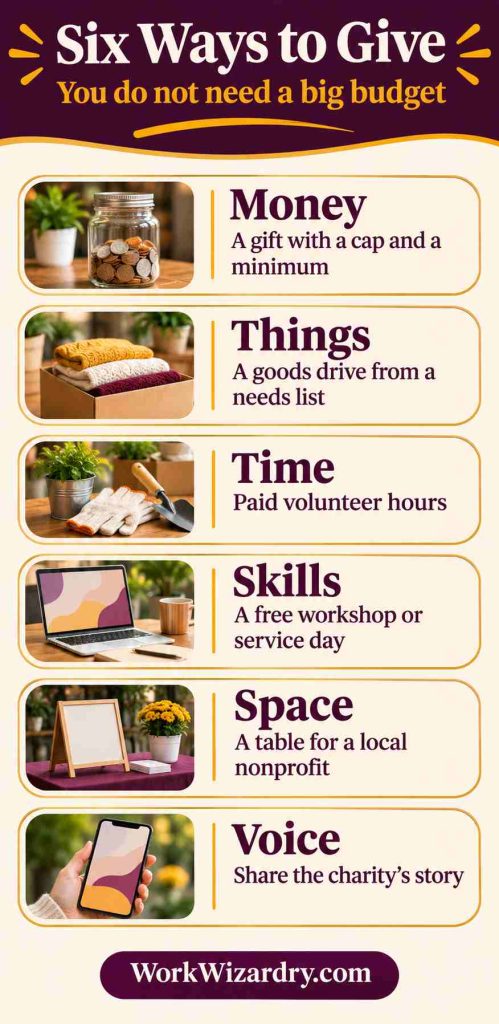
- Time, skills and space count. You do not need a big budget.
- Report the real total, thank people and keep giving after the day.
Want it all prepared for you? The Giving Tuesday Campaign Kit has a giving calculator in Excel, a charity scorecard, 40 posts, 8 emails, signs and a results report. This article is complete on its own.

Find Your Best Giving Tuesday Idea in a Minute
Giving Tuesday for restaurants and cafes, Giving Tuesday for retailers, online stores and service businesses all follow the same steps. Only the ideas change.
| You are | Start with | First move |
|---|---|---|
| A shop with foot traffic | A goods drive, a percent of sales with a cap, a round-up | Ask a charity for its needs list |
| An online store | A flat gift per order, a named product, a pledge with a link | Set the cap and write the rule |
| A cafe or bakery | A named drink, a pay-it-forward board, surplus donation | Pick one product to tie to the cause |
| A service business | A pro bono day, a free workshop, paid volunteer hours | Choose the skill you will give |
| A tiny budget | Time, skills, a story and a goods drive | Spend under $50 |
| A business with staff | Paid volunteer hours, a staff vote, a matching pool | Ask staff for a cause |
| A business that is tired of sale emails | One no-sale email about giving | Skip the offer and tell the story |
| An owner new to giving | A fixed pledge and a link to the charity | Give first, ask second |
What Is Giving Tuesday? The Numbers and Why It Fits a Small Business
Giving Tuesday ideas for businesses of any size start with the same basics.
| Question | Answer |
|---|---|
| What it is | A global day of giving held on the Tuesday after Thanksgiving, started in 2012. It is for money, goods, time, skills and speaking up. |
| The date | Tuesday, Dec 1, 2026 (the Tuesday after Thanksgiving, so Cyber Monday is the day before). |
| Who runs it | GivingTuesday is a nonprofit movement. It is not a government day or a shopping event. |
| Who can take part | Any person, business or group. You do not have to be a nonprofit. |
| What counts | Money, goods, volunteer time, skills, space and using your voice. |
Giving Tuesday is a nonprofit-led movement, not a shopping event. That matters for a business. People are asked to give, and a business that turns the day into another sale will feel out of place.
What happened in 2025. According to the GivingTuesday results for 2025, people in the US gave about $4.0 billion, and 38.1 million took part in some way.
| What people did | People | Change |
|---|---|---|
| US dollars given in 2025 | $4.0 billion | Up about 13% from the year before |
| People who took part | 38.1 million | Up about 6% |
| People who gave money | 19.1 million | Up about 3% |
| People who gave goods | 13.5 million | Up about 4% |
| People who volunteered | 11.1 million | Up about 20% |
| People who spoke up for a cause | 20.9 million | Up about 26% |
These are estimates from the GivingTuesday Data Commons, not a count of every gift. Two lines stand out for a small business. Dollars rose faster than the number of donors, so giving is concentrating among fewer, larger gifts. And volunteering and speaking up grew faster than money, which means your time and your voice are in demand, not only your cash.
Mind the fatigue. Your customers have had weeks of Black Friday, Small Business Saturday and Cyber Monday offers. A short, honest message about what you are giving and why can stand out because it asks for nothing.
Decide First: Your Goal, Your Budget and the Kind of Giving
Write down three things before you design anything.
- The goal. Money raised, goods collected, volunteer hours, or new customers who learn what you stand for. Pick one main goal.
- The budget. What you can give without hurting the business, in money and in staff time.
- The kind of giving. Money, goods, time, skills, space or voice. Time and skills are often the cheapest and the most useful.
A worked example. A small candle shop averages about $900 in sales and 45 orders on an ordinary Tuesday, with a 55% gross margin, so its gross profit is about $495. Here are three ways it could give, and what each costs on an ordinary day and on a busy one with $2,400 in sales and 120 orders.
| Idea | Ordinary day | Busy day |
|---|---|---|
| 5% of sales, $100 minimum, $250 cap | $100 | $120 |
| $2 per order, $150 cap | $90 | $150 |
| $8 profit on each of 20 candles of one product | $160 | $160 |
Now compare each gift to the shop’s gross profit, not only its sales. The 5% rule with a $100 minimum gives $100 on an ordinary day, which is 20% of gross profit. The $2 per order idea gives $90, about 18% of gross profit. The one-product idea gives $160, about 32% of gross profit. A gift that looks small as a share of sales can be large as a share of profit, and that is the number that decides whether you can afford it.
Rules of thumb: set a cap so a great day cannot cost too much, a minimum so a slow day still helps the charity, and write both down before you announce. The Excel calculator in the kit does this for your own numbers.
How to Choose and Vet a Charity: Seven Steps
Knowing how to vet a charity is the part most Giving Tuesday posts skip.
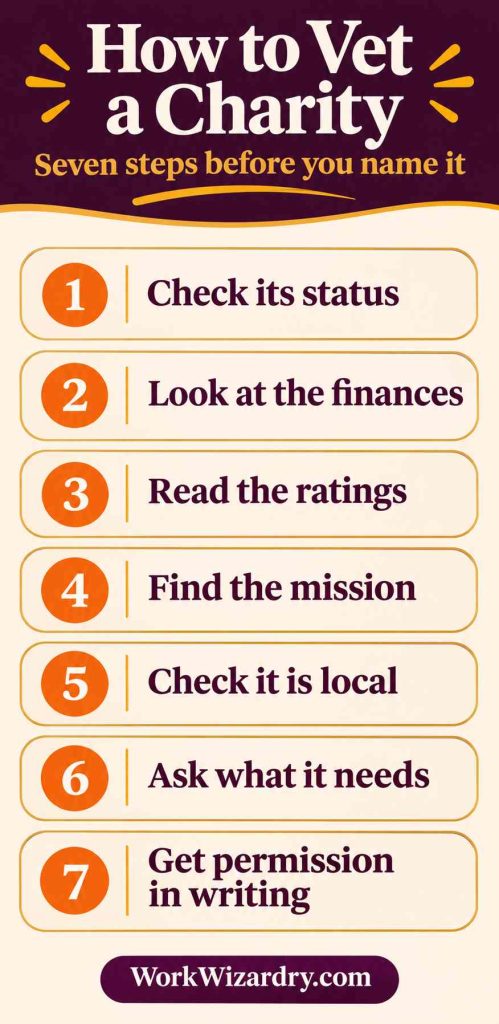
A small business puts its name next to a charity’s name. Check before you do.
- Check the status. Search the IRS Tax Exempt Organization Search to confirm the group is a recognized charity eligible for deductible gifts.
- Look at the finances. Open its Candid profile or its Form 990 and check how it spends money.
- Read the ratings. Look at Charity Navigator and Give.org for scores and standards.
- Find the mission. Read what it does in plain words. Choose a cause your customers will understand.
- Check it is local. A local charity is easier to verify, visit and talk about.
- Ask it three questions. What do you need most? Can you take a goods drive? Can I use your name and logo?
- Get permission in writing. Never use a charity’s name or logo without written permission, and send gifts directly to it.
A simple test: could you visit the charity, explain what it does in one sentence and send the gift directly to it? If not, pick another.
The Rules in Plain English (This Is Not Legal Advice)
Giving is simple. Advertising that you give is where small businesses get into trouble, and cause marketing for small business is regulated in many states. These are the points to know. Ask a lawyer and your accountant about your own case.
- Say exactly what you give. “A portion of sales” is vague. Say “5% of the day’s sales up to $500” and name the charity.
- Know the cause-marketing laws. If you advertise that a sale benefits a charity, you may be a commercial co-venturer under state law. Many states regulate it. Rules can include a written contract with the charity, disclosures in your ads and reports after the promotion. One-time promotions are less likely to need registration than ongoing ones. Check your state charity regulator or attorney general, and ask a lawyer.
- Be honest about results. Report the actual total after the day. Never say “up to” and then give less.
- Round-ups are the customer’s gift. Giving Tuesday customer donations at checkout belong to the customer. Money customers add is their gift, so the receipt or the charity’s acknowledgment matters to them, not to your books.
- Understand your own tax position. On the Giving Tuesday tax deduction for business, a gift can be deductible depending on how you are set up. A corporation generally cannot deduct more than 10% of taxable income, with a five-year carryover. You cannot deduct the value of your own time or services, and gifts to individuals are not deductible. Ask your accountant.
- Give the charity control. Send gifts directly, use its donation page and do not hold money for months.
- Keep every record. Save the charity’s thank-you, receipts and your calculations. For gifts of $250 or more, you need a written acknowledgment.
- Do not pressure. Ask once. Accept no. Never shame someone for not giving.
For the legal side, the Council of Nonprofits explains commercial co-ventures and cause-related marketing in plain language. For tax, start with IRS Publication 526. The pages are long, and counts of states with these laws vary by source, so check your own state.
Giving Tuesday Donation Ideas for Small Business, by What You Give
Give money: set the amount before you announce it
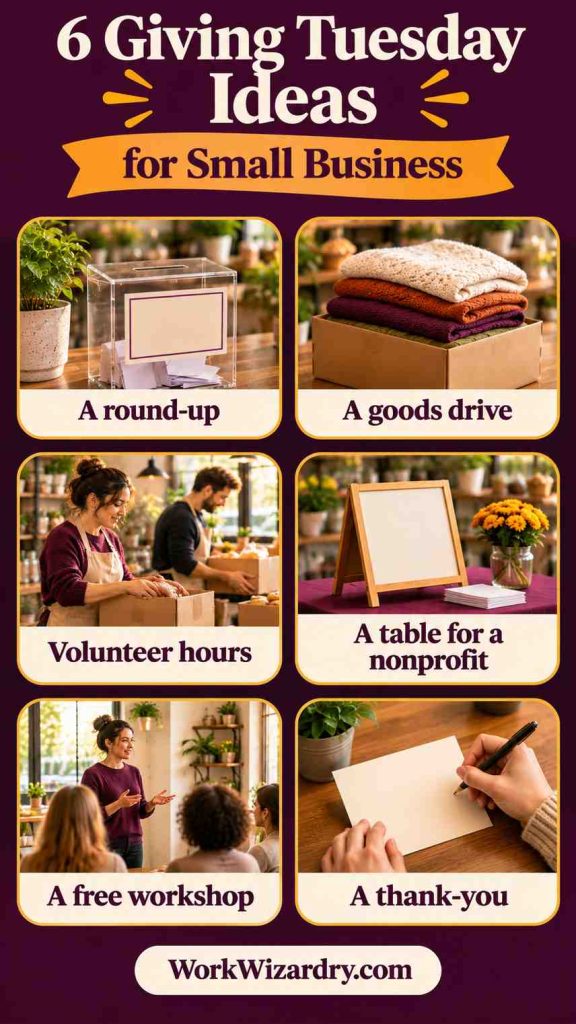
Money is the most common way for a small business to take part and the easiest to get wrong. Decide the amount, the cap and the charity first, then promise only what you can afford.
At a glance
| Idea | Cost | Time |
|---|---|---|
| A percent of the day’s sales, with a cap and a floor | Your choice | 1 hour to plan |
| A flat gift per order | $1 to $5 per order | 30 minutes |
| Donate the profit from one product | Profit on one item | 1 hour |
| A round-up at checkout | Free to set up | 1 to 3 hours |
| Match your customers’ gifts up to a cap | Up to your cap | 1 hour |
| Match your team’s gifts | Up to your cap | 30 minutes |
| Announce a pledge first, then top it up | A fixed pledge | 1 hour |
| Skip one sale email and give instead | Free | 30 minutes |
1. A percent of the day’s sales, with a cap and a floor
Pick a percent of the day’s sales (3% to 10% is common), set a maximum, and set a minimum you will give even on a slow day. Write the rule down before you post it.
- Why it works: A percent feels fair to customers and scales with the day, while the cap protects your margin and the floor protects the charity.
- Cost: Your choice · Time: 1 hour to plan
- Best for: Shops, cafes and service businesses
- Watch out: A promise to give “a portion of sales” can trigger state cause-marketing rules (see the rules section). Say exactly what you give and to whom.
- Sample line: “On Giving Tuesday we give 5% of the day’s sales to [charity], with a minimum of $100.”
2. A flat gift per order
Give a fixed amount for each order placed during the day. Set a total cap so a very busy day cannot hurt you.
- Why it works: A flat amount per order is simple to explain and simple to count.
- Cost: $1 to $5 per order · Time: 30 minutes
- Best for: Online stores and shops with steady orders
- Watch out: Do the math on a busy day before you promise it. Five dollars per order can be a large share of a small margin.
- Sample line: “For every order today, we give $2 to [charity].”
3. Donate the profit from one product
Choose one product, tell people it supports a cause and give the profit (or a stated amount) from every sale of that product.
- Why it works: One named product is clearer than a vague percent, and it is easy to track.
- Cost: Profit on one item · Time: 1 hour
- Best for: Product businesses
- Watch out: Say if you give profit, revenue or a fixed dollar amount. Those are very different.
- Sample line: “Every [product] sold today sends $4 to [charity].”
4. A round-up at checkout
Ask customers to round their total up to the next dollar for a charity. Train staff to ask once, kindly, and to accept no.
- Why it works: Round-ups are low effort for customers and add up over a day.
- Cost: Free to set up · Time: 1 to 3 hours
- Best for: Shops with a card reader or online checkout
- Watch out: The gift is the customer’s, not yours, so your own deduction is different. Pick a round-up tool that sends the money straight to the charity.
- Sample line: “Would you like to round up to the next dollar for [charity]? No pressure at all.”
5. Match your customers’ gifts up to a cap
Tell customers you will match what they give to the charity, up to a stated total. Report the real total afterwards.
- Why it works: A match gives people a reason to give today rather than later.
- Cost: Up to your cap · Time: 1 hour
- Best for: Businesses with a loyal list
- Watch out: Decide the cap first and never go over what you can pay. Do not claim a match you cannot honor.
- Sample line: “Give to [charity] today and we will match gifts up to $500.”
6. Match your team’s gifts
Offer to match whatever your employees give to a charity of their choice during the day, up to a set amount each.
- Why it works: Matching raises giving and shows staff that their choices matter.
- Cost: Up to your cap · Time: 30 minutes
- Best for: Employers of any size
- Watch out: Put the rules in writing: the amount, who is eligible and what counts.
- Sample line: “Give to a charity you care about today and the company will match you, up to $50.”
7. Announce a pledge first, then top it up
Announce a firm gift (for example $250) and invite customers to add to it through a link to the charity’s own page.
- Why it works: You make a guaranteed promise, and customers see their own gifts as extra.
- Cost: A fixed pledge · Time: 1 hour
- Best for: Small shops that want a safe start
- Watch out: Send customers to the charity’s official page, not to your own account.
- Sample line: “We are giving $250 to [charity]. Add yours here: [link].”
8. Skip one sale email and give instead
After weeks of Black Friday and Cyber Monday emails, send one note about giving and make no sale in it.
- Why it works: People are tired of offers, and a note about your community stands out.
- Cost: Free · Time: 30 minutes
- Best for: Anyone tired of sale emails
- Watch out: Do not smuggle in a discount. Keep it about the cause.
- Sample line: “No sale today. Here is what we are giving and why.”
Give things: goods drives and surplus
A Giving Tuesday goods drive works when a charity has a clear needs list. They fail when a business collects what it wants to clear out.
At a glance
| Idea | Cost | Time |
|---|---|---|
| A goods drive at your counter | $0 to $50 | 1 week |
| Donate surplus or unsold inventory | Free | 2 hours |
| A staff shop-and-drop | $100 to $500 | 2 hours |
| Assemble kits with your team | $100 to $400 | 2 hours |
| A coat, blanket or sock drive | $0 to $50 | 1 to 2 weeks |
| Donate prizes to a charity event | Value of the prize | 1 hour |
9. A goods drive at your counter
Ask a local charity for its current needs list, set out a box (a lockable acrylic donation box suits cash) and a sign, and arrange pickup. Photograph progress and share it.
- Why it works: A visible box makes giving easy and shows customers the result.
- Cost: $0 to $50 · Time: 1 week
- Best for: Shops with foot traffic
- Watch out: Collect only what is on the list, and plan where the box goes if it overflows.
- Sample line: “Bring items from [charity]’s list. We will deliver them on Friday.”
10. Donate surplus or unsold inventory
Offer surplus products to a charity that wants them. Ask the charity first about quantity, timing and food safety rules.
- Why it works: It turns waste into help at no extra cost.
- Cost: Free · Time: 2 hours
- Best for: Cafes, bakeries and retail
- Watch out: Food has safety rules, so confirm what the charity can accept before you bring anything.
- Sample line: “Today’s surplus goes to [charity].”
11. A staff shop-and-drop
Give each team member a small budget and an hour to buy items from the charity’s needs list, then deliver them together.
- Why it works: It is hands-on, and staff often pick the best items.
- Cost: $100 to $500 · Time: 2 hours
- Best for: Teams of 3 to 30
- Watch out: Keep receipts and agree the budget in advance.
- Sample line: “Our team went shopping for [charity]’s shelves today.”
12. Assemble kits with your team
Pack hygiene, school or winter kits using the charity’s list, and deliver them. A pack of clear zipper pouches holds hygiene items neatly.
- Why it works: A shared task builds team spirit and delivers something concrete.
- Cost: $100 to $400 · Time: 2 hours
- Best for: Teams that like a project
- Watch out: Ask the charity what contents are allowed and how to package them.
- Sample line: “We packed 40 kits for [charity] this afternoon.”
13. A coat, blanket or sock drive
Collect new or clean warm items and deliver them to a charity that distributes them.
- Why it works: Warm items matter in winter and are easy to give.
- Cost: $0 to $50 · Time: 1 to 2 weeks
- Best for: Shops in cold climates
- Watch out: Confirm whether the charity wants new items only.
- Sample line: “Warm things wanted: coats, blankets and socks.”
14. Donate prizes to a charity event
Offer a gift card, service or product as a prize at a local charity raffle or auction.
- Why it works: It supports the charity’s fundraiser without taking cash from you.
- Cost: Value of the prize · Time: 1 hour
- Best for: Service businesses and shops
- Watch out: Check that the charity is registered for raffles where it operates.
- Sample line: “We donated a [prize] to [charity]’s auction.”
Give time: volunteer hours and acts of service
Time is the one thing every business can give, and the day is a good moment to show what your team does when no one is selling.
At a glance
| Idea | Cost | Time |
|---|---|---|
| Paid volunteer hours for staff | 2 to 8 paid hours each | 1 hour to plan |
| A team volunteer shift | Paid time | 3 hours |
| Close early to volunteer | Lost sales | Half a day |
| Check on neighbors | Free | 2 hours |
| The owner volunteers on site | Free | 2 to 4 hours |
| Virtual volunteering | Free | 1 to 2 hours |
15. Paid volunteer hours for staff
Give each employee paid hours to volunteer on the day or in the weeks after. Put the policy in writing.
- Why it works: Paid hours let people take part without losing pay.
- Cost: 2 to 8 paid hours each · Time: 1 hour to plan
- Best for: Employers
- Watch out: Paid hours count as time worked, so check your payroll rules.
- Sample line: “You can use up to four paid hours to volunteer this week.”
16. A team volunteer shift
Book a shift at a food bank, shelter or park clean-up with a charity that wants groups.
- Why it works: A group shift is rewarding and creates stories to share.
- Cost: Paid time · Time: 3 hours
- Best for: Teams of 3 to 20
- Watch out: Charities need notice for groups, so book early.
- Sample line: “Our team spent the morning at [charity].”
17. Close early to volunteer
Close for part of the day and tell customers why. Plan for the lost sales.
- Why it works: It is a strong statement of values.
- Cost: Lost sales · Time: Half a day
- Best for: Businesses that can afford it
- Watch out: Count the cost and tell customers early, so they are not surprised.
- Sample line: “We close at 2 p.m. today so our team can volunteer.”
18. Check on neighbors
Send staff to check on older or housebound neighbors, run errands or share a hot drink.
- Why it works: It is personal and local.
- Cost: Free · Time: 2 hours
- Best for: Any business
- Watch out: Keep it safe, and tell people where staff are going.
- Sample line: “We spent the afternoon checking on neighbors.”
19. The owner volunteers on site
Spend a shift at a charity yourself and share what you did.
- Why it works: It shows leadership and costs nothing.
- Cost: Free · Time: 2 to 4 hours
- Best for: Owners
- Watch out: Do not turn it into a photo opportunity. Keep the focus on the charity.
- Sample line: “I spent the morning serving lunches at [charity].”
20. Virtual volunteering
Write letters, tutor, mentor or do tasks that charities can use from home.
- Why it works: Remote staff can take part, and small tasks add up.
- Cost: Free · Time: 1 to 2 hours
- Best for: Remote teams
- Watch out: Ask the charity what is useful, not what you think is.
- Sample line: “We wrote 50 notes for [charity] from our desks.”
Give skills and space
You may have more to give than money. Skills, space and attention often matter just as much to a small charity.
At a glance
| Idea | Cost | Time |
|---|---|---|
| A free workshop with a donation at the door | Your time | 2 hours |
| Offer your space to a nonprofit | Free | 1 hour |
| A pro bono service day | Your time | Half a day |
| Host a local nonprofit on site | Free | 2 hours |
| Share a charity’s story | Free | 1 hour |
| Sponsor a student or a young business | Your time | 1 to 2 hours |
21. A free workshop with a donation at the door
Teach a class or workshop and ask for donations to a named charity.
- Why it works: It shows what you do and brings new people in.
- Cost: Your time · Time: 2 hours
- Best for: Service businesses and makers
- Watch out: Make the donation optional and give the charity’s name and link.
- Sample line: “Free class tonight. Donations go to [charity].”
22. Offer your space to a nonprofit
Let a local nonprofit use a table, a corner or a back room for an event, with all proceeds going to them.
- Why it works: It brings foot traffic and helps a neighbor.
- Cost: Free · Time: 1 hour
- Best for: Shops and studios
- Watch out: Agree the rules in writing, including insurance, hours and clean-up.
- Sample line: “[Charity] has a table in our shop today.”
23. A pro bono service day
Give a charity a day of your services, such as a logo, a bookkeeping review or repairs.
- Why it works: Skills are expensive for small charities.
- Cost: Your time · Time: Half a day
- Best for: Designers, accountants, repairers
- Watch out: Scope the work in writing so it does not run on.
- Sample line: “Today we are doing [service] for [charity] at no charge.”
24. Host a local nonprofit on site
Invite a nonprofit to run activities in your shop and keep what they raise.
- Why it works: It gives them an audience and gives you a story.
- Cost: Free · Time: 2 hours
- Best for: Cafes and shops
- Watch out: Do not take a cut and do not ask them to buy anything.
- Sample line: “Meet [charity] at our counter from 10 to 2.”
25. Share a charity’s story
Post about a local charity, tag it and add its donation link. Ask permission and use its own words and photos.
- Why it works: A good post can raise more than a small gift.
- Cost: Free · Time: 1 hour
- Best for: Everyone
- Watch out: Share the charity’s link, not a link to your own account.
- Sample line: “Meet [charity]. This is what they do and how you can help.”
26. Sponsor a student or a young business
Offer an hour of advice or mentoring to a local student or young business owner.
- Why it works: Mentoring costs little and can change someone’s year.
- Cost: Your time · Time: 1 to 2 hours
- Best for: Established owners
- Watch out: Keep boundaries and be clear about what you offer.
- Sample line: “I am offering mentoring hours to local founders this week.”
Bring customers in
These Giving Tuesday in-store ideas work because the ask is clear, easy and honest, and Giving Tuesday customer donations stay optional. Avoid pressure and keep the focus on the cause.
At a glance
| Idea | Cost | Time |
|---|---|---|
| A give-a-gift display | $50 to $200 | 2 hours |
| A named item that supports a cause | Cost of setup | 3 hours |
| A pay-it-forward board | Cost of prepaid items | 1 hour |
| A community wall | $20 to $60 | 1 hour |
| A customer vote on the charity | Free | 1 hour |
| A kindness challenge | Free | 1 hour |
27. A give-a-gift display
Set up a display of items that customers can buy for a charity’s list, and deliver them.
- Why it works: It turns giving into a simple purchase.
- Cost: $50 to $200 · Time: 2 hours
- Best for: Retail
- Watch out: Use the charity’s list and sell items at cost or near it.
- Sample line: “Buy one for [charity]. We will deliver it.”
28. A named item that supports a cause
Make a limited item (a drink, a scent, a box) for the day and state exactly how much from each sale goes to the cause.
- Why it works: A named item is memorable.
- Cost: Cost of setup · Time: 3 hours
- Best for: Product businesses
- Watch out: State the amount per unit, and check cause-marketing rules.
- Sample line: “The Giving Blend: $3 from every cup goes to [charity].”
29. A pay-it-forward board
Let customers prepay a coffee or a loaf for someone who needs it, and keep a count on a board.
- Why it works: It is simple and heartwarming.
- Cost: Cost of prepaid items · Time: 1 hour
- Best for: Cafes and bakeries
- Watch out: Make it dignified, and track funds so they are used.
- Sample line: “Pay it forward: one coffee for someone who needs it.”
30. A community wall
Invite customers to write a thank-you or a wish for the neighborhood on cards and pin them up.
- Why it works: It is free to join and gives people a voice.
- Cost: $20 to $60 · Time: 1 hour
- Best for: Shops with wall space
- Watch out: Moderate the wall and take cards down on a set date.
- Sample line: “Write one thing you are thankful for in our neighborhood.”
31. A customer vote on the charity
Let customers vote on which local charity receives your gift.
- Why it works: People care about outcomes they helped choose.
- Cost: Free · Time: 1 hour
- Best for: Businesses with an active audience
- Watch out: Pick the shortlist yourself, and vet each charity first.
- Sample line: “Vote for which of these three charities gets our gift.”
32. A kindness challenge
Invite customers to do one kind act and post about it with your hashtag.
- Why it works: It spreads the day beyond your own giving.
- Cost: Free · Time: 1 hour
- Best for: Social media-friendly businesses
- Watch out: Make it optional, and do not make it a contest with prizes that need rules.
- Sample line: “Do one kind thing today and tell us about it.”
Bring your team in
Giving works best when employees help decide it. Staff choices make a program last.
At a glance
| Idea | Cost | Time |
|---|---|---|
| Let staff choose the charity | Free | 30 minutes |
| A staff giving day with a matching pool | $100 to $1,000 | 1 hour |
| A thank-you video from the team | Free | 1 hour |
| A year-round giving plan | Your choice | 2 hours |
33. Let staff choose the charity
Ask employees to nominate and vote on a charity, using a shortlist you have vetted.
- Why it works: People give more when they care about the cause.
- Cost: Free · Time: 30 minutes
- Best for: Employers
- Watch out: Do not pressure anyone to give personally.
- Sample line: “Which of these causes should we support this year?”
34. A staff giving day with a matching pool
Set aside a pool and match staff gifts until it runs out.
- Why it works: A pool makes the match feel real and the budget safe.
- Cost: $100 to $1,000 · Time: 1 hour
- Best for: Employers
- Watch out: Tell staff the rules and what happens when the pool is gone.
- Sample line: “We will match staff gifts until the $500 pool is used.”
35. A thank-you video from the team
Record a short video of staff thanking customers and naming the cause.
- Why it works: A human face builds trust.
- Cost: Free · Time: 1 hour
- Best for: Any team
- Watch out: Keep it short and honest.
- Sample line: “Thank you from all of us at [business].”
36. A year-round giving plan
Choose one cause and one small act each month so that Giving Tuesday is a start, not the whole year.
- Why it works: Regular giving builds trust more than a single day.
- Cost: Your choice · Time: 2 hours
- Best for: Owners
- Watch out: Keep the plan small enough to maintain.
- Sample line: “This is the first step in a year of giving.”
A 21-Day Giving Tuesday Campaign Plan, Counted Back From the Day
Counting back from the day keeps the plan working in any year.
| When | Task | What to do |
|---|---|---|
| 21 days before | Set the goal and budget | Decide what you will give and what you can afford. Write it down. |
| 18 days before | Pick and vet the charity | Use the 7-step checklist. Get written permission to use its name. |
| 14 days before | Write the rule | Percent, cap, floor and wording. Check cause-marketing rules and tax with your accountant or a lawyer. |
| 10 days before | Build the pieces | Signs, a donation page link, round-up setup, email and posts. |
| 7 days before | Announce | One email and one post. Say what, why and how. |
| 3 days before | Brief the team | Give staff the script, the answers and the rule. |
| 1 day before | Test everything | Links, round-up, signs, the donation total sheet. |
| The day | Run it | Post three times. Count orders and gifts. Thank people in real time. |
| The next day | Report | Share the actual total. Send the gift. Thank everyone. |
| 2 weeks after | Review | Note what worked, save receipts and plan your year of giving. |
A day-of run sheet
| When | Task | What to do |
|---|---|---|
| Morning | Open and post | Share your rule and the charity’s link. Put signs up. |
| Mid-morning | Brief the team | Remind staff of the script and the answers. |
| Noon | Check and post | Check totals so far and share one story. |
| Afternoon | Thank and share | Thank customers by name where they agree. Share progress. |
| Close | Count | Add up the total. Put it in the donation log. |
| Next morning | Announce the result | Post the final total and the date the gift goes. |
Messages You Can Copy: Posts, Emails and a Round-Up Script
Eight Giving Tuesday social media posts
- “Today is Giving Tuesday. We are giving [rule] to [charity]. Here is why we picked them: [one line].”
- “Our team is volunteering at [charity] today. We will share what we learn.”
- “Goods drive open at the counter until [day]. [Charity] needs [items]. Thank you for helping.”
- “We are matching your gifts to [charity] up to $500. Give here: [link].”
- “Thank you to everyone who gave today. Together we raised [amount] for [charity].”
- “No sale today. Just thank you. Here is what we are giving and why.”
- “Meet [charity]. They do [one line]. This is how you can help today.”
- “One kind thing today. Tell us yours with #GivingTuesday.”
Use #GivingTuesday, tag the charity with its permission and link to its own donation page.
An announcement email
“` Subject: What we are giving on Giving Tuesday
Hi [Name],
On Giving Tuesday, [date], we will give [rule] to [charity], which [one line about what it does].
There is nothing you need to buy. If you would like to help, you can give to [charity] directly at [link], bring items from its list to our counter, or simply share its story.
Thank you for being part of our community.
[Name] [Business] “`
A Giving Tuesday thank-you email
“` Subject: Thank you: here is what we gave
Hi [Name],
Thank you for being part of Giving Tuesday. Together we gave [total] to [charity]. [One line about what it will do].
Your support made it possible. We will tell you what happens next.
[Name] [Business] “`
A round-up script for the register
At the register: "Would you like to round up to the next dollar for [charity]? It goes straight to them. No pressure at all." If the customer says no: "No problem. Have a great day." If asked where it goes: "All of it goes directly to [charity]. They do [one line]."
Sign text
A small A-frame chalkboard sign on the counter is easy to change each year.
- Giving Tuesday: [rule] to [charity]
- Goods drive: [items] needed
- Round up for [charity]
- Thank you: we gave [amount] to [charity]
- Ask me about [charity]
Your Team: Giving Tuesday Volunteer Ideas, Matching and a Staff Vote
If you have employees, Giving Tuesday is a good moment to involve them, and a Giving Tuesday employee volunteer shift is one of the easiest ways to start. Ask staff to choose the charity from a list you have checked, offer paid volunteer hours, and consider Giving Tuesday matching gifts up to a set amount. Giving Tuesday paid volunteer time is often part of a wider policy of 8 to 40 hours a year, but there is no standard. Paid volunteer hours count as time worked, so confirm the payroll treatment. Keep everything optional and never pressure anyone to give. Our guide to workplace giving covers employer programs in full.
After the Day: Report, Thank and Keep Going
The next morning, post the real total, the date the gift will be sent and what it will do. Thank customers, staff and the charity. Send the gift directly and keep the charity’s thank-you for your records. Then note what worked and plan one small act a month so that Giving Tuesday is the start of a habit, not a one-day event.
Mistakes to Avoid
- Promising a percent without a cap and discovering it costs too much.
- Saying “a portion of sales” and not saying how much.
- Choosing a charity you have not checked.
- Using a charity’s name or logo without permission.
- Holding donations for weeks instead of sending them.
- Collecting goods the charity does not want.
- Claiming a match you cannot pay.
- Pressuring customers or staff to give.
- Posting only about your offer and not about the cause.
- Forgetting to report the real result.
- Treating Giving Tuesday as a sale.
- Forgetting that giving is a year-round habit.
Giving Tuesday Checklist: Check These Before the Day
- [ ] Goal: Have you written your goal and your budget?
- [ ] Charity: Have you vetted the charity and got permission to use its name?
- [ ] Rule: Is your rule in writing with a percent, a cap and a floor?
- [ ] Law: Have you checked state cause-marketing rules and your tax position?
- [ ] Pieces: Are your signs, links and round-up ready?
- [ ] Team: Does every staff member know the script and the answers?
- [ ] Record: Do you have a donation log ready?
- [ ] Report: Have you set the date to post the final total?
Giving Tuesday Campaign Kit: What the Paid Kit Adds
The article above is complete on its own. If you would rather have the tools and copy ready, the paid Giving Tuesday Campaign Kit adds:
- A giving calculator in Excel: percent-of-sales with a cap and floor, a flat gift per order, a round-up projector, a match tool, a donation log and a results report, all as formulas.
- A charity scorecard and a one-page partner agreement: a printable vetting form and a plain agreement template (general information, not legal advice).
- 40 posts and story scripts, 8 emails and 4 texts: announcement, reminder, thank-you and report, plus a press release and answers to customer questions.
- Signs and print set (Letter and A4): a donation thermometer, counter signs, bag tags, a window poster, thank-you cards and a 21-day checklist.
- For your team: an employee survey, a volunteer day run sheet and a paid volunteer time one-pager.
Related Guides
- November themes for work: every awareness day in the month.
- Workplace giving: employer programs, matching and paid volunteer time.
- Fundraising ideas for workplace teams: staff-run events.
- Cyber Monday ideas for small business: the day before.
- Small Business Saturday ideas: the weekend before.
- Thanksgiving employee appreciation ideas: thank your team too.
Frequently Asked Questions About Giving Tuesday for Small Business
When is Giving Tuesday in 2026?
Giving Tuesday 2026 is Tuesday, December 1. It always falls on the Tuesday after Thanksgiving, so it comes right after Black Friday, Small Business Saturday and Cyber Monday. A few calendar sites show December 2 or 3, but the official small business page lists December 1, so plan around that date.
How can a small business take part in Giving Tuesday?
A small business can give money, goods, time, skills or space. Common choices are a percent of the day’s sales with a cap, a goods drive at your counter, paid volunteer hours for staff, a free workshop, or a round-up at checkout. Pick one or two that fit your budget and name the charity clearly.
How much should a small business give on Giving Tuesday?
There is no set amount. Many small businesses give between 3% and 10% of the day’s sales or a flat sum such as $100 to $500. Start with what you can afford, set a cap and a minimum, and check what the gift is as a share of your profit, not only your sales.
Can I donate a percentage of sales to charity?
Yes, but say exactly what you give and to whom. In many states, advertising that a sale benefits a charity can make you a commercial co-venturer, which may need a written agreement with the charity, disclosures and a report afterwards. Check your state charity regulator or attorney general, and ask a lawyer before you advertise.
Are Giving Tuesday donations tax deductible for a business?
It depends on how your business is set up. A corporation generally cannot deduct more than 10% of its taxable income for charitable gifts and can carry extra forward for five years. You cannot deduct the value of your own time or services, and gifts to individuals are not deductible. Ask your accountant for your own case.
How do I choose a charity to support?
Choose a cause your customers understand, preferably local. Check that it is a recognized charity in the IRS Tax Exempt Organization Search, look at its profile on Candid, Charity Navigator or Give.org, and ask it what it needs most. Get written permission before you use its name or logo.
Is a round-up at checkout a good idea?
It can be, if you ask once, kindly, and accept no. The gift belongs to the customer, not to you, so it is not your own deduction. Use a tool that sends the money directly to the charity, tell customers where it goes and report the total afterwards.
What if I have no money to give?
Give time, skills, space or attention. You can volunteer a few hours, run a free workshop, offer your space to a nonprofit, share a charity’s story with its link or collect goods from its needs list. Small, specific gifts that fit the charity’s needs are better than a big gesture that does not.
Should I send a Giving Tuesday email, or is that too many emails?
Send one clear email, and keep it separate from sales. After several weeks of Black Friday and Cyber Monday messages, a short note about what you are giving and why stands out. Say what you will do, how people can help if they want to, and thank them afterwards.
How do I get my employees involved?
Ask staff to pick the charity from a vetted list, offer paid volunteer hours and consider matching their gifts up to a set amount. Make taking part optional, put the rules in writing and never pressure anyone to give. Paid volunteer time in company policies is often 8 to 40 hours a year.
What should I post on social media on Giving Tuesday?
Post three times: before, during and after. Say what you are giving and why, tag the charity with its permission and link to its donation page. Share a short story about the cause, thank people and post the real total the next day. Use #GivingTuesday and keep the tone warm, not promotional.
How do I report results after Giving Tuesday?
Post the real total, the date the gift was sent and what it will do, and thank customers and staff. Keep the charity’s thank-you and your calculation for your records. Save notes on what worked so you can plan next year, and tell the charity so it can thank people directly.
Sources: ideas, messages and checklists are original to Work Wizardry. Data: GivingTuesday 2025 results and the GivingTuesday small business toolkit. Tax: IRS Publication 526 and IRS Publication 542 (corporate limit of 10% of taxable income, five-year carryover). Law: Council of Nonprofits on commercial co-ventures. Charity checks: the IRS Tax Exempt Organization Search, Candid, Charity Navigator and Give.org.
