
This post contains affiliate links. As an Amazon Associate I earn from qualifying purchases, and Work Wizardry may earn a small commission at no extra cost to you. Prices and stock change, so check each listing before you buy.
World Kindness Day is Friday, November 13, 2026. The best World Kindness Day ideas for work are small, specific, optional and shared fairly: one specific compliment, credit given in a meeting, a small task taken off someone’s plate, a handwritten card, a two-minute thanks round. They cost little, and some research suggests they help the people who give, the people who receive and the people who watch.
The catch is that kindness at work can go wrong when it is forced, ranked or left to the same few people. This page gives you 30 ideas, an honest look at the research, seven rules to keep kindness fair, kind notes you can use, a free planner and a 12-day plan.
Key takeaways
- Small and specific wins. “Your handover note saved me an hour” beats “great job”.
- Make it optional. Nobody should have to take part, speak or smile.
- Share the load. Rotate the organising jobs. Kindness work should not fall on the same few people.
- No scoreboards. Do not count, rank or reward kindness.
- Kindness is not avoiding hard truths. Clear, caring feedback is kind.
- Build it into how you work: kind meetings, handovers and feedback last longer than an event.
- The research is encouraging, not conclusive. It is mostly small studies.
Want the worksheets and the tools? The free Kindness at Work Planner has an Excel kindness rotation and load check, a four-week five-acts tracker, a team charter, a pulse check, printable cards and a 45-minute run sheet.
Find Your Best Kindness Ideas in a Minute
| You are | Start with | First move |
|---|---|---|
| HR or people team | Kind meetings, a kindness rotation, a pulse check | Agree the norms with the team this week |
| A manager | Specific praise, kind and honest feedback, a two-minute thanks round | Say one specific thing to each person |
| A small team | A five-acts week, a thank-you card, a kind buddy | Start the first week on Friday |
| A remote or hybrid team | A kindness channel, a ten-minute thanks call, a mailed note | Open the channel today |
| A shift or frontline team | A shift-start shout-out, flexible cover, a help-wanted board | Brief your supervisors |
| A colleague who wants to help | One specific compliment, taking one thing off a plate, credit in the room | Pick one person and do it today |
World Kindness Day History, Date and the Days Around It
The World Kindness Day date is November 13 every year. According to the World Kindness Movement, the day was introduced in 1998 by this coalition of national organizations, which grew out of a 1997 conference in Tokyo. Sources disagree on the exact conference year (some say 1996, others 1997 or 1998), and we found no United Nations designation, so treat it as a widely observed but unofficial day. In 2026 it falls on a Friday, which suits a short observance at the end of the working week.
The days around it
| Day | Date | Note |
|---|---|---|
| World Kindness Day | Friday, November 13 | Observed internationally since 1998; started by the World Kindness Movement; not an official UN day (we found no UN designation) |
| Random Acts of Kindness Week | February | Run by the Random Acts of Kindness Foundation; check its site for the dates |
| International Friendship Day | July 30 | A UN day on connection; see our friendship day guide |
| Giving Tuesday | Tuesday, December 1 | The Tuesday after Thanksgiving; a day for giving |
Because the day is unofficial, nobody has to mark it. The point of this page is to help you make kindness a habit that does not depend on one date.
Kindness in the Workplace: What the Research Says (and What It Does Not)
The benefits of kindness at work are promising but thinly studied. Kindness is researched under several names (prosocial behavior, helping, organizational citizenship), and here is what we read, with the caveat for each.
| What was found | Source | Caveat |
|---|---|---|
| Employees who performed kind acts reported better wellbeing, higher life and job satisfaction and fewer depressive symptoms over time | Chancellor et al. 2018, Emotion (summarised by Berkeley Greater Good) | One multinational company in Spain; employees were assigned to give, receive or carry on as usual |
| Receivers of kindness paid it forward with about 278% more kind acts than the comparison group | Same study, Berkeley summary | A relative figure from a single company over a short period |
| People who only watched kind acts also improved on wellbeing | Same study, Berkeley summary | Observers improved less visibly than givers; details are in the paper |
| Kindness and prosocial behavior are often confused, and many studies use narrow samples | Hart 2024, special issue editorial (PMC) | Interventions such as ‘kindness media’ are barely tested |
| Toxic positivity (pressure to look cheerful) was linked to shame, exhaustion and intention to quit | Grosvenor and Loi, Scandinavian Journal of Psychology (301 Australian employees) | Indirect evidence: the study is not about kindness programs |
| A ‘systemic organizational citizenship behavior burden’ of helping limits women’s power | Bergeron, ‘Organizational Wives’, Center for Creative Leadership | We read the summary page only; read the paper before quoting figures |
The main study. In Chancellor and colleagues’ 2018 study in Emotion, summarised by the Berkeley Greater Good in Action project, employees of a Spanish multinational were assigned to perform kind acts, to receive them or to go to work as usual. People who performed kind acts reported better wellbeing, higher life and job satisfaction and fewer depressive symptoms, receivers reported more happiness and passed on far more kind acts, and observers also improved. It is one company, a modest sample and a short period. It supports trying kindness, not promising results.
What the field still lacks. A 2024 editorial in a special issue on prosocial behavior at work notes that kindness and prosocial behavior are often used interchangeably, that samples are narrow and that interventions are barely tested. It also reports a study linking organizational citizenship behavior to work stress. In other words, helping is not automatically free for the helper.
The caution. Research on toxic positivity at work, which is pressure to appear cheerful, found in a survey of 301 Australian employees that it was linked to shame, emotional exhaustion and intentions to quit (Grosvenor and Loi). It was not a study of kindness programs, so the evidence is indirect, but it is a reason to avoid forced cheer. And a 2025 Center for Creative Leadership paper describes a “systemic organizational citizenship behavior burden” of helping that limits women’s power. We read its summary page only, so read the paper before you quote figures.
How to Make Kindness Fair and Real: Seven Rules
These rules protect people from the worst version of a kindness campaign.
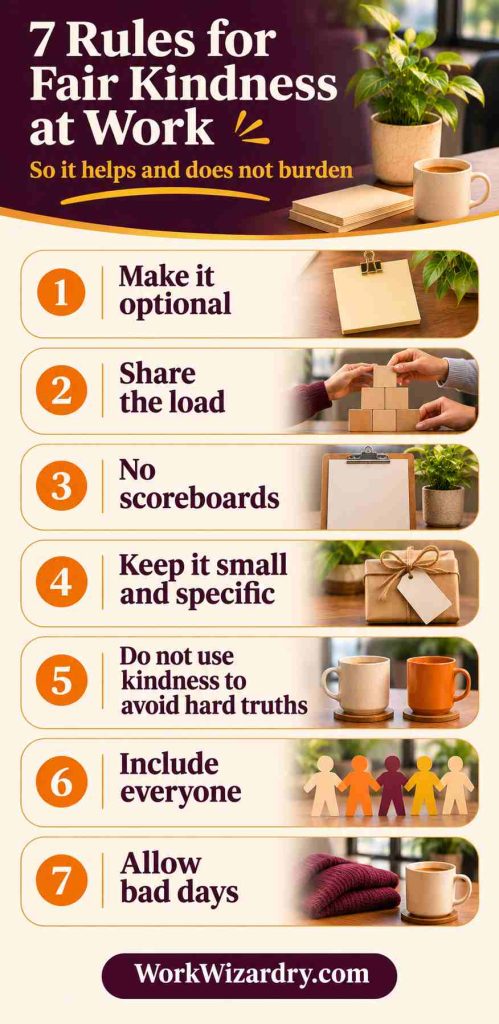
- Make it optional. Nobody should have to take part, speak, smile or perform. Invitations, not requirements.
- Share the load. Rotate the organising jobs, include managers and keep them small. Kindness work should not fall on the same few people.
- No scoreboards. Do not count, rank or reward the most kind. A leaderboard turns kindness into competition.
- Keep it small and specific. Kindness here means small acts toward a person. Big gestures are fine, but the everyday ones matter most.
- Kindness vs being nice: do not avoid hard truths. Clear, caring feedback is kind. Silence and vagueness are not.
- Include everyone. Remote, frontline, introverts, people from different cultures and people with disabilities. Offer private options and ask before praising in public.
- Allow bad days. Do not require positivity. People can be tired, annoyed or sad and still be treated with respect.
World Kindness Day Ideas for Work, by What They Do
These ideas for kindness at work each show cost, time, who they suit and one thing to watch. Pick two or three, not thirty.
Five-minute acts: small, specific and free
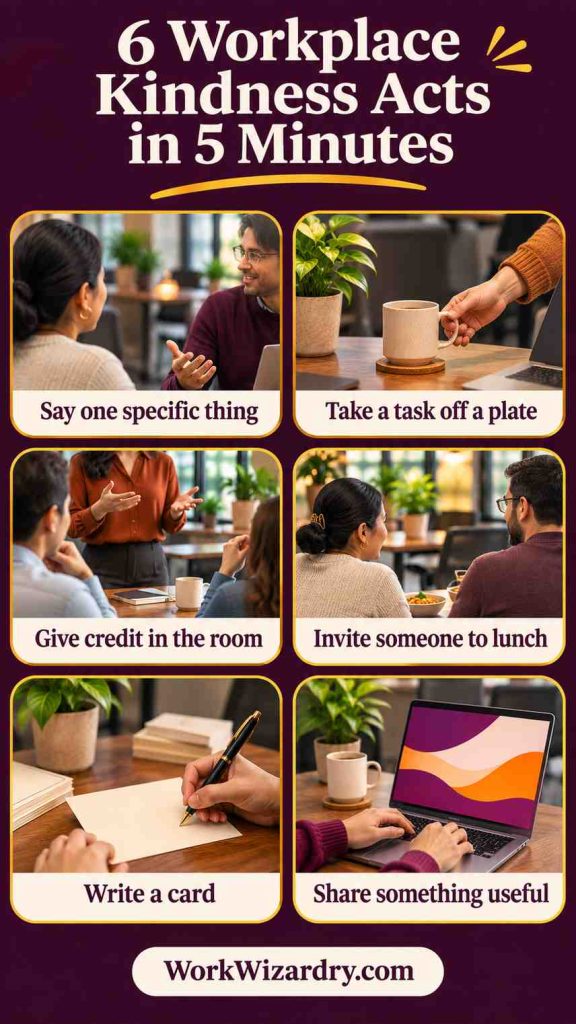
Most acts of kindness in the workplace are small. These are the random acts of kindness for coworkers that cost nothing, take minutes and can be done by anyone, on the day or any day.
At a glance
| Idea | Cost | Time |
|---|---|---|
| Say one specific thing you noticed | Free | 2 minutes |
| Take one thing off someone’s plate | Free | 15 minutes |
| Give credit in the room | Free | 1 minute |
| Ask how someone is, and wait | Free | 5 minutes |
| Invite the person who is eating alone | Free | 20 minutes |
| Write a recommendation | Free | 5 minutes |
| Pass on something useful | Free | 10 minutes |
| Tidy something shared | Free | 10 minutes |
1. Say one specific thing you noticed
Tell a colleague one thing they did well and why it mattered, in one or two sentences, in person or in writing.
- Why it works: Specific praise is believable. “Great job” is easy to forget, while “your summary saved me an hour” is not.
- Cost: Free · Time: 2 minutes
- Best for: Anyone
- Watch out: Mean it. Keep it about the work or the person’s conduct, not their appearance.
- Sample line: “Your handover note yesterday saved me an hour. Thank you.”
2. Take one thing off someone’s plate
Offer to take a small, defined task for someone who looks stretched: a call, a form, a coffee run, a first draft.
- Why it works: A concrete offer is easier to accept than “let me know if I can help”.
- Cost: Free · Time: 15 minutes
- Best for: Colleagues and managers
- Watch out: Make the offer specific and easy to decline. Do not take over a task they want to own.
- Sample line: “I have 15 minutes. Can I take the booking form off you?”
3. Give credit in the room
When an idea is raised, name the person it came from and what you liked about it.
- Why it works: Credit is one of the most valuable things to give, and it is free.
- Cost: Free · Time: 1 minute
- Best for: Meetings
- Watch out: Be accurate. Do not exaggerate, and do not take credit for the shared work of others.
- Sample line: “That was Priya’s idea, and it solved the delivery problem.”
4. Ask how someone is, and wait
Ask “How are you, really?” once, in private, and then listen without fixing.
- Why it works: People often answer “fine” until they are asked twice. A pause shows you mean it.
- Cost: Free · Time: 5 minutes
- Best for: Colleagues
- Watch out: Let them say “I’d rather not” without comment. Do not repeat what they said to others.
- Sample line: “How are you, really? No rush, I have ten minutes.”
5. Invite the person who is eating alone
Ask a colleague who is eating alone whether they would like company, and make it easy to say no.
- Why it works: Belonging is made of small invitations, especially for new or remote-first staff.
- Cost: Free · Time: 20 minutes
- Best for: Offices
- Watch out: Ask lightly. Some people prefer their own lunch, and that is fine.
- Sample line: “Want to join us? No pressure either way.”
6. Write a recommendation
Write a short, honest recommendation for a colleague or former colleague, on LinkedIn or in a company system.
- Why it works: A recommendation helps someone’s career long after the day is over.
- Cost: Free · Time: 5 minutes
- Best for: Anyone with a network
- Watch out: Say only what is true, and give an example.
- Sample line: “I worked with Sam for three years. Here is what stood out.”
7. Pass on something useful
Share a template, a contact, a shortcut or a link you wish you had known earlier, with a line on why.
- Why it works: Sharing what you know saves other people hours.
- Cost: Free · Time: 10 minutes
- Best for: Anyone
- Watch out: Check that it is allowed to be shared and that it is current.
- Sample line: “Here’s the template I use for status reports. Take it.”
8. Tidy something shared
Clean the break room counter, reorganise a shared folder or fix an out-of-date page nobody owns.
- Why it works: Shared spaces rarely belong to anyone, so small repairs are noticed by everyone.
- Cost: Free · Time: 10 minutes
- Best for: Offices and shared drives
- Watch out: Do not make a point of it. The kindness is the repair.
- Sample line: “I fixed the broken links in the team handbook.”
Team habits: kindness that does not rely on one person
A habit beats a stunt. These ideas keep kindness going after November 13, and they are designed so the work is shared.
At a glance
| Idea | Cost | Time |
|---|---|---|
| A five-acts week | Free | 10 minutes a week |
| A kindness rotation | Free | 15 minutes to set up |
| A two-minute thanks round | Free | 2 minutes |
| A kindness channel without a scoreboard | Free | 1 hour |
| Thank you cards for coworkers, left on the desk | $5 to $20 | 1 hour |
| A help-wanted board | Free | 30 minutes |
| A kind buddy for new starters | Free | 30 minutes to set up |
| A moderated kind note wall | $5 to $15 | 1 hour |
9. A five-acts week
Once a week for four weeks, each person lists five people and one small kind act for each, does all five in a day and notices what happens. The Berkeley Greater Good practice suggests exactly this, and it is five acts of kindness in a day.
- Why it works: It turns good intentions into a plan, and a month is long enough to see a change.
- Cost: Free · Time: 10 minutes a week
- Best for: Teams
- Watch out: Keep it voluntary and private. Do not collect or rank the results.
- Sample line: “This week: five people, five small acts.”
10. A kindness rotation
Share the small organising jobs (starting the thanks round, welcoming a newcomer, writing a card) round-robin so they pass around the team every week.
- Why it works: Without a rotation, kindness work often lands on the same few people, and they burn out.
- Cost: Free · Time: 15 minutes to set up
- Best for: Teams of five or more
- Watch out: Include managers and senior staff in the rotation. Do not make the jobs large.
- Sample line: “This week’s kindness lead is Alex. Next week it’s Sam.”
11. A two-minute thanks round
Open a regular meeting with two minutes in which anyone who wants to can thank someone, with no obligation to speak.
- Why it works: It builds a habit of noticing, and it takes almost no time.
- Cost: Free · Time: 2 minutes
- Best for: Team meetings
- Watch out: Make speaking optional. Do not go round the table.
- Sample line: “Thanks to Maria for covering Monday.”
12. A kindness channel without a scoreboard
Create a shared channel where people can post a short thank-you, with a rule that there are no counts, points or rankings.
- Why it works: A channel gives remote teams a place to notice each other.
- Cost: Free · Time: 1 hour
- Best for: Remote and hybrid teams
- Watch out: Moderate it, and make sure the same people are not always thanked. Do not rank anyone.
- Sample line: “Thank you to the whole night shift for the stock count.”
13. Thank you cards for coworkers, left on the desk
Leave a handwritten card (a box of blank thank-you cards keeps a stack handy) on someone’s desk, signed or unsigned, saying one thing you value.
- Why it works: A physical card is a keepsake, and it is more personal than an emoji.
- Cost: $5 to $20 · Time: 1 hour
- Best for: Offices
- Watch out: Remember colleagues who work remotely. Mail a card to them instead.
- Sample line: “Thank you for being the calm in the busy week.”
14. A help-wanted board
Put up a board or a thread where people can ask for small help (swap a shift, proofread a note, lend a charger) and others can pick it up.
- Why it works: Many people will not ask for help unless there is an easy, normal way to do it.
- Cost: Free · Time: 30 minutes
- Best for: Teams and shift groups
- Watch out: Make asking normal. Thank people who ask as well as those who help.
- Sample line: “I need 10 minutes to check a form. Anyone free?”
15. A kind buddy for new starters
Pair each new starter with a buddy for their first 30 days, to answer small questions and sit together at lunch.
- Why it works: New people often feel unable to ask the “silly” questions. A buddy gives them a safe place to ask.
- Cost: Free · Time: 30 minutes to set up
- Best for: Teams that hire
- Watch out: Rotate buddies, and ask the new starter whether the match is working.
- Sample line: “Your buddy is Jo. Ask them anything.”
16. A moderated kind note wall
Put up a board where people can pin a short, positive note (a pack of sticky notes works) about a colleague, with a moderator who removes anything unkind or personal.
- Why it works: A note wall gives visible, shared appreciation without asking people to speak.
- Cost: $5 to $15 · Time: 1 hour
- Best for: Offices
- Watch out: Check notes before they go up, and ask whether people are happy to be named.
- Sample line: “Pin a note for someone who helped you.”
Kindness in how we work: policy and practice
The strongest kindness is built into how a team works every day. These ideas change habits rather than add events.
At a glance
| Idea | Cost | Time |
|---|---|---|
| Kind meetings | Free | 1 hour to agree |
| Kind handovers | Free | 10 minutes |
| Kind feedback that is also honest | Free | 15 minutes |
| Share a mistake and what you learned | Free | 5 minutes |
| Kind email norms | Free | 30 minutes |
| Flexible cover on a hard day | Cost of cover | 1 hour to set up |
17. Kind meetings
Agree five norms: start on time, end early, invite the quiet voices, no interruptions and no side conversations on screens.
- Why it works: Meetings are where most people experience the culture of a team.
- Cost: Free · Time: 1 hour to agree
- Best for: Any team
- Watch out: Write the norms down and review them after a month.
- Sample line: “We start at 10:00 sharp and finish at 10:25.”
18. Kind handovers
Write the handover note you would like to receive: what is done, what is not, what is risky and who to ask.
- Why it works: A good handover saves the next person stress and hours.
- Cost: Free · Time: 10 minutes
- Best for: Shift and project work
- Watch out: Keep it short. Say what is risky first.
- Sample line: “Handover: done, not done, watch out, ask [name].”
19. Kind feedback that is also honest
Say the problem clearly and say you care about the person’s success in the same sentence.
- Why it works: Kindness is not avoiding hard truths. Clear, caring feedback respects people more than silence.
- Cost: Free · Time: 15 minutes
- Best for: Managers
- Watch out: Do it in private, soon after, and about behavior, not character.
- Sample line: “I want you to do well here, and this report needs to change.”
20. Share a mistake and what you learned
A leader describes a recent mistake and what they changed.
- Why it works: It shows that mistakes are survivable, which makes it easier for others to speak up.
- Cost: Free · Time: 5 minutes
- Best for: Leaders
- Watch out: Choose a real, modest mistake. Do not turn it into a performance.
- Sample line: “Here’s what I got wrong last month, and what I do now.”
21. Kind email norms
Agree norms: no late-night pings, a clear ask in the first line, ‘no reply needed’ when true and no reply-all pile-ons.
- Why it works: Email is where small unkindnesses add up.
- Cost: Free · Time: 30 minutes
- Best for: Remote and hybrid teams
- Watch out: Review the norms after a month, and apply them to leaders too.
- Sample line: “Subject: [No reply needed] Notes from today.”
22. Flexible cover on a hard day
Make it normal to swap or cover shifts when a colleague has a family emergency or a hard day, with a simple, written way to do it.
- Why it works: It treats people as people, and it builds goodwill that comes back.
- Cost: Cost of cover · Time: 1 hour to set up
- Best for: Frontline and shift teams
- Watch out: Write the rules down so the favor does not depend on who you know.
- Sample line: “If you need to swap, ask the board. Someone usually can.”
World Kindness Day for remote teams, hybrid teams and frontline workers: kindness without a shared room
Kindness for frontline workers and remote staff needs different habits from an office. Make them easy to join and easy to skip.
At a glance
| Idea | Cost | Time |
|---|---|---|
| A ten-minute thanks call | Free | 10 minutes |
| A handwritten note, mailed | $3 to $6 each | 30 minutes |
| A shift-start shout-out | Free | 5 minutes |
| Kind scheduling across time zones | Free | 30 minutes |
23. A ten-minute thanks call
A short, optional call at the start of the day where anyone can say thank you, with no agenda.
- Why it works: It gives a spread-out team a shared moment.
- Cost: Free · Time: 10 minutes
- Best for: Remote teams
- Watch out: Make it optional, and do not require video.
- Sample line: “Optional 10 minutes at 9:00: say thanks, then go.”
24. A handwritten note, mailed
Mail a short handwritten note to a remote colleague, after asking whether they would like one.
- Why it works: A note on the doormat feels more personal than another message in the inbox.
- Cost: $3 to $6 each · Time: 30 minutes
- Best for: Remote teams
- Watch out: Ask first. Many people prefer to keep their home address private.
- Sample line: “A note is on its way, with thanks.”
25. A shift-start shout-out
Open each shift with a supervisor thanking a named person for something specific.
- Why it works: Frontline staff are often missed in recognition schemes, and this reaches them where they are.
- Cost: Free · Time: 5 minutes
- Best for: Factories, hospitals, shops and call centers
- Watch out: Rotate who is thanked, and be accurate.
- Sample line: “Before we start, thanks to Dee for the safe stack yesterday.”
26. Kind scheduling across time zones
Rotate the inconvenient meeting times so the same people do not always take the early or late slot.
- Why it works: It treats fairness as part of kindness.
- Cost: Free · Time: 30 minutes
- Best for: Global teams
- Watch out: Record the rotation, and say thank you to whoever takes the hard slot.
- Sample line: “This month the late call is on our side. Next month it’s yours.”
Giving beyond work: kindness with a wider reach
Many teams like to turn the day outward. Ask the receiving group what it needs, and check any charity before you give.
At a glance
| Idea | Cost | Time |
|---|---|---|
| A paid hour for a kind act in the community | Cost of an hour | 1 hour per person |
| A needs-list drive | $0 to $100 | 1 week |
| A pro bono hour of skills | Time | 1 hour |
| Lunch from a local small business | $50 to $300 | 1 hour |
27. A paid hour for a kind act in the community
Give every employee a paid hour to do a kind act in their own community, from helping a neighbor to volunteering.
- Why it works: It lets people choose what matters to them, without a company project.
- Cost: Cost of an hour · Time: 1 hour per person
- Best for: Employers that can offer time
- Watch out: Make it optional, and trust people. Do not ask them to prove it.
- Sample line: “You have an hour on us. Do something kind.”
28. A needs-list drive
Ask a local charity for a list of items it needs, then collect those items for a week. Check the charity first.
- Why it works: Giving what is needed is more useful than giving what is convenient.
- Cost: $0 to $100 · Time: 1 week
- Best for: Offices
- Watch out: Check the charity’s rating and registration. Do not collect used items unless it asks for them.
- Sample line: “This week we’re collecting the items on the shelter’s list.”
29. A pro bono hour of skills
Offer an hour of your skill, such as editing, spreadsheet help or design, to a small charity or a neighbor’s business.
- Why it works: A skilled hour can be worth more than a donation.
- Cost: Time · Time: 1 hour
- Best for: Teams with skills to share
- Watch out: Agree what you will and will not do before you start.
- Sample line: “I can give your newsletter a one-hour edit.”
30. Lunch from a local small business
Order the team’s lunch from a local small business, and say thank you to the owner.
- Why it works: It turns appreciation into business for a neighbor. Our Small Business Saturday guide has more.
- Cost: $50 to $300 · Time: 1 hour
- Best for: Offices
- Watch out: Order early, pay promptly and ask about allergens.
- Sample line: “Lunch from the bakery two streets away.”
Kind Notes for Coworkers, Messages and Emails You Can Use
A kind note works when it is specific, short and true. Change the details. For many more thank-you messages, see our guide to professional thank-you messages for appreciation.
Notes to a colleague
- Thank you for staying calm when it got busy. It helped me stay calm too.
- I noticed how patient you were with that customer. I learned from it.
- Your note at the end of the project made my week.
- You always make time to explain things. Thank you.
- I appreciated you covering for me on Tuesday. I owe you one, and I mean it.
- The way you ran that meeting made everyone feel heard.
- You make the hard days easier to get through. Thank you.
- I was struggling with that spreadsheet, and you fixed it in ten minutes. Thank you.
- Thank you for remembering my first week and being so kind.
- You said what needed saying, and you said it kindly. That is rare.
Notes for someone having a hard time
Keep these private and short, and do not require a reply.
- I noticed you’ve had a tough week. No need to reply. I’m here if you want a coffee.
- I’m thinking of you. If you want me to take something off your plate, tell me what.
- You don’t have to be fine. Take the time you need, and I’ll cover what I can.
- I’m sorry about what you’re going through. I’m happy to listen, or to leave you in peace, whichever helps.
- Whatever happens with the project, you did good work. I mean that.
Notes from a manager
- I want you to know that I see how hard you’ve worked this month. Thank you.
- Your idea last week changed how we do things. I should have said so at the time.
- If you’re stretched, tell me, and we’ll work out what to move.
- I appreciate you saying what the rest of us were thinking.
- You don’t need to answer this tonight. Take the evening off.
Lines for kindness cards
- Thank you. It mattered.
- I noticed. Thank you.
- You made today easier.
- Thank you for being kind about it.
- I’m glad you’re on this team.
- Thank you for listening.
- You helped, and I won’t forget it.
- Thanks, from all of us.
A World Kindness Day email to employees
Subject: World Kindness Day, in small ways
Hi team,
Friday is World Kindness Day. We are not planning a party. We would simply like to make it easier to be kind to each other this week.
Here is what is on offer, all optional: – A two-minute thanks round at Friday’s team meeting. – A card on every desk, to write or to leave. – A shared channel for short thank-yous. There are no points or rankings. – A five-acts week, if you would like to try it.
If you would rather not take part, that is completely fine.
Thank you for the way you treat each other. [Name]
World Kindness Day social media posts
Use real people and real details, with permission.
A plain note
Today is World Kindness Day.
We’re not doing anything big. We’re saying thank you to the people we work with, in small, specific ways.
Who helped you this week?
About the team
Our team’s kindest habit: we write the handover note we’d want to receive.
Nothing fancy. It makes everyone’s Monday easier.
A question
What’s one small thing a colleague did for you that you still remember?
Tell us in the comments. We’ll go first: someone made us a coffee on the worst day of the year.
A reminder
Kindness at work doesn’t have to be a big gesture.
Specific praise. Credit in the room. Taking a task off someone’s plate. Five minutes each.
A local note
Lunch today came from the bakery two streets away. We said thank you to the owner in person.
Shop local, and say it out loud.
Remote
Our remote team has a ten-minute call on Friday mornings. Optional, no agenda, just thanks.
It’s the best ten minutes of the week.
A boundary
Kindness doesn’t mean saying yes to everything.
It means saying no clearly, and saying thank you often.
A thank-you
Thank you to everyone who took part today, and to everyone who didn’t. Both are fine.
A 45-Minute Kindness Hour at Work
If you want one simple event, this needs a room or a call, pens and some cards. Everything is optional.
| Time | Activity | What to do |
|---|---|---|
| 0:00 to 0:05 | Welcome | A leader explains the idea in two sentences and says taking part is optional. |
| 0:05 to 0:15 | Five-acts planning | Each person writes five names and one small act for each, privately. |
| 0:15 to 0:25 | Thank-you cards | Write one or two cards, signed or unsigned. Leave them or mail them. |
| 0:25 to 0:35 | Pairs: one thing I noticed | In pairs, each person tells the other one specific thing they noticed. Skip if uncomfortable. |
| 0:35 to 0:42 | Agree one norm | Choose one kind-meeting or kind-email norm to try for a month. |
| 0:42 to 0:45 | Close | Say what happens next: a four-week five-acts practice, a pulse check in a month. |
A Four-Week Kindness Challenge for Work
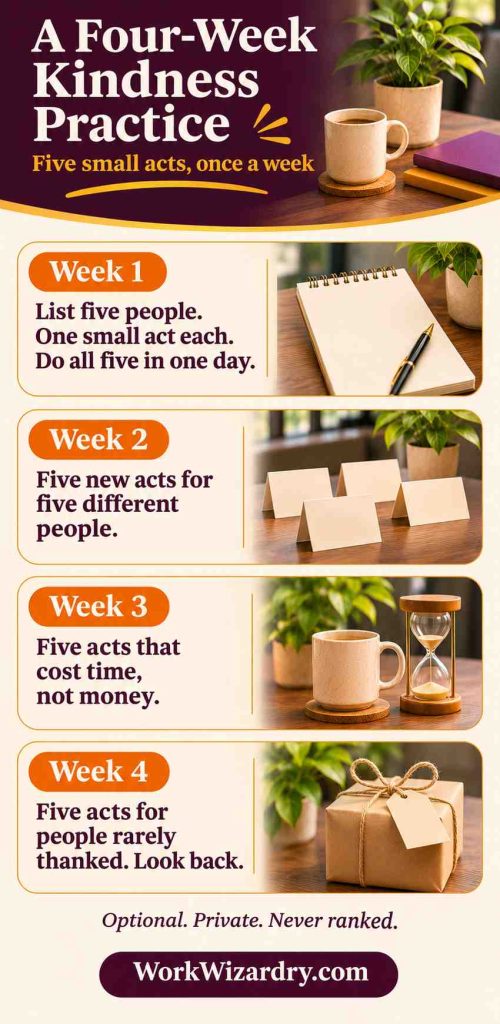
The Berkeley Greater Good in Action practice suggests listing five people at or related to work and one small kind act for each, doing all five in one day and repeating once a week for four weeks. Each act should take up to five minutes. Here is a way to run it with a team.
| Week | What to do |
|---|---|
| Week 1 | List five people and one small act for each. Do all five in one day. Notice how it feels and how people respond. |
| Week 2 | Do five new acts for five different people, including someone you do not know well. |
| Week 3 | Do five acts that cost time rather than money, such as taking a task off someone’s plate. |
| Week 4 | Do five acts for people you find difficult, or who are rarely thanked. Look back over the month. |
Keep it private and optional. Do not collect or rank the results. At the end of the month, ask each person what they noticed and keep one habit.
Your 12-Day Plan to World Kindness Day
From November 1 there are 12 days to Friday, November 13. If you are starting late, do the first row, the “Announce” row and the last three.
| When | Focus | What to do |
|---|---|---|
| 12 to 10 days out | Decide | Choose two or three ideas. Decide the one norm to try. Ask a few colleagues what they would like. |
| 9 to 8 days out | Prepare | Print cards. Open the shared channel. Draft the announcement and the rotation. |
| 7 to 5 days out | Announce | Send the announcement email. Open the channel. Brief managers. |
| 4 to 2 days out | Set up | Set the room or the call. Fix the rota for the thanks round. Print the pulse survey. |
| 1 day out | Final checks | Remind the team the day is optional. Check accessibility. |
| Nov 13 | The day | Run the 45-minute hour or the two-minute thanks round. Share the cards. |
| The next week | Start the practice | Week 1 of the five-acts practice. Rotate the kindness lead. |
| Four weeks later | Check | Run the three-question pulse. Review the load check. Keep what worked. |
How to Tell Whether It Worked: A Kindness Pulse Check and a Kindness Load Check
Judge kindness by what people experience, not by how many acts were counted. Run these two checks after a month.
1. A three-question kindness pulse check. Ask the whole team, anonymously, to answer each on a scale of 1 (not at all) to 5 (very much):
- In the past month, someone at work did something kind for me.
- I felt able to ask for help when I needed it.
- The kindness here is shared fairly, not left to a few people.
If the third score is low, the kindness is not being shared fairly, and that is the first thing to fix.
2. A kindness load check. Once a month, ask each person to say roughly how many times they helped someone and how many times they were helped, with names optional. If one person helps far more than the average, spread the load. The free planner has a sheet that flags anyone giving more than twice the average, using only the counts, never the names of who was helped.
Check These Before the Day
| Check | What to ask |
|---|---|
| Optional | Is every part optional, with no pressure to speak, smile or attend? |
| Fair | Is the organising work rotated, with managers included? |
| No scoreboard | Are there no counts, points or rankings of kindness? |
| Inclusion | Does it work for remote, frontline and shy colleagues, and for people with disabilities? |
| Private | Do we ask before we praise anyone in public or share a story? |
| Honest | Does it avoid using kindness to hide a real problem? |
| Time and pay | If it takes working time, is that time paid and optional? |
| Follow-through | Is there a plan for after November 13? |
After November 13: Keep Kindness Going
One day does not change a culture. To keep it going, pick one norm (kind meetings, kind handovers or kind email) and try it for a month. Rotate the kindness lead each week. Run the pulse check in December and again in February, when the Random Acts of Kindness Foundation runs its own week (check its site for the dates). The best sign that it is working is that people stop calling it a campaign.
Free Kindness at Work Planner
Plan it in an afternoon, and keep it fair. The free kit includes:
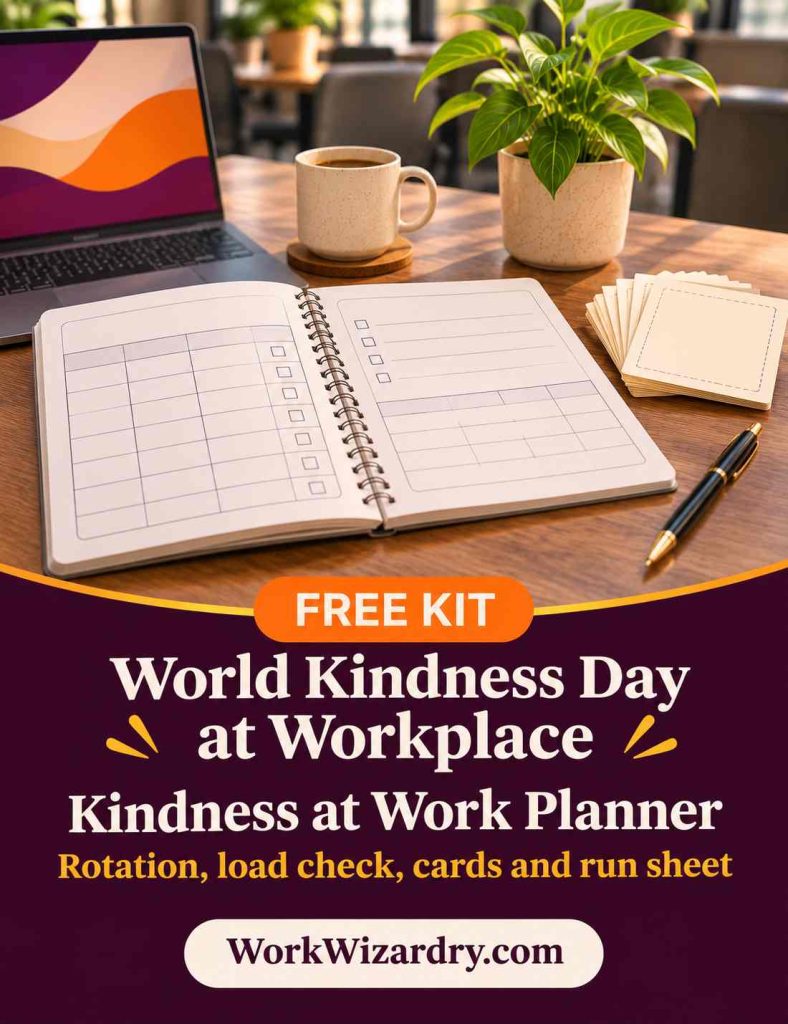
- A kindness rotation in Excel. Enter your team’s names and it assigns the organising jobs round-robin across weeks.
- A load check that counts acts given and received and flags anyone giving more than twice the average.
- A four-week five-acts tracker and a three-question pulse tally.
- A team kindness charter with the norms to agree.
- Printable kind note cards, a kind-meeting checklist and a pulse survey (Letter and A4).
- A 45-minute run sheet, an announcement email and a 12-day plan with dates.
Related Guides
- Professional thank-you messages for appreciation: more notes to say thank you.
- November themes for work: every awareness day in the month.
- How to celebrate International Friendship Day in the workplace: another day about connection.
- Thanksgiving employee appreciation ideas: thank your whole team.
- Small Business Saturday ideas: buy kindness from a local shop.
Frequently Asked Questions About World Kindness Day at Work
When is World Kindness Day in 2026?
World Kindness Day is observed every year on November 13, which is Friday, November 13, 2026. It was introduced in 1998 by the World Kindness Movement, a coalition of national organizations. It is not an official United Nations day, and sources differ on whether the first conference was held in 1996, 1997 or 1998.
How do you celebrate World Kindness Day at work?
Keep it small, optional and specific: give a colleague one specific compliment, open a meeting with a two-minute thanks round, write a card, take a small task off someone’s plate or invite someone to lunch. Then agree one habit to keep, such as a kind-meeting norm or a four-week five-acts practice.
What are good random acts of kindness at work?
Specific praise, giving credit for an idea, offering to take over a small task, asking how a colleague really is, inviting someone who eats alone, writing a recommendation, sharing a useful template and tidying a shared space. They cost little and take minutes, and they work best when they are real and specific.
Does kindness at work improve wellbeing?
Research suggests it can. In a 2018 study in Emotion, employees at a Spanish multinational who performed kind acts reported better wellbeing, higher life and job satisfaction and fewer depressive symptoms, and people who received kindness paid more of it forward. It was one company and a modest sample, so treat it as encouraging, not conclusive.
What are the downsides of workplace kindness programs?
Forced cheerfulness can backfire. A survey of 301 Australian employees linked toxic positivity to shame, exhaustion and intention to quit, and research on helping at work suggests the burden often falls unevenly. Keep participation optional, rotate the work, avoid scoreboards and do not use kindness to avoid hard conversations.
What is the difference between kindness and being nice?
Niceness avoids discomfort. Kindness cares about the person even when it is uncomfortable. A kind manager says the problem clearly and says they want the person to succeed. A merely nice one stays vague to avoid friction. At work, kindness includes honest feedback, fair workloads and respect for boundaries.
What World Kindness Day ideas work for remote teams?
Try an optional ten-minute thanks call, a shared channel for short thank-yous with no points, a mailed handwritten note (after asking for an address), a kindness buddy for new starters and a rotation of inconvenient meeting times across time zones. Do not require video, and ask before sharing anyone’s story.
How do I make kindness at work fair and not exhausting?
Rotate the organising jobs, keep them small and include managers. Do not make one person the kindness champion. Avoid counting or ranking acts. Check the load once a month: if the same few people give most of the help, redistribute it. The free planner includes a rotation and a load check.
Should we recognise kindness with rewards?
Be careful. Rewards and leaderboards can turn kindness into competition and encourage performance instead of care. A simple, private thank-you is usually better. If you do recognise people, ask them first, rotate who is thanked, describe the specific act and avoid ranking anyone.
How long should a kindness practice last?
A month is a good start. The Berkeley Greater Good practice suggests listing five people and doing one small kind act for each, in one day, once a week for four weeks, then noticing the response. After a month, keep one habit that worked and drop the rest.
What should I say in a kind note to a colleague?
Name the person, say one specific thing they did and what it meant to you, and stop. For example, ‘Your handover note saved me an hour. Thank you.’ Do not add conditions or comparisons. Our thank-you message guide has many more examples.
Is there a free kindness at work planner?
Yes. The free Kindness at Work Planner has a four-week five-acts tracker, a kindness rotation and load check in Excel, a team charter, a pulse check, printable cards, a 45-minute run sheet and a 12-day plan. Download it from the section above.
Sources: ideas, notes and templates are original to Work Wizardry. History and date: the World Kindness Movement. Research: Chancellor, Margolis, Bao and Lyubomirsky (2018), Emotion, 18(4), 507-517, as summarised by Berkeley Greater Good in Action (the PubMed page would not load for our tools); the 2024 prosocial behavior editorial; Grosvenor and Loi; and the CCL paper (summary page only). Competitor pages read for the gap analysis: the Random Acts of Kindness Foundation, BetterUp, Red Letter Days and others. This page is general information and not medical, legal or HR advice.
