
This post contains affiliate links. As an Amazon Associate I earn from qualifying purchases, and Work Wizardry may earn a small commission at no extra cost to you. Prices and stock change, so check each listing before you buy.
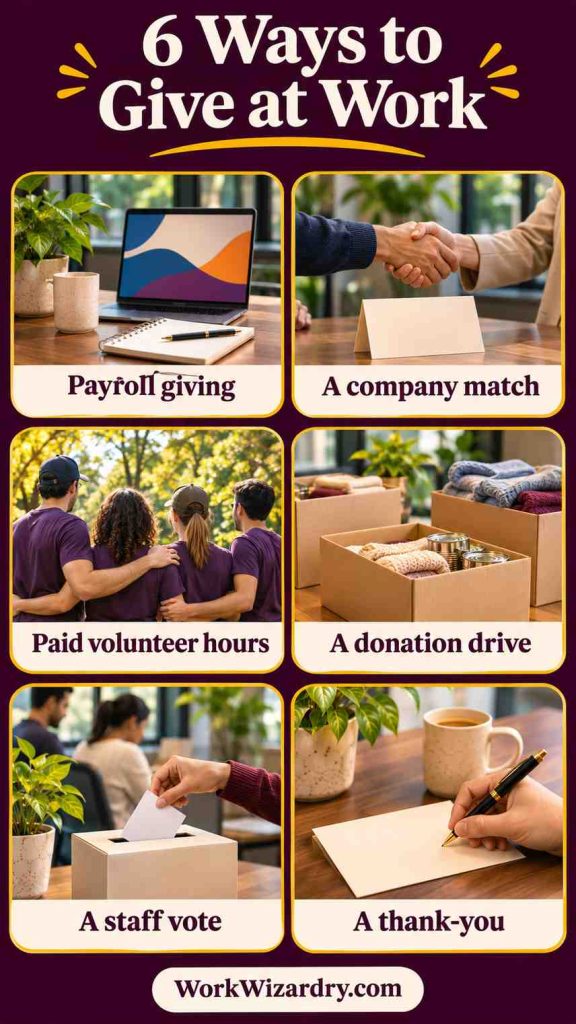
Workplace giving is any way an employer helps its people give money, goods or time to charities. It is also called employee giving. In the US it usually means payroll giving, matching gifts, paid volunteer time, giving campaigns such as United Way and drives.
This guide explains what workplace giving is and how it works, how to start a workplace giving program in seven steps with a cost model for small, mid-size and large companies, the rules on matching, payroll deductions, tax and volunteer hours, 40 ideas, a Giving Tuesday plan for employers (Tuesday, December 1, 2026), and what employees can do when their company has no program.
Key takeaways
- Start small: one charity, a capped match and a few paid volunteer hours beats a big program nobody uses.
- Write a one-page policy for the match, the volunteer hours and privacy.
- Keep it optional and private. Do not track who gave, and do not let managers ask their own staff.
- Know the rules: payroll gifts need written authorization, volunteering at the employer’s request counts as hours worked, and company gifts have a tax limit.
- Ask early and often. The main reason people do not give is that no one asked.
- Report real results and thank everyone.
Want everything prepared for you? The Workplace Giving Kit has a program cost model and a match calculator in Excel, written policies, forms, 20 emails, a volunteer day toolkit and a print set. This article is complete on its own.

Find Your Best Workplace Giving Starting Point in a Minute
| You are | Start with | First move |
|---|---|---|
| A small business (under 20 staff) | A charity of the quarter, a 1:1 match with a small cap, paid volunteer hours | Pick one charity and set a $500 budget |
| A mid-size company (20 to 250) | Payroll giving, a match with a pool, a volunteer day | Form a small giving committee |
| A large company (250+) | A platform or United Way campaign, department challenges, a Giving Tuesday boost | Ask for leadership sponsorship |
| A remote or hybrid team | Virtual volunteering, online giving links, a giving channel | Choose one link and one day |
| A tight budget | Time, skills, a giving channel and a drive | Spend under $100 |
| An employee who wants to start something | A proposal, a charity of the quarter, a volunteer day | Ask HR with a one-page proposal |
| An HR lead who needs policies | A matching policy, a volunteer time policy and a donation request policy | Start with the policy templates in the kit |
| A company that wants a Giving Tuesday plan | A boosted match and a 21-day plan | Start 3 weeks ahead |
What Is Workplace Giving? Employee Giving, Payroll Giving and Matching Explained
The terms overlap, which is why searches are confusing. Here is how they fit together.
| Term | What it means |
|---|---|
| Workplace giving | The umbrella term, also called workplace charitable giving: ways an employer helps staff give money, goods or time to charities. |
| Employee giving | The same idea from the staff side: giving through payroll, campaigns and matching. |
| Payroll giving (payroll deduction) | Staff choose an amount to be taken from each paycheck and sent to a charity. ‘Workplace giving’ is the Australian name for it. |
| Matching gifts | The employer matches what staff give, often dollar for dollar, up to a cap. |
| Volunteer time off | Paid hours staff can use to volunteer. |
| A workplace giving campaign | A short, organized drive for gifts or pledges, such as a United Way campaign. |
| Public sector campaigns | The Combined Federal Campaign for federal employees and similar state campaigns, with their own rules. |
If you are reading about workplace giving in Australia, the term means payroll giving specifically, and the tax rules there are different. This guide is written for US employers, so use it alongside your own state rules and advice.
Why Workplace Giving Is Worth Doing: What the Data Says
- Employees care. In a 2024 Deloitte survey, as reported in its press release, 87% of respondents said workplace volunteer opportunities matter when deciding whether to stay with or join an employer, and 49% of those who took part said it helped them build connection with colleagues.
- Time is in demand. According to GivingTuesday’s 2025 results, 11.1 million people volunteered in the US, up about 20% on the year before, faster than the growth in people giving money.
- Companies are a small part of US giving. Giving USA reported that corporations gave about 7% of the $592.50 billion given in 2024, with individuals giving about two thirds. The rest of giving starts with people, and an employer can make that giving easier.
These are survey and report figures, not guarantees. Judge your own program by your own participation and feedback.
How to Start a Workplace Giving Program in 7 Steps
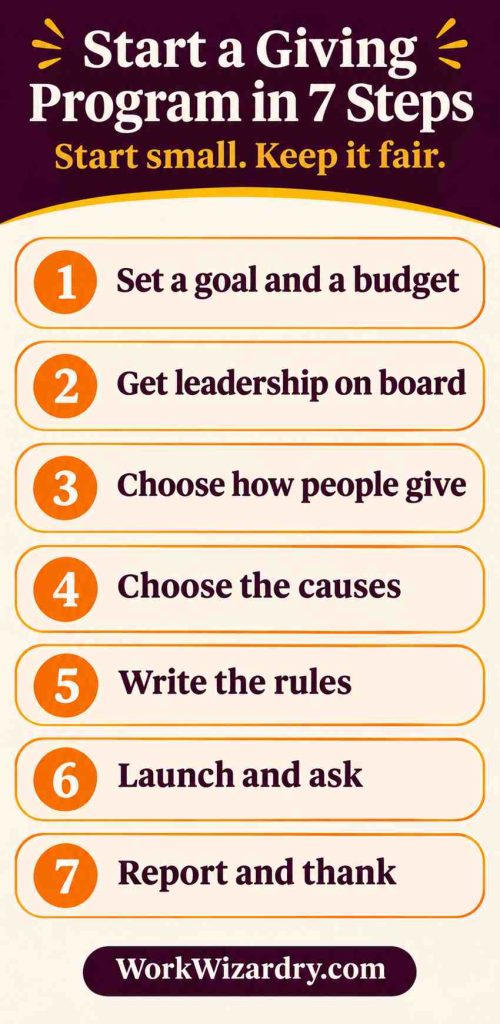
- Set a goal and a budget. Decide what success means (participation, dollars, hours) and what you can spend on a match, paid hours and admin time.
- Get leadership on board. Pitch retention, culture and community value with a one-page proposal and a small first-year budget.
- Choose how people give. Pick two or three channels: payroll giving, one-time campaigns, matching, volunteering and drives.
- Choose the causes. Let staff nominate and vote on a shortlist you have checked. See the vetting steps.
- Write the rules. Put the match, volunteer hours, eligibility and privacy in a short written policy.
- Launch and ask. Ask early and often, and say it is optional. The top reason people do not give is that they are not asked.
- Report and thank. Share the real totals, participation and stories, and thank everyone.
What it costs: three example companies
These are example calculations with stated assumptions. They show how to do the math with your own numbers. They are not benchmarks.
| Company | What it costs the company | What reaches charities |
|---|---|---|
| Small business (10 staff) | $520 a year: a match of $80 and 20 paid volunteer hours worth $440 | $160 plus 20 volunteer hours |
| Mid-size company (50 staff) | $5,005 a year: a match of $525 and 160 paid volunteer hours worth $4,480 | $1,050 plus 160 volunteer hours |
| Large company (250 staff) | $41,400 a year: a match of $3,000 and 1200 paid volunteer hours worth $38,400 | $6,000 plus 1200 volunteer hours |
The assumptions: the small business has 40% of staff giving an average of $20 with a one-to-one match capped at $50 and 4 paid volunteer hours offered, half using them at $22 an hour. The mid-size company has 35% giving $30, a cap of $100 and 8 hours offered, 40% using them at $28. The large company has 30% giving $40, a cap of $250 and 16 hours offered, 30% using them at $32. Set your own cap and hours, and check the total against your budget before you announce.
The Rules in Plain English (This Is Not Legal Advice)
- Make it voluntary and private. Giving must be a free choice, in writing where payroll is involved. Do not track who gave or how much. OPM’s guidance for federal campaigns says employees must never be pressured to donate.
- Payroll giving needs written authorization. Employees authorize a deduction in writing and can stop it. Ask your payroll provider how to set it up as a voluntary after-tax deduction.
- Know the employee’s tax position. An employee’s own gift is deductible only if they itemize. For payroll gifts they need a pay stub or W-2 showing the amount, plus a pledge card from the charity that says no goods or services were provided (IRS Publication 526). Employees should ask a tax adviser.
- Matching gifts are paid by the employer. An employer match paid directly to a charity is generally not taxable to the employee when the employee does not benefit personally, according to employment-law guidance. The employee deducts only their own gift, and the match is the company’s gift.
- Company gifts have a limit. A corporation generally cannot deduct charitable gifts above 10% of taxable income, and can carry the excess forward for five years (IRS Publication 542). Other entities differ, so ask your accountant.
- Volunteering during work time is paid work time. Under 29 CFR 785.44, charitable work done at the employer’s request, under its direction or control, or while required to be on the premises counts as hours worked. Time spent voluntarily outside normal hours does not.
- Check solicitation and fundraising policies. Many employers limit asking for money to breaks and non-work time and need approval for drives. Write your own rule so it is the same for everyone.
- Public sector employers have their own rules. Federal employees give through the Combined Federal Campaign, and many states and cities run their own campaigns. Check the campaign rules before you add anything.
- Never let managers ask their own staff. Peers may invite, and leaders may match. A manager’s ask can feel like pressure.
- Check every charity. Confirm its status, finances and needs and get written permission before using its name or logo.
For employee tax records on payroll gifts, see IRS Publication 526. For hours worked, see 29 CFR 785.44. For the federal campaign, OPM oversees the Combined Federal Campaign and says employees must never be pressured to give.
How to Choose and Check Charities
Staff trust a program more when the charities are real, clear and well run. Use these steps.
- Check the status. Confirm in the IRS Tax Exempt Organization Search that the group is a recognized charity.
- Look at the finances. Open its Candid profile or Form 990.
- Read the ratings. Check Charity Navigator and Give.org.
- Find the mission. Read what it does in plain words and choose causes staff understand.
- Ask what it needs. Ask whether it wants cash, goods or volunteers.
- Ask about names and logos. Get written permission to use its name.
- Ask how it will acknowledge gifts. A written acknowledgment matters for larger gifts.
Workplace Giving Ideas and Employee Giving Ideas by Type
Employee giving programs: regular and easy
These ideas make giving small, regular and easy, which is how most workplace giving programs grow.
At a glance
| Idea | Cost | Time |
|---|---|---|
| Payroll giving (payroll deduction) | Setup time | 2 to 4 hours to set up |
| A one-time giving campaign | $0 to $50 | 1 to 2 weeks |
| A charity of the quarter | $0 | 1 hour a quarter |
| Donate instead of gifts | $0 | 30 minutes |
| A holiday party donation per attendee | $5 to $15 per person | 1 hour |
| Birthday giving | $0 | Ongoing |
| A year-end giving month | $0 to $50 | 1 month |
| A monthly giving club | Setup time | 2 hours |
1. Payroll giving (payroll deduction)
Staff choose an amount to give from each paycheck to a charity or a short list. Payroll sends the money to the charity.
- Example math (assumptions, not a benchmark): 10 staff giving $10 a pay period over 24 pay periods = $2,400 a year
- Cost: Setup time · Time: 2 to 4 hours to set up · People: HR or payroll
- Best for: Companies with payroll software
- Watch out: It must be voluntary and in writing. The employee’s own gift is generally not pre-tax in the US, so ask payroll and a tax adviser.
- Sample line: “Give a little every pay period. You choose the amount and the charity.”
2. A one-time giving campaign
Run a short campaign, often 1 to 2 weeks, with a pledge form or the charity’s link and a kickoff.
- Example math (assumptions, not a benchmark): 20 staff at $25 = $500
- Cost: $0 to $50 · Time: 1 to 2 weeks · People: 1 coordinator
- Best for: Any size
- Watch out: Keep it short, optional and private.
- Sample line: “Our giving week runs from [day] to [day].”
3. A charity of the quarter
Staff vote each quarter on a charity from a checked list and the company gives a set gift while staff add their own.
- Example math (assumptions, not a benchmark): 4 charities a year, $250 each = $1,000
- Cost: $0 · Time: 1 hour a quarter · People: 1 coordinator
- Best for: Teams that want focus
- Watch out: Use a short list and check each charity.
- Sample line: “Vote for our charity this quarter.”
4. Donate instead of gifts
Invite staff to give to a charity in place of exchanging gifts, and share the total.
- Example math (assumptions, not a benchmark): 20 staff at $10 = $200
- Cost: $0 · Time: 30 minutes · People: 1 coordinator
- Best for: Holiday season
- Watch out: Keep it optional.
- Sample line: “Give in a colleague’s name this year.”
5. A holiday party donation per attendee
The company gives a set amount to charity for each attendee.
- Example math (assumptions, not a benchmark): 40 attendees at $5 = $200
- Cost: $5 to $15 per person · Time: 1 hour · People: 1 organizer
- Best for: Companies with a party
- Watch out: Announce the amount and the charity in the invitation.
- Sample line: “$5 per guest goes to [charity].”
6. Birthday giving
Staff can choose a charity gift in place of a birthday gift or cake.
- Example math (assumptions, not a benchmark): 20 birthdays at $5 = $100 a year
- Cost: $0 · Time: Ongoing · People: 1 coordinator
- Best for: Small teams
- Watch out: Opt in only.
- Sample line: “Choose a charity gift on your birthday.”
7. A year-end giving month
Run a month of simple giving, with a weekly total and a thank-you.
- Example math (assumptions, not a benchmark): 25 staff at $20 = $500
- Cost: $0 to $50 · Time: 1 month · People: 1 coordinator
- Best for: December
- Watch out: Keep it light and optional.
- Sample line: “Our December giving month starts [day].”
8. A monthly giving club
Staff sign up for a small monthly gift, sometimes through payroll, to one shared charity.
- Example math (assumptions, not a benchmark): 12 members at $10 a month = $1,440 a year
- Cost: Setup time · Time: 2 hours · People: 1 coordinator
- Best for: Teams that like regular habits
- Watch out: Make signing up and leaving easy.
- Sample line: “Join the monthly giving club.”
Matching gifts: double the effect
A match is the most powerful tool in workplace giving because it gives people a reason to act. It is also where the budget needs a cap.
At a glance
| Idea | Cost | Time |
|---|---|---|
| A 1:1 match with an annual cap | Your cap | 2 hours to set up |
| A Giving Tuesday boosted match | Your cap | 1 day |
| Volunteer hours grant (dollars for doers) | $10 to $25 per hour | Ongoing |
| A department challenge match | Your cap | 2 weeks |
| Match what staff raise at a fundraiser | Your cap | 1 hour |
| A matching pool | $500 to $5,000 | 1 hour |
9. A 1:1 match with an annual cap
The company matches employee gifts to recognized charities, dollar for dollar, up to a set amount per person each year.
- Example math (assumptions, not a benchmark): 20 staff give $30 each with a $50 cap per person = $600 + $600 match
- Cost: Your cap · Time: 2 hours to set up · People: HR
- Best for: Any size
- Watch out: Set a cap per person and a total budget before you announce.
- Sample line: “We match your gifts up to $50 a year.”
10. A Giving Tuesday boosted match
Increase the usual match for one day or week to give staff a reason to give then.
- Example math (assumptions, not a benchmark): Raise the match to 2:1 for one day, $500 cap
- Cost: Your cap · Time: 1 day · People: HR
- Best for: Giving Tuesday
- Watch out: Say exactly how long the boost lasts.
- Sample line: “Today we match 2 to 1, up to $500 in total.”
11. Volunteer hours grant (dollars for doers)
The company gives a small grant to a charity for each set number of hours an employee volunteers.
- Example math (assumptions, not a benchmark): 50 volunteer hours at $15 = $750
- Cost: $10 to $25 per hour · Time: Ongoing · People: HR
- Best for: Companies that want to reward time
- Watch out: Require simple proof from the charity.
- Sample line: “Volunteer 10 hours and we give $150 to your charity.”
12. A department challenge match
Departments compete on participation rate and the company matches what each raises.
- Example math (assumptions, not a benchmark): 3 teams raise $150 each; match $450
- Cost: Your cap · Time: 2 weeks · People: 1 organizer per team
- Best for: Larger offices
- Watch out: Rank on participation, never on individual gifts.
- Sample line: “Which team has the highest participation?”
13. Match what staff raise at a fundraiser
Offer to match the net total of an approved staff fundraiser, up to a cap.
- Example math (assumptions, not a benchmark): Staff raise $400 at a bake sale; match $400
- Cost: Your cap · Time: 1 hour · People: 1 leader
- Best for: Companies with staff-run fundraisers
- Watch out: Match net money after costs, and confirm the charity.
- Sample line: “We will match what you raise, up to $500.”
14. A matching pool
Set aside a pool and match gifts first come, first served until it is used.
- Example math (assumptions, not a benchmark): A $1,000 pool matches the first $1,000 of staff gifts
- Cost: $500 to $5,000 · Time: 1 hour · People: HR
- Best for: Companies with a fixed budget
- Watch out: Say what happens when the pool runs out.
- Sample line: “The first $1,000 of your gifts will be matched.”
Time and skills: employee volunteer ideas
Time is often what employees most want to give, and it costs the company only the hours.
At a glance
| Idea | Cost | Time |
|---|---|---|
| Paid volunteer time off | Hours x wage | 1 hour to set up |
| A team volunteer day | Hours x wage | Half a day |
| Skills-based volunteering | Hours x wage | 1 to 4 hours each |
| Virtual volunteering | Hours x wage | 1 to 2 hours each |
| Mentoring or tutoring | Hours x wage | 1 hour a week |
| Board and committee service | Hours x wage | Ongoing |
| A pro bono service day | Hours x wage | A day |
| Volunteer ambassadors | $0 | 1 hour a month |
15. Paid volunteer time off
Give each employee a set number of paid hours a year to volunteer with a recognized charity.
- Example math (assumptions, not a benchmark): 12 staff x 4 hours x $25 = $1,200 if all use it
- Cost: Hours x wage · Time: 1 hour to set up · People: HR
- Best for: Any size
- Watch out: Paid volunteer hours at the employer’s request count as hours worked.
- Sample line: “Use up to 8 paid hours a year to volunteer.”
16. A team volunteer day
Book a group shift with a charity that takes groups and send staff together.
- Example math (assumptions, not a benchmark): 20 staff x 4 hours = 80 hours
- Cost: Hours x wage · Time: Half a day · People: 1 coordinator
- Best for: Teams of 5 to 50
- Watch out: Charities need notice for groups, so book early.
- Sample line: “Our volunteer day is on [day].”
17. Skills-based volunteering
Staff lend a professional skill, such as design, accounting or IT, to a charity.
- Example math (assumptions, not a benchmark): 5 staff x 4 hours of design, finance or IT help
- Cost: Hours x wage · Time: 1 to 4 hours each · People: HR or a manager
- Best for: Professional teams
- Watch out: Scope the job in writing so it does not run on.
- Sample line: “Offer a skill for a charity.”
18. Virtual volunteering
Staff do tasks from home such as writing notes, tutoring or data entry for a charity.
- Example math (assumptions, not a benchmark): 15 staff x 2 hours = 30 hours
- Cost: Hours x wage · Time: 1 to 2 hours each · People: 1 coordinator
- Best for: Remote teams
- Watch out: Ask the charity what is useful.
- Sample line: “Volunteer from your desk this week.”
19. Mentoring or tutoring
Staff mentor students or young founders through a recognized program.
- Example math (assumptions, not a benchmark): 6 staff x 20 hours a year = 120 hours
- Cost: Hours x wage · Time: 1 hour a week · People: 1 coordinator
- Best for: Teams with experienced staff
- Watch out: Check the program’s safeguarding rules.
- Sample line: “Give an hour a week to a student.”
20. Board and committee service
Support an employee or leader who serves on a charity’s board by giving paid hours.
- Example math (assumptions, not a benchmark): 1 leader x 5 hours a month
- Cost: Hours x wage · Time: Ongoing · People: 1 leader
- Best for: Leaders
- Watch out: Make sure there is no conflict of interest.
- Sample line: “We support staff who serve.”
21. A pro bono service day
Give a charity a day of your company’s service at no charge.
- Example math (assumptions, not a benchmark): 5 staff x 6 hours
- Cost: Hours x wage · Time: A day · People: 1 leader
- Best for: Service businesses
- Watch out: Agree the scope in writing.
- Sample line: “Today we serve [charity].”
22. Volunteer ambassadors
Staff volunteers promote giving and volunteering and bring ideas.
- Example math (assumptions, not a benchmark): 3 ambassadors x 1 hour a month
- Cost: $0 · Time: 1 hour a month · People: 3 to 5 staff
- Best for: Any size
- Watch out: Rotate the role each year.
- Sample line: “Meet our giving ambassadors.”
Drives and in-kind giving
Drives work when the charity gives you a needs list. They fail when a business collects what it wants to clear out.
At a glance
| Idea | Cost | Time |
|---|---|---|
| A food drive | $0 to $50 | 1 to 2 weeks |
| A coat, blanket or sock drive | $0 to $50 | 2 weeks |
| A toy or book drive | $0 to $50 | 2 weeks |
| A school supply drive | $0 to $50 | 2 weeks |
| A hygiene kit assembly | $100 to $300 | 2 hours |
| A pet shelter supply drive | $0 to $50 | 2 weeks |
23. A food drive
Ask the charity for its list, set out boxes and deliver on a set date.
- Example math (assumptions, not a benchmark): 60 items for a food bank
- Cost: $0 to $50 · Time: 1 to 2 weeks · People: 1 coordinator
- Best for: Any size
- Watch out: Collect only what is on the list.
- Sample line: “Bring items from [charity]’s list.”
24. A coat, blanket or sock drive
Collect new or clean warm items and deliver them.
- Example math (assumptions, not a benchmark): 50 items
- Cost: $0 to $50 · Time: 2 weeks · People: 1 coordinator
- Best for: Winter
- Watch out: Confirm what the charity accepts.
- Sample line: “Warm things wanted.”
25. A toy or book drive
Collect new toys or books from a charity’s list.
- Example math (assumptions, not a benchmark): 40 items
- Cost: $0 to $50 · Time: 2 weeks · People: 1 coordinator
- Best for: Holiday season
- Watch out: Use the charity’s age and safety rules.
- Sample line: “New toys wanted.”
26. A school supply drive
Collect supplies listed by a school or charity.
- Example math (assumptions, not a benchmark): 40 backpacks of supplies
- Cost: $0 to $50 · Time: 2 weeks · People: 1 coordinator
- Best for: Late summer
- Watch out: Collect only the listed items.
- Sample line: “Fill a backpack.”
27. A hygiene kit assembly
Staff pack kits from a charity’s list and deliver them together. Clear zipper pouches keep each kit tidy.
- Example math (assumptions, not a benchmark): 40 kits
- Cost: $100 to $300 · Time: 2 hours · People: 10 staff
- Best for: Teams that like a project
- Watch out: Check what contents are allowed.
- Sample line: “We packed 40 kits.”
28. A pet shelter supply drive
Collect blankets, food and toys from a shelter’s list.
- Example math (assumptions, not a benchmark): 30 items
- Cost: $0 to $50 · Time: 2 weeks · People: 1 coordinator
- Best for: Pet-loving teams
- Watch out: Use the shelter’s list.
- Sample line: “Shelter wish list.”
Culture, communication and recognition
A giving program lasts when people can see it, understand it and feel appreciated for taking part.
At a glance
| Idea | Cost | Time |
|---|---|---|
| A staff vote on the charity | $0 | 1 hour |
| A giving wall or channel | $0 | 30 minutes |
| A leadership message | $0 | 1 hour |
| Recognition without ranking | $0 to $50 | 1 hour |
| An annual impact report | $0 | 3 hours |
| A giving calendar | $0 | 2 hours |
29. A staff vote on the charity
Let staff vote on a shortlist you have checked.
- Example math (assumptions, not a benchmark): 60 votes on 3 charities
- Cost: $0 · Time: 1 hour · People: 1 coordinator
- Best for: Any size
- Watch out: Do not pressure anyone to vote or give.
- Sample line: “Vote for our charity this quarter.”
30. A giving wall or channel
Share stories about causes and acts of giving in a chat channel or on a wall.
- Example math (assumptions, not a benchmark): 20 stories
- Cost: $0 · Time: 30 minutes · People: 1 coordinator
- Best for: Any size
- Watch out: Make sharing optional.
- Sample line: “Share a cause that matters to you.”
31. A leadership message
A leader explains why the company gives and what it offers.
- Example math (assumptions, not a benchmark): 1 video or note
- Cost: $0 · Time: 1 hour · People: 1 leader
- Best for: Any size
- Watch out: Keep it honest and short.
- Sample line: “Why we give.”
32. Recognition without ranking
Thank every participant in public with permission, without ranking donors.
- Example math (assumptions, not a benchmark): A thank-you note for each helper
- Cost: $0 to $50 · Time: 1 hour · People: 1 coordinator
- Best for: Any size
- Watch out: Never rank individual gifts.
- Sample line: “Thank you for taking part.”
33. An annual impact report
Report total given, volunteer hours, participation and stories.
- Example math (assumptions, not a benchmark): 1 page
- Cost: $0 · Time: 3 hours · People: 1 coordinator
- Best for: Any size
- Watch out: Report real numbers only.
- Sample line: “Our year of giving.”
34. A giving calendar
Plan one small act a month across the year.
- Example math (assumptions, not a benchmark): 12 months
- Cost: $0 · Time: 2 hours · People: 1 coordinator
- Best for: Any size
- Watch out: Keep it simple.
- Sample line: “Our year of giving.”
Staff fundraisers that fit a giving program
Staff-run fundraisers are covered in full in our guide to fundraising ideas for workplace teams. These six fit well inside a program, with approval and rules.
At a glance
| Idea | Cost | Time |
|---|---|---|
| A jeans day | $0 | 1 day |
| A bake sale | $20 to $60 | 3 to 4 hours |
| A quiz night | $20 to $60 | 1 hour |
| A step challenge | $0 to $50 | 2 to 4 weeks |
| A silent auction | $20 to $80 | 3 weeks |
| A change jar | $0 | Ongoing |
35. A jeans day
Collect a small donation to wear casual clothes for a day.
- Example math (assumptions, not a benchmark): 60 people at $5 = $300
- Cost: $0 · Time: 1 day · People: 1 organizer
- Best for: Any size
- Watch out: Keep it optional.
- Sample line: “Jeans day for [charity].”
36. A bake sale
Sell baked goods with allergen labels.
- Example math (assumptions, not a benchmark): 30 items at $3 = $90
- Cost: $20 to $60 · Time: 3 to 4 hours · People: 4 to 8 bakers
- Best for: Offices of 20+
- Watch out: Check local food rules.
- Sample line: “Bake sale for [charity].”
37. A quiz night
Teams pay to play.
- Example math (assumptions, not a benchmark): 24 people at $5 = $120
- Cost: $20 to $60 · Time: 1 hour · People: 1 host
- Best for: Any size
- Watch out: Keep questions fair.
- Sample line: “Quiz night for [charity].”
38. A step challenge
Staff gather pledges for steps.
- Example math (assumptions, not a benchmark): 20 people at $20 = $400
- Cost: $0 to $50 · Time: 2 to 4 weeks · People: 1 organizer
- Best for: Any size
- Watch out: Offer alternatives.
- Sample line: “Step challenge for [charity].”
39. A silent auction
Collect items and run bids.
- Example math (assumptions, not a benchmark): 20 items averaging $25 = $500
- Cost: $20 to $80 · Time: 3 weeks · People: 3 to 5 organizers
- Best for: Larger offices
- Watch out: Check state rules.
- Sample line: “Silent auction for [charity].”
40. A change jar
A jar by the entrance, counted by two people. A lockable donation box works if you want a lid and a lock.
- Example math (assumptions, not a benchmark): 20 people at $5 a month = $100
- Cost: $0 · Time: Ongoing · People: 1 organizer
- Best for: Any size
- Watch out: Count safely.
- Sample line: “Spare change, big difference.”
Matching Gifts: How a Company Match Works
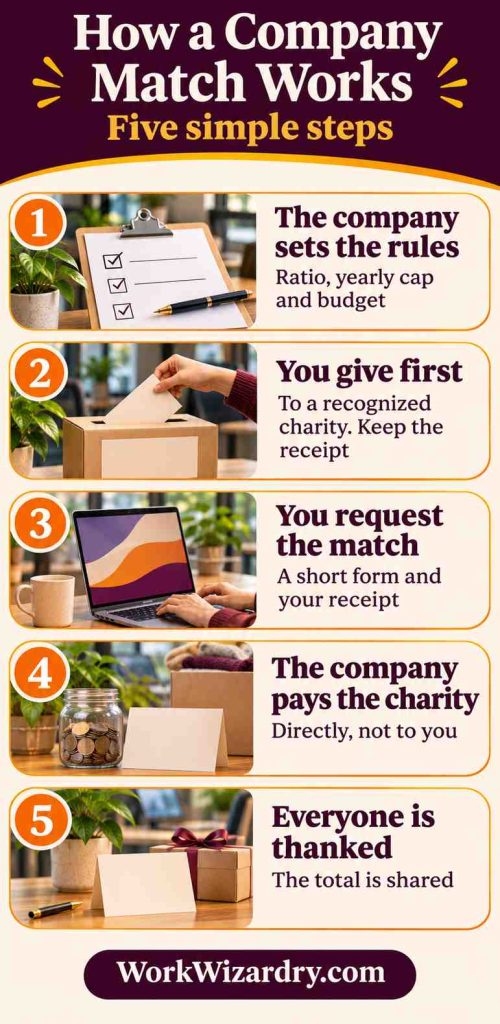
A match means the employer gives a matching amount to the same charity as the employee. Most programs follow the same steps.
- The company sets the rules: the ratio (often one to one), a yearly cap per person, a total budget, which charities qualify and a deadline.
- The employee gives first to a recognized charity and keeps the receipt.
- The employee requests the match with a short form and the receipt.
- The company pays the match directly to the charity and keeps a record.
- The company reports the total and thanks staff.
What it costs: gifts x ratio, up to the cap per person. For example, 20 staff giving $30 each with a one-to-one match and a $50 cap costs the company $600. The employee deducts only their own gift, and the match is the company’s gift.
If you are an employee: how to find out and ask
- Ask HR or your manager. Ask whether your company matches gifts, offers payroll giving or gives paid volunteer hours.
- Look for the match form. Many programs need a form from HR with your receipt and the charity’s name.
- Check the limits. Ask about the yearly cap, the ratio and which charities qualify.
- Give first, then request. Many programs match after you give. Keep your receipt.
- Suggest a program. If there is none, a one-page proposal with a small first-year budget is a good start.
Paid Volunteer Time Off: What to Put in the Policy
How to get employees to volunteer starts with paid hours and a clear, optional ask. Volunteer time off, or paid volunteer time off, gives employees a set number of paid hours a year to volunteer. HR glossaries commonly show 8 to 40 hours a year, but there is no standard. Cover these points in a one-page policy:
- Hours: how many a year, and whether they carry over.
- Eligibility: all staff or after a set number of days.
- Use: volunteering with a recognized charity, with manager approval.
- Proof: a short note from the charity.
- Pay: paid at the normal rate, and paid hours count as hours worked.
- Fairness: a way for shift and remote staff to use the hours.
- Optional: nobody is required to volunteer.
Do You Need a Workplace Giving Platform?
Workplace giving platforms handle payroll files, matching, receipts and reports. They are worth a look when you have payroll deductions, matching and many charities to track. A small company can start with a charity’s own donation page, a simple form and a spreadsheet.
| If you have | Consider |
|---|---|
| Under 50 staff and one or two charities | A form, a link and a spreadsheet |
| Payroll giving for many people | A platform or a United Way campaign |
| Matching with many charities | A platform that tracks matches |
Compare fees, what the platform sends to payroll, how it handles receipts and whether you can export your data.
United Way and Other Workplace Campaigns
A United Way workplace campaign is a short drive, often one to two weeks, where staff pledge by payroll deduction or one-time gifts. A coordinator runs a kickoff, shares pledge forms and returns them, and local chapters provide toolkits and payroll files. Chapters differ, so ask your local chapter for its coordinator handbook and deadlines. Public sector employees give through campaigns such as the Combined Federal Campaign.

Giving Tuesday for Employees and Employers: A 21-Day Plan
Giving Tuesday 2026 is Tuesday, December 1, the Tuesday after Thanksgiving. It is a good day for a boosted match, a volunteer day or a launch. This plan counts back from the day so it works every year.
| When | Task | What to do |
|---|---|---|
| 21 days before | Set the goal and budget | Decide the match, the cap and paid hours. Write them down. |
| 18 days before | Choose and check the charity | Use the 7 steps. Get permission to use its name. |
| 14 days before | Write the rules | Match policy, eligibility, privacy and how to claim a match. |
| 10 days before | Build the pieces | Pledge links, forms, posts, emails and the intranet page. |
| 7 days before | Announce | One email, one post. Say what, why and how, and that it is optional. |
| 3 days before | Brief managers | Give managers the talking points and the rule that they do not ask their own staff. |
| 1 day before | Test everything | Links, forms, payroll file, match tracker. |
| The day | Run it | Post three times, thank people, track totals by team. |
| The next day | Report | Share the real total and the match used. Send the gifts. |
| 2 weeks after | Review | Note participation, lessons and next steps. |
A day-of run sheet
| When | Task | What to do |
|---|---|---|
| Morning | Open | Share the rule, the charity’s link and the match. |
| Mid-morning | Remind | Share one story and one reminder to staff. |
| Noon | Update | Share progress by team participation, not individual gifts. |
| Afternoon | Thank | Thank people with permission and share progress. |
| Close | Count | Add the totals, record the match and confirm the charity. |
| Next day | Announce | Post the final total and the date the gifts go. |
Messages You Can Copy: Emails and Posts
A launch email
“` Subject: Our new giving program
Hi team,
We are launching [program] on [day]. Here is what it offers:
- A match of your gifts to recognized charities, dollar for dollar, up to $[cap] per person a year
- [Number] paid hours a year to volunteer
- Payroll giving, if you would like to give a little every pay period
Everything is optional and private. We will not track who gives. If you want to take part, here is how: [link].
If you have a charity you would like us to consider, tell [name] by [day].
Thank you, [Name] “`
How to request a match
“` Subject: How to request a match
Hi team,
To have your gift matched: (1) give to a recognized charity, (2) fill in the match request at [link] with your receipt, (3) we send the match to the charity within [number] days. The limit is $[cap] per person per year.
If you are not sure your charity qualifies, ask [name].
Thank you, [Name] “`
A thank-you and report email
“` Subject: Thank you: here is what we gave together
Hi team,
Thank you for taking part. Together we gave [total] to [charity], and the company added [match]. Our team volunteered [hours] hours, and [percent] of us took part.
Here is what it will make possible: [one line].
[Name] “`
Eight posts for your intranet or chat
- “We are launching [program] on [day]. Here is how it works: [one line].”
- “Giving is optional and private. Here is how to take part: [link].”
- “We are matching gifts up to $[cap] per person until [day].”
- “Our team spent [hours] hours volunteering at [charity]. Here is what we learned.”
- “Halfway through our giving week. Participation is [percent]. Thank you.”
- “Thank you. Together we gave [total] and volunteered [hours] hours for [charity].”
- “Meet [charity]. They do [one line]. This is why staff chose them.”
- “Our year of giving: here is the impact report.”
A Year of Workplace Giving, Month by Month
| Month | Idea |
|---|---|
| January | Start monthly giving and a volunteer plan for the year |
| February | A kindness or neighbors project |
| March | A match week for a cause staff chose |
| April | A volunteer day for earth or community clean-up |
| May | Skills-based volunteering month |
| June | Mid-year report and a drive for summer needs |
| July | A school supply drive |
| August | A team volunteer day |
| September | Charity of the quarter vote |
| October | A workplace campaign or United Way campaign |
| November | A drive and the Giving Tuesday plan |
| December | A year-end giving month and an impact report |
How to Measure and Report Workplace Giving
Track four numbers: participation rate (people who took part divided by staff), money given by staff and by the company, volunteer hours, and match used. Add a three-question pulse check (Did you know about the program? Was it easy to take part? Would you take part again?) and share one or two stories. Compare teams by participation, never by individual gifts.
Mistakes to Avoid
- Starting without a written policy for the match and volunteer hours.
- Promising a match with no cap or budget.
- Letting managers ask the people they manage.
- Tracking and sharing who gave and how much.
- Choosing a charity without checking it.
- Forgetting that volunteering at the employer’s request is paid time.
- Making the program complicated with too many channels.
- Launching once and never asking again.
- Ranking individuals instead of comparing participation.
- Not telling staff how to claim a match.
- Ignoring remote and shift staff.
- Never reporting the results.
Workplace Giving Checklist
- [ ] Goal: Is the goal and budget written down?
- [ ] Leadership: Does leadership support and sponsor the program?
- [ ] Policy: Is there a short written policy for the match and volunteer hours?
- [ ] Charity: Have you checked each charity?
- [ ] Privacy: Is giving optional and private?
- [ ] Payroll: Has payroll confirmed how a voluntary deduction works?
- [ ] Managers: Do managers know not to ask their own staff?
- [ ] Report: Is the date for the impact report set?
Workplace Giving Kit: What the Paid Kit Adds
The article above is complete on its own. If you would rather have the tools, policies and copy ready, the paid Workplace Giving Kit adds:
- A program cost model and match calculator in Excel: headcount, participation, ratio, cap and paid volunteer hours, a match request tracker, a volunteer hour log, a campaign tracker with team participation, an impact report and a 12-month calendar, all as formulas.
- Written policies and forms (Word): a charitable giving policy, a matching gift policy, a volunteer time off policy and request form, a payroll giving authorization form, a solicitation and fundraising approval policy and a program charter.
- Copy: 20 emails, 40 posts, a kickoff agenda and script, manager talking points, a staff FAQ, a business case for leadership, a survey, a ballot and an impact report template.
- A volunteer day toolkit: run sheet, roles, safety and photo checklists.
- A print set (Letter and A4): posters, pledge cards, a thermometer, sign-in sheets, ballots, certificates and thank-you cards.
Related Guides
- Fundraising ideas for workplace teams: staff-run events with costs and rules.
- Giving Tuesday ideas for small businesses: giving that involves customers.
- November themes for work: every awareness day in the month.
- Thanksgiving employee appreciation ideas: thank your team too.
Frequently Asked Questions About Workplace Giving
What is workplace giving?
Workplace giving is any way an employer helps staff give money, goods or time to charities. In the US it usually means payroll giving, campaigns such as United Way, matching gifts, volunteer time off and drives. In Australia the term means payroll giving specifically. It is also called employee giving.
How does workplace giving work?
An employer chooses ways for staff to give, such as payroll deduction, a one-time campaign, matching gifts or volunteer hours, writes simple rules, asks staff to take part and reports the results. Staff choose the charity and the amount, and the money goes directly to recognized charities.
How do I start a workplace giving program?
Set a goal and a budget, get leadership support, choose two or three ways for staff to give, check the charities, write a short policy, launch with a clear ask and report the results. Start small, such as a charity of the quarter, a capped match and a few paid volunteer hours.
What is the difference between workplace giving and employee giving?
They mostly mean the same thing from different angles. Workplace giving describes what the employer offers, and employee giving describes what staff do. Payroll giving is one channel, and matching gifts and volunteering are others. Some regions, such as Australia, use workplace giving for payroll giving only.
Is workplace giving tax deductible?
An employee’s own gift to a recognized charity may be deductible if they itemize. For payroll gifts they need a pay stub or W-2 showing the amount and a pledge card from the charity. Company gifts are limited for a corporation to 10% of taxable income. Ask a tax adviser about your case.
How does a company match donations?
The employer gives a matching amount to the same charity, often dollar for dollar, up to a yearly cap per person. Staff usually give first and then submit a match request with a receipt. The employer pays the match directly to the charity. Set the cap, the ratio, eligible charities and the deadline in writing.
How much should a company match?
There is no standard. Many small employers start with a one-to-one match and a cap of $50 to $250 per person per year, and a total budget they can afford. Work out the cost with your headcount, expected participation and the cap before you announce it.
Do employees have to be paid for volunteer time?
If charitable work is done at the employer’s request, under its direction or control, or while the employee must be on the premises, it counts as hours worked under federal rules. Time that employees choose to volunteer outside normal hours does not. Paid volunteer time off is usually paid at the normal rate.
How do you get employees to participate in giving?
Ask early and ask more than once, because the main reason people do not give is that no one asked. Keep it optional and private, make giving a few clicks, let staff pick the causes, offer a match and share participation by team instead of ranking individuals.
Do we need a workplace giving platform?
Not always. A small company can use a charity’s own donation page, a simple form and a spreadsheet. A platform helps when you have payroll deductions, matching and many charities to track, since it handles files, receipts and reports. Compare fees and what the platform sends to payroll before you choose.
What is a United Way workplace campaign?
A United Way workplace campaign is a short, organized giving drive, often one or two weeks, where staff pledge by payroll deduction or one-time gifts to local United Way programs. A coordinator runs a kickoff, shares pledge forms and returns them. Local United Way chapters provide toolkits and payroll files.
What can employees do if their company has no giving program?
Ask HR or a manager, share a one-page proposal and suggest a small first step such as a charity of the quarter or a staff volunteer day. Offer to help. A small, low-cost pilot is easier for a company to say yes to than a large program.
What is the Combined Federal Campaign?
The Combined Federal Campaign is the federal government’s workplace giving program. Federal employees pledge through payroll deduction or online, and OPM oversees it. Federal rules say employees must not be pressured to give. If you work in the public sector, check the campaign rules before you add other asks.
How should we report workplace giving results?
Share the real totals: money given by staff, the company match, volunteer hours, the number of charities and the participation rate. Add one or two stories and thank everyone. Compare teams by participation, not by individual gifts, and never share who gave or how much.
What should a charitable giving policy (a corporate giving policy) include?
A short policy states the purpose, who is eligible, the match ratio and yearly cap, which charities qualify, how to request a match, paid volunteer hours, privacy, approval rules and how the company reports results. Keep it to a page or two and review it each year.
Sources: ideas, messages and checklists are original to Work Wizardry, and the example amounts are arithmetic, not benchmarks. Data: GivingTuesday 2025 results; a 2024 Deloitte workplace volunteer survey (press release); Giving USA 2025. Tax: IRS Publication 526 (payroll deduction records) and IRS Publication 542 (corporate limit of 10% of taxable income, five-year carryover); matching-gift taxability from employment-law guidance (ask a tax adviser). Hours worked: 29 CFR 785.44. Federal campaign: OPM’s Combined Federal Campaign guidance. United Way campaign practices vary by local chapter. Charity checks: the IRS Tax Exempt Organization Search, Candid, Charity Navigator and Give.org.
