
This post contains affiliate links. As an Amazon Associate I earn from qualifying purchases, and Work Wizardry may earn a small commission at no extra cost to you.
The best Halloween team building activities are short workshops with a purpose, not just party games. A good session has a clear outcome (such as clearer roles, a shared goal or safer conversations), a Halloween theme that makes it memorable, a few simple steps and a debrief that connects the activity to real work. Below are 12 original Halloween team building workshops with timings, materials, step-by-step instructions, debrief questions and remote versions, plus a 4-week series, a facilitator’s guide, guidance by team type and a way to measure whether it worked.
Most lists of Halloween team building activities are lists of games and paid experiences. Those are fun, and we have guides for them: Halloween office games, Halloween icebreaker questions, Halloween trivia and Halloween office activities. This page is different: halloween team building activities for work that help a team become clearer, safer and better at working together. It works for halloween team building activities for the workplace, for employees, for managers and leaders, and for in-person, remote and hybrid teams.
Who this guide is for
- Managers and leaders planning corporate halloween team building, halloween team building events or a halloween team building session for a department.
- Employees and colleagues who want halloween workplace team building and halloween office team building ideas that are easy and fun halloween team building activities for adults.
- New and growing groups that need halloween team bonding activities, or leaders who want halloween team building for leaders to start with honesty.
Where you can run it
- Virtual halloween team building on a video call.
- Halloween team building activities for hybrid teams with a shared board.
- Halloween team building activities in the office with paper and a timer.
Each workshop is a ready halloween team building session with its own halloween team building agenda, so these are easy halloween team building ideas for work even if you have never facilitated before. They are halloween team building exercises for halloween team building activities for employees at every level.
Want it ready to run? Grab the free Halloween Team Building Facilitator Planner, or see the Halloween Team Building Workshop Kit with all 12 workshops, materials, screens and a pulse-survey analyzer.
Key takeaways
- Start with an outcome. Pick what you want the team to be better at, then choose the workshop.
- Debrief every time. The conversation after the activity is where the learning happens.
- Make it safe and optional. People should be able to pass, and nobody should be pushed to share personal stories.
- Aim for clarity. Research suggests role clarity and goal setting are among the most useful parts of team building.
- Follow up. One session helps. A short series with actions helps more.
Find the Right Halloween Team Building Activity in One Minute
| Your goal | Start with | Time |
|---|---|---|
| Clearer roles | The Haunted Project Map | 60 minutes |
| Shared goals | Goal Lanterns | 45 minutes |
| Safer conversations | Ghost Stories of Work | 50 minutes |
| Better meetings and reviews | The Pumpkin Retro | 45 minutes |
| Better decisions | Haunted House Survival Ranking | 50 minutes |
| Understanding other roles | Costume Swap, Perspective Swap | 45 minutes |
| Appreciation | Trick-or-Treat Feedback | 30 minutes |
| Clear instructions and handoffs | Haunted Handoff | 35 minutes |
Does Team Building Work? What the Research Says
Team building has a mixed reputation, so it helps to know what the evidence says before you plan a session.
- A meta-analysis of team building (Klein and colleagues, 2009, in the journal Small Group Research) found that team building has a moderate positive effect on team outcomes. The effect was clearest for how people feel about the team and how it coordinates, and weaker for direct performance. Summaries of the study point to role clarification and goal setting as the most useful components. The research also says results depend on how team building is run.
- Google’s Project Aristotle, a study of what makes teams effective, found five dynamics that set the best teams apart: psychological safety, dependability, structure and clarity, meaning and impact. Psychological safety came first.
What this means for Halloween team building:
- Use the theme for energy, not for content. The Halloween wrapper makes a workshop memorable, but the value comes from the structure.
- Build every session around clarity, goals and safety. Those are the parts the research supports.
- Run it well. Facilitation and follow-up matter as much as the activity.
- Be realistic. A Halloween session will not fix a culture, but it can start a better habit.
We read summaries of these studies and cite the originals so you can check them: Klein et al. (2009), “Does team building work?”, Small Group Research 40(2), and Google’s re:Work guide on team effectiveness.
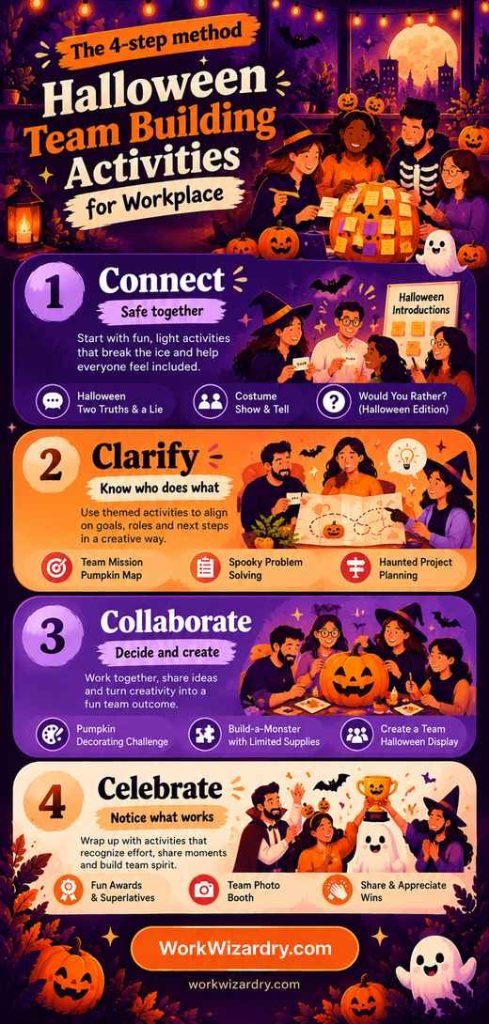
The Connect, Clarify, Collaborate, Celebrate Method
We use a simple four-part method for any Halloween team building session or series.
| Stage | Question the team answers | Workshops |
|---|---|---|
| Connect | Do we feel safe with each other? | Ghost Stories of Work, Costume Swap, Monster Mash-Up |
| Clarify | Do we know who does what and why? | The Haunted Project Map, Goal Lanterns, Haunted Handoff |
| Collaborate | Can we decide and create together? | Cauldron Challenge, Survival Ranking, Witching Hour Sprint, The Candy Trade |
| Celebrate | Do we notice and learn from what works? | Trick-or-Treat Feedback, The Pumpkin Retro |
Pick Your Halloween Team Building Activity by Goal
| If you want better… | Try | Why it works |
|---|---|---|
| Trust | Ghost Stories of Work, Costume Swap | People share safely and see each other’s day |
| Communication | Haunted Handoff, The Candy Trade | They show how information gets lost or shared |
| Clarity | The Haunted Project Map, Goal Lanterns | They make roles and goals visible |
| Collaboration | Cauldron Challenge, Survival Ranking | They require shared thinking |
| Creativity | Witching Hour Sprint, Monster Mash-Up | They reward quantity and mixing skills |
| Feedback | Trick-or-Treat Feedback | It makes specific appreciation a habit |
| Culture | The Pumpkin Retro | It turns lessons into actions |
| New-team bonding | Monster Mash-Up, Costume Swap | They help people learn strengths and roles |
| Remote connection | Haunted Handoff, Goal Lanterns | They work on a shared board |
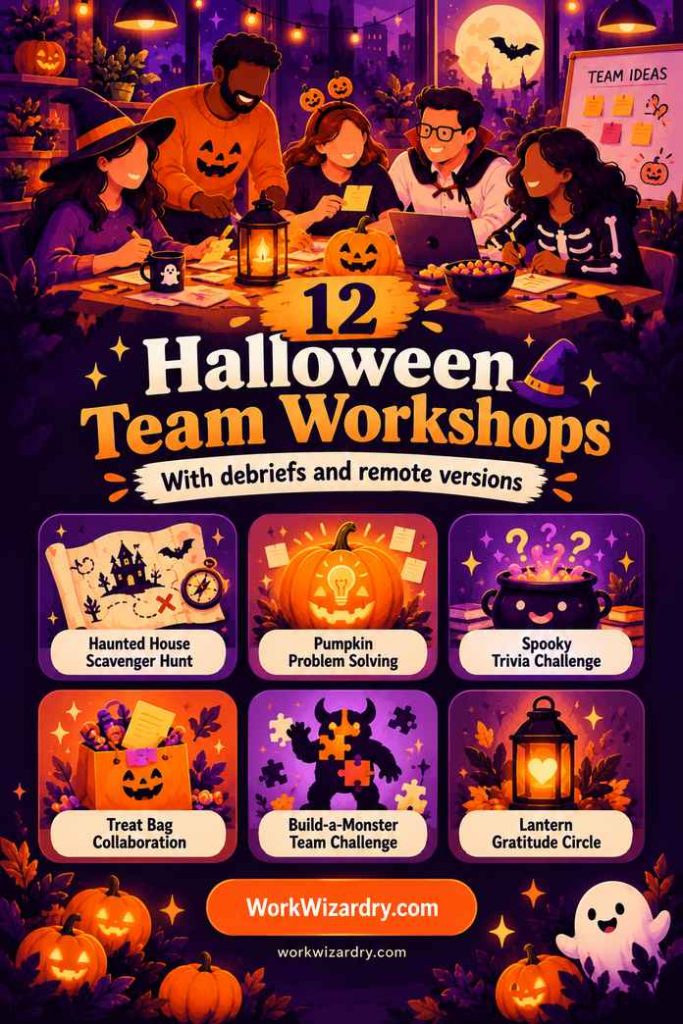
12 Halloween Team Building Workshops
Each workshop below has an outcome, a time, a group size, materials, prep, a timed agenda, debrief questions, a remote version, variations and pitfalls. The ready-to-print materials (cards, sheets, scenario and answer keys, screens) are in the Workshop Kit. The steps here are enough to run the sessions on your own. You will need basic supplies such as sticky notes, markers, dot stickers for voting and a visual timer so everyone can see the time.
Workshop 1: The Haunted Project Map
Find the ghost tasks nobody owns.
- Outcome: Role and ownership clarity
- Research link: Structure and clarity; role clarification
- Time: 60 minutes · Group size: 4 to 24
- Best for: Teams with a shared project or a repeating process
Materials
- Sticky notes in three colors
- Markers
- The Haunted House map (printed large or on screen)
- Ghost stickers or a ghost icon
- A timer
Prep
- Pick one real project or process that is not in crisis.
- Print the map on the largest paper you have, or share it on a whiteboard.
- Tell the team a week ahead which project you will map.
Timed agenda
| Minutes | Step | What to do |
|---|---|---|
| 5 | Welcome and ground rules | Explain the goal: make ownership visible, not to blame. Read the ground rules. |
| 10 | Write the tasks | Everyone writes one task per sticky note: every step that must happen for the project. Silent writing. |
| 15 | Build the map | Place each task in a room of the haunted house: Planning Hall, Workshop, Review Room, Launch Door, Cellar (hidden work) and Attic (future). |
| 10 | Find the ghosts | Put a ghost sticker on every task with no owner or with two owners. |
| 10 | Assign owners | For each ghost choose one Doer and one Decider. Agree out loud. |
| 10 | Debrief and commit | Pick the three most important changes. Write the owner and the date for each. |
Debrief questions
- What surprised you on the map?
- Which ghost task was costing us the most?
- Where did we assume someone else owned something?
- What will we change this week?
- What help do we need from outside the team?
What to say at the start: “Today we are not looking for who is wrong. We are looking for tasks that fall between chairs.”
What to say at the end: “Thank you. A task with a name and a date is a task that gets done.”
Remote or hybrid version: Use a shared whiteboard with the map as the background. Each person adds sticky notes in their own color. Use breakout rooms of 3 to 4 people for the map step.
Variations
- 30-minute version: map one process with six steps.
- Cross-team version: invite one partner team and map the handoffs.
Watch out for
- Choosing a project that is too big. Keep it to one project.
- Letting the most senior person assign every owner. Ask the team first.
Success looks like: Every task has one Doer and one Decider, and the team has three dated actions.
Workshop 2: Goal Lanterns
Light one shared goal.
- Outcome: Shared, specific team goals
- Research link: Goal setting; meaning
- Time: 45 minutes · Group size: 4 to 30
- Best for: New quarters, new teams and teams that feel pulled in different directions
Materials
- Lantern cards (printed, one per person plus spares)
- Markers
- Dot stickers or a voting tool
- Wall space or a whiteboard
- A timer
Prep
- Print the lantern cards.
- Write the quarter or the period on the board.
- Prepare three dot stickers per person.
Timed agenda
| Minutes | Step | What to do |
|---|---|---|
| 5 | Welcome | Explain that a goal is a light everyone can see. Show an example lantern. |
| 10 | Write a lantern | Each person writes one team goal on a lantern: what, by when and how we will know. |
| 10 | Gallery walk and cluster | Hang the lanterns and group similar goals together. |
| 10 | Vote | Each person places three dots on the goals that matter most. |
| 8 | Define success | For the top three, finish the sentence: We will know we reached it when… Add an owner. |
| 2 | Close | Read the three goals aloud. |
Debrief questions
- Which goals did many of us write? What does that tell us?
- Which goal surprised you?
- What would we stop doing to make room for these goals?
- How will we check progress?
What to say at the start: “A goal nobody can see does not guide anyone. Let us make ours visible.”
What to say at the end: “Three lanterns, three owners. We will check them in two weeks.”
Remote or hybrid version: Use sticky notes on a shared whiteboard and the voting feature. Run the gallery walk as a screen share.
Variations
- Personal lanterns: each person writes one personal learning goal.
- One-goal version: the whole session on a single goal.
Watch out for
- Goals that are vague (be better). Ask for what and by when.
- Too many goals. Keep three.
Success looks like: Three specific goals with an owner and a success sentence.
Workshop 3: Ghost Stories of Work
Learn from near misses, without blame.
- Outcome: Psychological safety and learning
- Research link: Psychological safety
- Time: 50 minutes · Group size: 4 to 20
- Best for: Teams that want to talk about mistakes and lessons
Materials
- Story planner cards
- Pens
- Ground rules card
- Large paper for the lessons list
- A timer
Prep
- Decide who goes first. The most senior person should share a real, safe example.
- Print the story planner cards.
- Make sure the room is private or the call is not recorded.
Timed agenda
| Minutes | Step | What to do |
|---|---|---|
| 5 | Rules and model | Read the rules: no blame, no names of blame, stories about systems, pass is OK. The leader tells a short example first. |
| 10 | Plan a story | Each person plans a story with the card: Setting, What happened, What we missed, What helped, The lesson. |
| 20 | Tell stories in small groups | Groups of three tell stories, five minutes each, then listen for the lesson. |
| 10 | Collect the lessons | Each group shares one lesson. Write them as Rules of the Haunted House. |
| 5 | Close | Choose one rule to try this month. |
Debrief questions
- What did you hear that you did not know?
- What helped a story go well?
- Which lesson can we apply this week?
- What would make it safer to share things like this?
What to say at the start: “We learn more from things that went a little wrong than from things that went perfectly.”
What to say at the end: “Thank you for trusting the room. Keep these stories here and carry the lessons out.”
Remote or hybrid version: Use breakout rooms of three. Do not record. Write the lessons in a shared document.
Variations
- Short version: two-minute stories in pairs.
- Series version: one story each week at the start of a meeting.
Watch out for
- A leader who does not go first. Model it.
- Stories that point at an individual. Redirect to the system.
Success looks like: The team has three or more shared lessons and says it felt safe.
Workshop 4: The Pumpkin Retro
Carve out what to keep, stop and try.
- Outcome: A team retrospective with clear actions
- Research link: Dependability; continuous improvement
- Time: 45 minutes · Group size: 4 to 20
- Best for: End of a project, month or quarter
Materials
- Pumpkin retro poster (printed large)
- Sticky notes in three colors
- Markers
- Dot stickers
- A timer
Prep
- Print the poster or copy the three zones on a whiteboard.
- Choose the period you will review.
Timed agenda
| Minutes | Step | What to do |
|---|---|---|
| 5 | Welcome | Explain the zones: Glow (keep doing), Pulp (clear out), Seeds (try). |
| 10 | Silent writing | Everyone writes notes for each zone, one idea per note. |
| 10 | Share and cluster | Read the notes aloud and group similar ones. |
| 8 | Vote | Each person votes for the top item in each zone. |
| 10 | Actions | Turn the top item in each zone into an action with an owner and a date. |
| 2 | Close | Thank the team and set a date to review the actions. |
Debrief questions
- What is the most important thing to keep?
- What are we ready to stop doing?
- Which seed is worth a small test?
- How will we know it worked?
What to say at the start: “A good pumpkin gets carved on purpose. Let us decide what to keep, what to clear and what to try.”
What to say at the end: “Three actions, three owners. We will look at them again soon.”
Remote or hybrid version: Use a shared board with the three zones and a voting feature.
Variations
- Five-minute version for a weekly meeting: one item per zone.
- Anonymous version: use anonymous notes.
Watch out for
- Too many actions. Pick three.
- Skipping owners and dates.
Success looks like: Three actions with owners and dates.
Workshop 5: Cauldron Challenge
Mix skills to solve a real problem.
- Outcome: Collaborative problem solving
- Research link: Dependability; collaboration
- Time: 45 minutes · Group size: 6 to 24
- Best for: Teams with a small, real problem to solve
Materials
- Problem cards
- Ingredient cards (three colors)
- Recipe sheets
- Markers
- A timer
Prep
- Choose a real, low-stakes problem or pick a problem card.
- Print ingredient cards and recipe sheets.
- Make groups of four before the session.
Timed agenda
| Minutes | Step | What to do |
|---|---|---|
| 5 | Introduce the problem | Read the problem and agree on what a good solution looks like. |
| 8 | Write ingredients | Each person writes three ingredients: a skill, a resource and an idea. |
| 15 | Cook the recipe | Groups combine their ingredients into a recipe: steps, owner and first step this week. |
| 15 | Taste test | Groups swap recipes and give feedback: plus, minus and question. |
| 2 | Close | Pick the recipe to try first. |
Debrief questions
- Which ingredient was the most surprising?
- What did you learn about teammates’ skills?
- Which recipe can we try this week?
- What stops us from using our skills better?
What to say at the start: “Great teams are mixtures. Let us see what we can cook with what we have.”
What to say at the end: “A good recipe is a plan with a first step. Let us take that step this week.”
Remote or hybrid version: Use breakout rooms of four and a shared recipe template.
Variations
- Two-round version with a surprise constraint.
- Cross-team version with a partner team.
Watch out for
- A problem that is too big or too political.
- Letting one person write the whole recipe.
Success looks like: One recipe with a first step and an owner.
Workshop 6: Haunted House Survival Ranking
Decide together, then compare.
- Outcome: Consensus decision making
- Research link: Collaboration; communication
- Time: 50 minutes · Group size: 6 to 30
- Best for: Teams that need to make group decisions or listen better
Materials
- Scenario sheet
- Item list
- Individual ranking sheets
- Team ranking sheet
- The expert key (hold back until the end)
- Calculators or a phone
- A timer
Prep
- Print the sheets. Keep the expert key in an envelope.
- Make teams of five or six.
Timed agenda
| Minutes | Step | What to do |
|---|---|---|
| 5 | Introduce the scenario | Read the scenario aloud. It is fictional and for discussion only. |
| 8 | Rank alone | Each person ranks the 12 items alone from most to least important. No talking. |
| 15 | Rank as a team | Teams agree on one ranking by consensus. No voting or averaging. |
| 7 | Score | Reveal the key. Score each individual and each team. Lower is better. |
| 10 | Compare | Did the team beat its best individual? The average individual? Why or why not? |
| 5 | Debrief | Discuss how the team made decisions. |
Debrief questions
- Did the team beat the best individual? Why or why not?
- Who shared knowledge? Who held it back?
- What helped the group reach agreement?
- What would we do differently in a real decision?
What to say at the start: “Teams are often better than their best member, but only when everyone shares what they know.”
What to say at the end: “The point is not the score. It is how we got there.”
Remote or hybrid version: Use a shared document for the team ranking and breakout rooms.
Variations
- Shorter version with 8 items.
- Alternative scenario: the office is closed overnight after a storm.
Watch out for
- Treating the key as the only right answer. It is for discussion.
- Averaging instead of discussing.
Success looks like: The team can name one thing it will do to decide better.
Workshop 7: Costume Swap, Perspective Swap
Walk a day in each other’s role.
- Outcome: Empathy across roles and functions
- Research link: Meaning and impact; psychological safety
- Time: 45 minutes · Group size: 6 to 30
- Best for: Cross-functional teams, sales and support, office and field
Materials
- A day in my role cards
- Conversation question cards
- Paper role badges
- Pens
- A timer
Prep
- Pair people from different roles.
- Print the cards.
Timed agenda
| Minutes | Step | What to do |
|---|---|---|
| 5 | Welcome | Explain: today we swap roles for a few minutes to understand each other. |
| 10 | Fill the card | Each person fills in a card: three pressures, three things I wish others knew and one thing I would love help with. |
| 10 | Swap and tell | Partners exchange cards and tell their partner’s story back in the first person. |
| 10 | Costume swap | Make a paper badge for your partner’s role and wear it for the rest of the session. |
| 8 | Share | Each pair shares one surprise with the group. |
| 2 | Close | Choose one change to make for each other. |
Debrief questions
- What surprised you about your partner’s role?
- What do you wish others knew about yours?
- What small change would help you work better together?
- How will we keep this going?
What to say at the start: “Most friction between roles comes from not seeing each other’s day.”
What to say at the end: “Take one thing you learned and use it this week.”
Remote or hybrid version: Use breakout rooms of two and a shared card template. Replace the paper badge with a virtual background label.
Variations
- Three-way version for a handoff chain.
- Leader version: leaders swap with front-line staff.
Watch out for
- Pairs who already know each other well. Mix them.
- Joking about the other role. Keep it respectful.
Success looks like: Each pair names one small change to help the other.
Workshop 8: Trick-or-Treat Feedback
Specific thanks and one helpful request.
- Outcome: Appreciation and feedback habits
- Research link: Dependability; psychological safety
- Time: 30 minutes · Group size: 4 to 20
- Best for: Teams that rarely give each other positive or helpful feedback
Materials
- Treat cards (printed, several per person)
- Pens
- A treat bowl or envelope for each person (optional)
- A timer
Prep
- Assign each person two or three teammates by a draw so everyone gets cards.
- Print the cards with the prompts.
Timed agenda
| Minutes | Step | What to do |
|---|---|---|
| 5 | Intro and examples | Show a good card: When you did X, the impact was Y, thank you. Then one request: it would help me if… |
| 10 | Write the cards | Each person writes a Treat (specific thanks) and, if they like, a Try (one helpful request) for each assigned teammate. |
| 10 | Deliver | Hand over the cards privately or read aloud if the receiver agrees. |
| 5 | Reflect | Everyone writes one thing they will do because of a card. |
Debrief questions
- How did it feel to receive a specific thank-you?
- What made a card useful?
- What request can we act on this week?
- How can we do this more often?
What to say at the start: “Specific thanks are the best kind of treat.”
What to say at the end: “Keep your cards. Read them on a hard day.”
Remote or hybrid version: Use private chat or email to deliver the cards, then share reflections on the call.
Variations
- Weekly version: one card a week.
- Manager version: managers write cards for each direct report.
Watch out for
- Vague praise such as great job. Ask for details.
- Hiding criticism inside a Treat.
Success looks like: Everyone has received at least two specific cards.
Workshop 9: Monster Mash-Up
Combine strengths into one team monster.
- Outcome: Understanding strengths and gaps
- Research link: Meaning; dependability
- Time: 45 minutes · Group size: 5 to 30
- Best for: New teams, teams that just changed, and teams planning work
Materials
- Strengths cards
- Monster template (printed large)
- Markers
- Sticky notes
- A timer
Prep
- Print the strengths cards and the monster template.
- Print one copy per group of five or six.
Timed agenda
| Minutes | Step | What to do |
|---|---|---|
| 5 | Welcome | Explain: every monster is made of different parts. Our team is too. |
| 5 | Pick strengths | Each person chooses three strengths from the cards. |
| 10 | Share | Each person tells the group their strengths and an example. |
| 15 | Build the monster | Place the strengths on the monster: head (ideas), hands (doing), heart (care), legs (drive), eyes (detail), tail (humor). |
| 8 | Spot the gaps | Which body part is thin? What does the team need more of? |
| 2 | Close | Choose one way to fill a gap. |
Debrief questions
- What strength is unusual for us?
- Which gap matters most right now?
- How can we use each other’s strengths more?
- Who could help fill a gap?
What to say at the start: “No one is the whole monster. Together we are.”
What to say at the end: “Notice the strengths in the room this week.”
Remote or hybrid version: Use a shared whiteboard and a monster image. Breakouts of five.
Variations
- Use it before a project kickoff.
- Two-team version where each team builds a monster for the other.
Watch out for
- Treating strengths as labels. They are not permanent.
- Ranking people.
Success looks like: The team can name one gap and one plan.
Workshop 10: Witching Hour Sprint
Solve a real challenge in three timed rounds.
- Outcome: Creativity and decision speed
- Research link: Collaboration; impact
- Time: 75 minutes · Group size: 6 to 30
- Best for: Teams with a real, low-stakes challenge to tackle
Materials
- Round cards
- Challenge cards
- Sticky notes
- Markers
- A visible timer
- Voting dots
Prep
- Pick a challenge or choose from the cards.
- Make groups of four or five.
Timed agenda
| Minutes | Step | What to do |
|---|---|---|
| 5 | Welcome and rules | Explain the three rounds and the timer. |
| 15 | Round 1: Diverge | Groups write as many ideas as possible. Quantity first. |
| 15 | Round 2: Decide | Choose one idea and define what it would take. |
| 15 | Round 3: Deliver | Make a simple plan or prototype. |
| 10 | Pitch | Each group pitches for two minutes. |
| 10 | Vote and next steps | Vote and choose one thing to start this week. |
| 5 | Close | Thank everyone. |
Debrief questions
- What did the timer do to our thinking?
- What idea would not have appeared without the sprint?
- Which idea should we try?
- What would help us do this regularly?
What to say at the start: “Short deadlines are good for ideas. Let us race the clock, kindly.”
What to say at the end: “Pick one idea and give it an owner.”
Remote or hybrid version: Use breakout rooms for each round and a shared board.
Variations
- 60-minute version with two rounds.
- Customer-focused sprint.
Watch out for
- A challenge with real consequences. Keep it low-stakes.
- Letting a round run long.
Success looks like: At least one idea has an owner and a date.
Workshop 11: The Candy Trade
Win by sharing information.
- Outcome: Cooperation and negotiation
- Research link: Communication; collaboration
- Time: 45 minutes · Group size: 8 to 40
- Best for: Teams that compete for resources or work in silos
Materials
- Token sets (four colors, printed and cut)
- Team cards with secret goals
- Scoring sheet
- A timer
Prep
- Make four teams of equal size.
- Cut the tokens and put each team’s start set in an envelope.
- Do not hand out the goal cards until the start.
Timed agenda
| Minutes | Step | What to do |
|---|---|---|
| 5 | Introduce | Explain: each team has tokens and a secret goal. You may talk and trade. |
| 15 | Round 1 | Teams try to reach their goal. 12 minutes. |
| 5 | Score | Count the tokens that match each team’s goal. |
| 10 | Discuss | What did teams share? What did they hide? |
| 5 | Reveal | Show that a four-way trade solves every goal. |
| 5 | Debrief | Link to the real work. |
Debrief questions
- What did you tell others about your goal?
- What made it hard to share?
- What was the effect of keeping information to yourself?
- Where do we do this at work?
What to say at the start: “In this game, you may talk. Whether you share is up to you.”
What to say at the end: “At work, information is the real currency.”
Remote or hybrid version: Use a shared spreadsheet or whiteboard for each team’s tokens and breakout rooms for the trading.
Variations
- Add a second round with all goals revealed.
- Use two teams for a smaller group.
Watch out for
- Debriefing too quickly. This is where the learning is.
- Letting people think they won or lost.
Success looks like: The team sees that sharing goals solves more than hoarding.
Workshop 12: Haunted Handoff
Describe it so they can draw it.
- Outcome: Clear communication and good questions
- Research link: Structure and clarity; communication
- Time: 35 minutes · Group size: 4 to 30
- Best for: Teams with handoffs, instructions or remote work
Materials
- Haunted drawings (printed)
- Blank paper
- Pens
- Builder sheets
- A timer
Prep
- Print the drawings and give one to each describer.
- Pair people back to back or turn cameras away.
Timed agenda
| Minutes | Step | What to do |
|---|---|---|
| 5 | Introduce | Explain: one person describes, one draws. The describer cannot show the picture. |
| 8 | Round 1: No questions | The describer gives instructions. The builder cannot ask questions. |
| 8 | Round 2: Questions allowed | Swap pictures and roles. This time questions are allowed. |
| 8 | Compare | Compare drawings with the originals. |
| 6 | Debrief | Discuss what made the instructions work. |
Debrief questions
- What made a description clear?
- What questions helped the most?
- Where do our real handoffs lose information?
- What will we add to our handoffs?
What to say at the start: “Most misunderstandings are not about people. They are about instructions.”
What to say at the end: “A good handoff is a description plus a question.”
Remote or hybrid version: Use cameras off or a shared screen for the drawing. The builder draws on paper and shows it at the end.
Variations
- Use a real work diagram instead of the haunted drawing.
- Add a time limit.
Watch out for
- Letting the describer gesture. Hands stay still.
- Skipping round 2.
Success looks like: The team adds one habit to its handoffs.
10 Five-Minute Halloween Team Moments for Weekly Meetings
You do not need a full workshop every week. These ten small team building moments fit the start of a regular meeting.
- Highlight and Hurdle. Each person shares one highlight and one hurdle from the week in one sentence each.
- Pumpkin pulse. Everyone rates their week from 1 to 5 using a pumpkin emoji or fingers. No explanation needed.
- One-word weather. Everyone gives one word for how the week feels, such as sunny, foggy or stormy.
- Treat of the week. Name one teammate and one thing they did well.
- Thank-you toss. Toss a soft pumpkin or call a name and say a quick thanks.
- Ghost task check. Ask: is there any task on our list with no owner?
- Costume-optional standup. A normal standup where people may wear one fun accessory.
- Lantern line. Each person shares one hope for the week.
- Ask the cauldron. Anyone can bring one stuck problem for a two-minute brainstorm.
- Two-minute teach. One person teaches one small trick in two minutes.
A 4-Week Halloween Team Building Series
One session helps. A short series builds a habit. Run one session a week for four weeks, with one small action in between.
| Week | Focus | Workshops | Between sessions |
|---|---|---|---|
| Week 1: Connect | Safety and connection | Ghost Stories of Work or Costume Swap, Perspective Swap | Pulse survey (before) |
| Week 2: Clarify | Roles and goals | The Haunted Project Map and Goal Lanterns | Write the three owners and goals on one page |
| Week 3: Collaborate | Decisions and creativity | Cauldron Challenge or Haunted House Survival Ranking | Try one recipe or decision habit |
| Week 4: Celebrate | Recognition and review | Trick-or-Treat Feedback and The Pumpkin Retro | Pulse survey (after) and action review |
Tip: Run the pulse survey (see the measurement section) in week 1 and again in week 4.
Halloween Team Building by Team Type
Different teams need different formats. Use this guide to pick and adapt.
New teams
Start with Costume Swap, Perspective Swap, Goal Lanterns and Monster Mash-Up. Keep stakes low.
Remote and hybrid teams
Use Haunted Handoff, Goal Lanterns, The Pumpkin Retro and Trick-or-Treat Feedback. Use shared boards, breakouts of three or four and clear time limits.
Cross-functional teams
Use The Haunted Project Map, Costume Swap, Perspective Swap and The Candy Trade.
Leadership teams
Use Ghost Stories of Work, Haunted House Survival Ranking and Goal Lanterns. Leaders must go first.
Frontline and shift teams
Use 20 to 30-minute versions: Trick-or-Treat Feedback and Haunted Handoff at a shift change. Pay for the time.
Small teams (under 8)
Run workshops as a single group. Use Goal Lanterns, Ghost Stories and The Pumpkin Retro.
Large teams (30+)
Split into groups of 5 or 6 with a facilitator at each table. Use Survival Ranking, Candy Trade and Monster Mash-Up.
Introverts
Use silent writing first, pair work and small groups. Never force speaking.
Neurodiverse and accessible teams
Share the agenda in advance, avoid surprises, offer quiet options and make every task possible without speed, touch or vision.
Halloween team building for small teams and large groups
Halloween team building for small teams works best as one conversation with a single facilitator. For Halloween team building for large groups, split people into tables of five or six, give each table a facilitator or a clear instruction sheet and run the debrief at the table first, then as a whole room.
Halloween Team Building Games vs Workshops
Looking for halloween team building games? Games are great for fun and energy. Workshops add a purpose and a debrief. Use games for the party and workshops for the team. Our Halloween office games guide has 14 games, and many of them become team building games when you add one debrief question: “What did this show us about how we work?”
Looking for a halloween team building scavenger hunt? You will find hunt ideas on our Halloween office activities page. To make one purposeful, add a clear team goal and a five-minute debrief, or use Haunted Handoff or the Witching Hour Sprint.
Looking for halloween team building questions? See our Halloween icebreaker questions for prompts, and use the debrief questions above to go deeper.
The Facilitator’s Guide: How to Run a Halloween Team Building Session
A good facilitator makes the session feel easy. These steps work for any workshop.
Before the session
- Choose one outcome. Say it in a sentence.
- Tell people in advance what will happen, how long it takes and that taking part is optional.
- Check accessibility. Share the agenda, avoid surprises and offer quiet options.
- Prepare the room or the board before people arrive.
- Decide who goes first. In trust-based workshops, the leader goes first.
Ground rules to read aloud
- What is said here stays here; what is learned leaves with us.
- We talk about situations, not blame.
- Everyone can pass.
- One voice at a time.
- Be curious. Ask before you assume.
Create psychological safety
- Start with a low-stakes warm-up.
- Model the behavior you want. Share a small mistake first.
- Thank people for honest answers. Do not defend or correct.
- Do not force people to share personal stories.
Handle quiet and dominant voices
- Use silent writing first so everyone has an idea ready.
- Use pairs or small groups before the whole room.
- Ask for one more voice: “Who has not spoken yet?”
- Thank the dominant voice and ask them to hear two others.
The debrief: What, So what, Now what
- What? What happened? What did you notice?
- So what? Why does it matter? What did it show us?
- Now what? What will we do differently? Who, what, by when?
Keep time
Use a visible timer. Cut the activity, not the debrief. If you run short, shorten the middle step.
Close with an action
End every session with one to three actions with an owner and a date, and say when you will check them.
How to Measure Whether Halloween Team Building Worked
You do not need a complex survey. Use a short pulse survey before and after, and compare the answers.
Five sample statements (rate 1 to 5):
- I feel safe to speak up and share mistakes on this team.
- I know who is responsible for what on this team.
- I know what our team is trying to achieve.
- I feel appreciated by my teammates.
- We solve problems well together.
How to use it:
- Ask the team to answer anonymously before the first session.
- Ask again a week after the last session.
- Compare the average for each statement.
- Share the results with the team and choose one action.
What to expect: small changes are normal. The goal is a conversation and a habit, not a perfect score. If a score drops, treat it as honest information. The free planner includes the survey, and the kit includes an Excel analyzer.
What Halloween Team Building Costs
| Format | Cost per person | Notes |
|---|---|---|
| Free workshop | $0 | Paper, pens and a timer |
| Basic supplies | $1 to $3 | Sticky notes, markers, dot stickers |
| Materials kit | $3 to $8 | Printed cards and sheets |
| Treat or small gift | $2 to $10 | Optional, non-food preferred |
| External facilitator | Varies | Useful for large or sensitive sessions |
Mistakes That Sink Halloween Team Building
| Mistake | Fix |
|---|---|
| Forced participation | Make it optional and offer a way to pass |
| No debrief | Always add the three debrief questions |
| Personal or invasive questions | Keep them about work |
| Competitions that embarrass people | Use team scores, not rankings of people |
| One-off and forgotten | Add actions and a follow-up |
| Leaders who do not join in | Leaders go first |
| Too much Halloween, not enough purpose | Pick the outcome first |
| Ignoring remote people | Design a remote version from the start |
Inclusion and HR Checks
- Make participation optional and say so in the invitation.
- Do not require costumes. If you offer them, keep them optional and work-appropriate.
- Respect people who do not celebrate Halloween for religious, cultural or personal reasons. Use the neutral titles “Autumn workshop” if you wish.
- Avoid scary content that could upset people. Keep it friendly.
- Check accessibility: seating, reading, mobility, hearing and vision.
- Do not run sessions in a way that excludes shift workers. Pay for the time.
- Do not record sessions that involve personal stories.
This is general guidance, not HR or legal advice. Check your workplace policy.
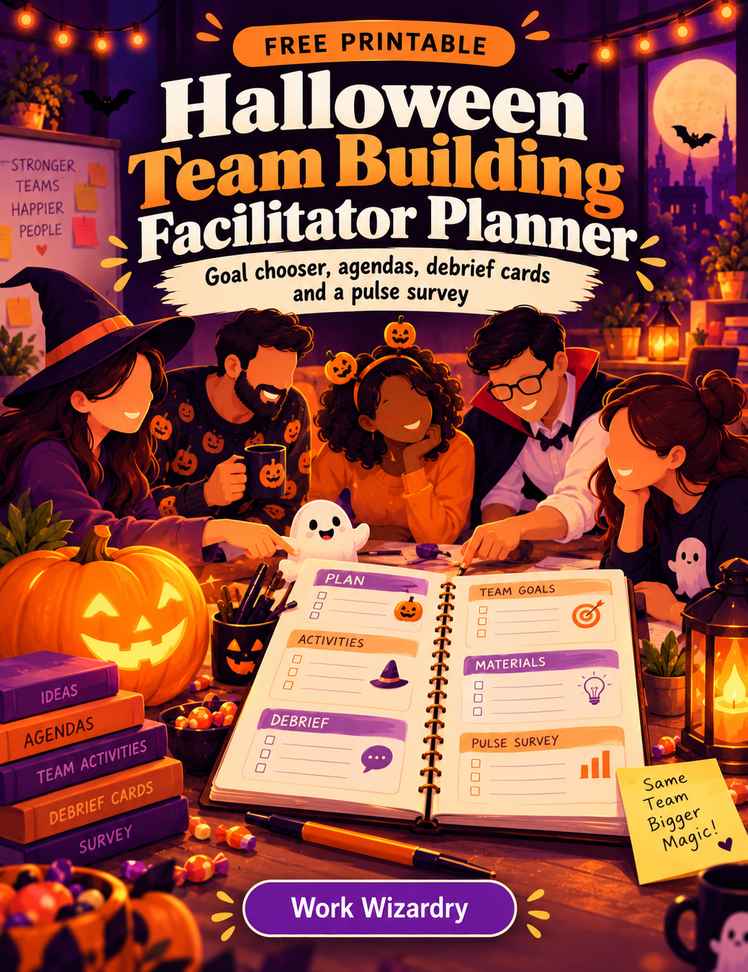
Free Printable: Halloween Team Building Facilitator Planner
Want the planning pages? The free planner gives you:
- A goal chooser.
- A session planner with a timed agenda.
- A ground rules card.
- Debrief cards (What, So what, Now what).
- A before-and-after pulse survey.
- 30, 60 and 90-minute agenda templates.
- An invitation message.
- A 4-week series calendar.
- An action tracker, an accessibility checklist and a feedback form.
Want Every Workshop Ready to Run? The Halloween Team Building Workshop Kit
The paid Halloween Team Building Workshop Kit has everything for all 12 workshops: a facilitator script and timed agenda, printable materials (maps, lantern cards, story planners, retro posters, problem and ingredient cards, the Survival Ranking scenario and expert key, role cards, treat cards, strengths cards, sprint cards, Candy Trade token sets and goal cards, and Handoff drawings), debrief cards, 16:9 workshop screens, the 4-week series guide, an Excel pulse-survey analyzer, Word templates for invitations and follow-up, and a facilitator’s handbook. It does not repeat our games, icebreaker, trivia or activities kits.
Frequently Asked Questions About Halloween Team Building Activities
What are good Halloween team building activities?
Short workshops with a purpose: mapping who owns what on a project, setting shared goals, sharing lessons from near misses, running a retro and giving specific feedback. Add a Halloween theme and a debrief.
How is Halloween team building different from Halloween games?
Games are for fun. Team building workshops have an outcome, such as clearer roles, and end with a debrief and an action. Games can become team building when you add a debrief.
What are good Halloween team building activities for remote teams?
Haunted Handoff, Goal Lanterns, The Pumpkin Retro and Trick-or-Treat Feedback all work on a shared board with breakout rooms of three or four people.
What are easy Halloween team building activities?
Trick-or-Treat Feedback takes 30 minutes and only needs paper. The five-minute team moments need no prep.
How long should a Halloween team building session be?
30 to 60 minutes for most workshops. The Witching Hour Sprint can take up to 75 minutes.
How many people can take part?
Most workshops work for 4 to 30 people. For larger groups, use tables of five or six.
Do employees have to join?
No. Make it optional and offer a way to pass. A session is better with willing people.
What are good Halloween team building activities for managers and leaders?
Ghost Stories of Work, Survival Ranking and Goal Lanterns. Leaders should go first and model honesty.
How do I measure whether team building worked?
Use a five-question pulse survey before and after, compare the averages and review the actions you set.
What are good Halloween team building ideas for new teams?
Costume Swap, Perspective Swap, Goal Lanterns and Monster Mash-Up are gentle and useful for new teams.
What are good Halloween team building activities for small or large groups?
Small teams can run workshops as one group. Large groups should split into tables of five or six.
Does team building really work?
Research suggests team building has a moderate positive effect, especially on how people feel about the team and how they coordinate. Role clarification and goal setting are among the most helpful parts. It depends on good facilitation and follow-up.
Is there a free Halloween team building planner?
Yes. The free planner has goal and agenda pages, debrief cards, a pulse survey and a series calendar.
Do I need a facilitator?
No. A team member can lead if the steps and ground rules are clear. For large or sensitive sessions, an experienced facilitator helps.
Sources: all workshops are original to Work Wizardry. Research: Klein, C. et al. (2009), “Does Team Building Work?”, Small Group Research 40(2); Google re:Work, “Understand team effectiveness” (Project Aristotle). Competitor review of Halloween team building pages (October 2026). This is general guidance, not HR or legal advice.
